Portret Edward Hicks

84 najsłynniejszych obrazów artysty Edward Hicks – wybór z galerii

Aktualizacja: Listopad 2026 · ranking według naszego wskaźnika popularności (liczba wyszukiwań, wizyt i zamówień dla każdego dzieła) · 85 dzieł Edward Hicks w naszym katalogu

W skrócie

Z wszystkich oryginałów pozostawionych przez Edward Hicks, najsłynniejszym jest Peaceable Kingdom (39) (1832). Tuż za nimi znajdują się Noah's Ark (1846) oraz Penn's Treaty with the Indians (1830). Nasz katalog zawiera 85 dzieł autorstwa Edward Hicks; galeria zachowała 84 najbardziej podziwianych na świecie prac, z których każda została przedstawiona wraz z datą powstania, informacją o muzeum oraz jej historią.

1780 – 1849, Langhorne American folk art Najwięcej dzieł: National Gallery of Art

10 najlepszych obrazów artysty Edward Hicks: wybór galerii

1
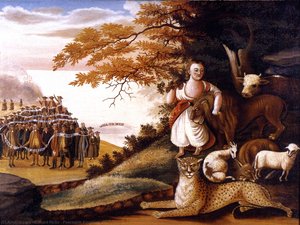
Peaceable Kingdom (39) (1832) autorstwa Edward Hicks

Peaceable Kingdom (39)

1832 · Oil On Canvas

In the vast tapestry of American folk art, few images resonate with as much profound serenity and spiritual longing as Edward Hicks’s Peaceable Kingdom (39). Painted in 1832, this masterpiece serves as a breathtaking window into a world where the boundaries between predator and prey, human and nature, are dissolved by a divine, quiet grace. The canvas unfolds as a pastoral dreamscape, a sanctuary of stillness where the ferocious lion…

2
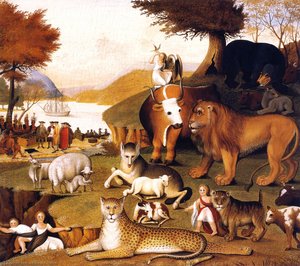
Noah's Ark (1846) autorstwa Edward Hicks

Noah's Ark

1846 · Oil On Canvas · Philadelphia Museum of Art, Filadelfia

To stand before Edward Hicks’ depiction of Noah's Ark is to encounter more than just a painting; it is an immersion into a profound narrative woven from faith, survival, and the enduring promise of renewal. This work, dating back to 1846, captures that monumental moment when humanity faced the deluge, yet found salvation within the sturdy embrace of the ark. Hicks, whose life was deeply intertwined with his Quaker ministry,…

3
Penn's Treaty with the Indians (1830) autorstwa Edward Hicks

Penn's Treaty with the Indians

1830 · Oil On Panel · Philadelphia Museum of Art, Filadelfia

In this work, titled Penn's Treaty with the Indians, the artist Edward Hicks presents a formal meeting between William Penn and Native American leaders. The scene captures a moment of diplomacy, specifically focusing on the Treaty of 1682 and the concept of peaceful coexistence. It is a significant example of 19th-century American Folk Art, reflecting the social and historical preoccupations of that era.

4
Peaceable Kingdom (21) (1849) autorstwa Edward Hicks

Peaceable Kingdom (21)

1849 · Oil · Nelson-Atkins Museum of Art, Kansas City

In the quietude of the mid-nineteenth century, a profound vision emerged from the brush of Edward Hicks, capturing a moment where the ferocity of nature is surrendered to a divine, tranquil order. Peaceable Kingdom (21) serves as more than just a landscape; it is a window into a spiritual utopia. The canvas unfolds with an extraordinary assembly of creatures—lions, tigers, and bears resting in uncharacteristic stillness alongside deer, cows, and…

5
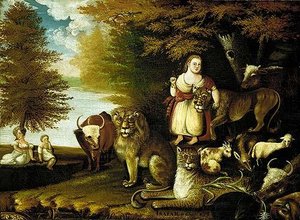
Peaceable Kingdom (12) (1826) autorstwa Edward Hicks

Peaceable Kingdom (12)

1826 · Oil On Canvas

In the quiet, profound depths of Edward Hicks’s 1826 masterpiece, Peaceable Kingdom (12), we encounter more than just a painting; we enter a spiritual sanctuary. This captivating oil on canvas serves as a window into a utopian realm where the boundaries between the wild and the domestic dissolve into a singular, breathtaking peace. At the heart of this composition, a young boy cradles a lion cub with an intimacy that…

6
The Cornell Farm (1848) autorstwa Edward Hicks

The Cornell Farm

1848 · Oil On Canvas · National Gallery of Art, Waszyngton

In the quiet, rolling landscapes of nineteenth-century Pennsylvania, few images capture the essence of American agrarian tranquility as profoundly as Edward Hicks’ 1848 masterpiece, The Cornell Farm. This expansive oil on canvas is far more than a mere record of livestock; it is a meticulously composed vision of harmony, where the wildness of nature is tamed by the steady hand of human stewardship. As one gazes upon the sprawling horizontal…

7
Peaceable Kingdom (19) (1845) autorstwa Edward Hicks

Peaceable Kingdom (19)

1845 · Oil On Canvas · Fine Arts Museums of San Francisco, San Francisco

A Vision of Harmony: Edward Hicks’ “Peaceable Kingdom” Edward Hicks' "Peaceable Kingdom" (circa 1833-1834) isn’t merely a painting; it’s a meticulously crafted allegory, a visual sermon rendered in oil on canvas that speaks volumes about the core tenets of Quaker faith and the burgeoning American identity. More than two centuries after its creation, this iconic work continues to resonate with viewers, inviting contemplation on themes of peace, reconciliation, and the…

8
Peaceable Kingdom (11) (1844) autorstwa Edward Hicks

Peaceable Kingdom (11)

1844 · Acrylic On Canvas · Dallas Museum of Art, Dallas

Edward Hicks' "Peaceable Kingdom" (1844) isn't merely a painting; it’s a visual sermon, a testament to Quaker faith rendered in the warm, inviting hues of folk art. This iconic image, currently residing within the Dallas Museum of Art, transcends its humble canvas dimensions to embody a profound yearning for peace and interconnectedness – a sentiment remarkably resonant even today. Hicks, a self-taught artist largely devoid of formal training, eschewed academic…

9
Peaceable Kingdom (16) (1816) autorstwa Edward Hicks

Peaceable Kingdom (16)

1816 · Oil On Canvas

In the quiet, profound stillness of Edward Hicks’s Peaceable Kingdom (16), we are invited into a realm where the boundaries between the wild and the domestic dissolve into a singular, breathtaking moment of tranquility. Painted in 1816, this oil on canvas masterpiece serves as more than just a landscape; it is a spiritual manifesto rendered in pigment. The scene unfolds with a masterful sense of balance, presenting a man standing…

10
Grave of William Penn at Jordans in England (1847) autorstwa Edward Hicks

Grave of William Penn at Jordans in England

1847 · Oil On Canvas · Yale University Art Gallery, Hartford

Edward Hicks’ “Grave of William Penn at Jordans in England” isn't merely a painting; it’s a carefully constructed tableau of faith, community, and the nascent ideals of colonial America. Completed in 1847 and now residing within the hallowed halls of the Yale University Art Gallery, this oil on canvas offers a poignant glimpse into the heart of the Quaker movement and the legacy of its most influential figure. Hicks, a…

Kontynuacja zestawienia Edward Hicks, od 11 do 84

11Peaceable Kingdom (40) (1826) autorstwa Edward HicksPeaceable Kingdom (40)1826 · Museum of Fine Arts 12Peaceable Kingdom (31) (1845) autorstwa Edward HicksPeaceable Kingdom (31)1845 · Yale University Art Gallery 13Peaceable Kingdom (20) (1829) autorstwa Edward HicksPeaceable Kingdom (20)1829 · Yale University Art Gallery 14Peaceable Kingdom (15) (1835) autorstwa Edward HicksPeaceable Kingdom (15)1835 · The Phillips Collection 15Grave of William Penn at Jordans in England (1847) autorstwa Edward HicksGrave of William Penn at Jordans in England1847 · National Gallery of Art 16Peaceable Kingdom (10) (1826) autorstwa Edward HicksPeaceable Kingdom (10)1826 17Peaceable Kingdom (14) (1826) autorstwa Edward HicksPeaceable Kingdom (14)1826 18Peaceable Kingdom (22) (1826) autorstwa Edward HicksPeaceable Kingdom (22)1826 · Philadelphia Museum of Art 19Penn's Treaty with the Indians (1840) autorstwa Edward HicksPenn's Treaty with the Indians1840 20Peaceable Kingdom (9) (1844) autorstwa Edward HicksPeaceable Kingdom (9)1844 21Peaceable Kingdom (1846) autorstwa Edward HicksPeaceable Kingdom1846 22A Peaceable Kingdom (1829) autorstwa Edward HicksA Peaceable Kingdom1829 · Metropolitan Museum of Art 23Noah's Ark (1846) autorstwa Edward HicksNoah's Ark1846 · Philadelphia Museum of Art 24The Peaceable Kingdom of the Branch (1827) autorstwa Edward HicksThe Peaceable Kingdom of the Branch1827 · Yale University Art Gallery 25The Peaceable Kingdom (1829) autorstwa Edward HicksThe Peaceable Kingdom1829 · Yale University Art Gallery 26Penn's Treaty with the Indians (1830) autorstwa Edward HicksPenn's Treaty with the Indians1830 · Museum of Fine Arts 27Peaceable Kingdom (18) (1829) autorstwa Edward HicksPeaceable Kingdom (18)1829 28Penn's Treaty (1830) autorstwa Edward HicksPenn's Treaty1830 29The Peaceable Kingdom (WAM) (1833) autorstwa Edward HicksThe Peaceable Kingdom (WAM)1833 · Worcester Art Museum 30A May Morning View of the Farm and Stock of David Leedon (1849) autorstwa Edward HicksA May Morning View of the Farm and Stock of David Leedon1849 31Peaceable Kingdom of the Branch (1822) autorstwa Edward HicksPeaceable Kingdom of the Branch1822 32The Landing of Columbus (1837) autorstwa Edward HicksThe Landing of Columbus1837 · National Gallery of Art 33Peaceable Kingdom (30) (1829) autorstwa Edward HicksPeaceable Kingdom (30)1829 · Brooklyn Museum 34George Washington with His Army Crossing the Delaware ...,'''' (1848) autorstwa Edward HicksGeorge Washington with His Army Crossing the Delaware ...,''''1848 35Peaceable Kingdom (34) (1834) autorstwa Edward HicksPeaceable Kingdom (34)1834 · National Gallery of Art 36Peaceable Kingdom (1832) autorstwa Edward HicksPeaceable Kingdom1832 · Worcester Art Museum 37The Peaceable Kingdom of the Branch (1822) autorstwa Edward HicksThe Peaceable Kingdom of the Branch1822 38Peaceable Kingdom (24) (1822) autorstwa Edward HicksPeaceable Kingdom (24)1822 39Peaceable Kingdom (41) (1822) autorstwa Edward HicksPeaceable Kingdom (41)1822 40Peaceable Kingdom of the Branch (1825) autorstwa Edward HicksPeaceable Kingdom of the Branch1825 · Reynolda House Museum of American Art 41Peaceable Kingdom (42) (1829) autorstwa Edward HicksPeaceable Kingdom (42)1829 42Peaceable Kingdom (13) (1830) autorstwa Edward HicksPeaceable Kingdom (13)1830 43Peaceable Kingdom (1829) autorstwa Edward HicksPeaceable Kingdom1829 44Peaceable Kingdom (43) (1826) autorstwa Edward HicksPeaceable Kingdom (43)1826 45Peaceable Kingdom (1829) autorstwa Edward HicksPeaceable Kingdom1829 46Peaceable Kingdom (32) (1827) autorstwa Edward HicksPeaceable Kingdom (32)1827 47Peaceable Kingdom (1833) autorstwa Edward HicksPeaceable Kingdom1833 · Pennsylvania Academy of Fine Arts 48The Peaceable Kingdom (1833) autorstwa Edward HicksThe Peaceable Kingdom1833 · Cleveland Museum of Art 49Peaceable Kingdom (27) (1837) autorstwa Edward HicksPeaceable Kingdom (27)1837 50Peaceable Kingdom (37) (1837) autorstwa Edward HicksPeaceable Kingdom (37)1837 51Peaceable Kingdom (28) (1832) autorstwa Edward HicksPeaceable Kingdom (28)1832 52Washington at the Deleware (1834) autorstwa Edward HicksWashington at the Deleware1834 53Peaceable Kingdom (33) (1835) autorstwa Edward HicksPeaceable Kingdom (33)1835 54Peaceable Kingdom (36) (1835) autorstwa Edward HicksPeaceable Kingdom (36)1835 55Penn's Treaty with the Indians (1844) autorstwa Edward HicksPenn's Treaty with the Indians1844 · National Gallery of Art 56Peaceable Kingdom (17) (1847) autorstwa Edward HicksPeaceable Kingdom (17)1847 57Peaceable Kingdom (23) (1846) autorstwa Edward HicksPeaceable Kingdom (23)1846 58Peaceable Kingdom (8) (1846) autorstwa Edward HicksPeaceable Kingdom (8)1846 59Peaceable Kingdom (35) (1845) autorstwa Edward HicksPeaceable Kingdom (35)1845 60Penn's Treaty (1847) autorstwa Edward HicksPenn's Treaty1847 61Peaceable Kingdom (25) (1847) autorstwa Edward HicksPeaceable Kingdom (25)1847 62Peaceable Kingdom (29) (1848) autorstwa Edward HicksPeaceable Kingdom (29)1848 63Peaceable Kingdom (1845) autorstwa Edward HicksPeaceable Kingdom1845 · Dallas Museum of Art 64The Peaceable Kingdom (1849) autorstwa Edward HicksThe Peaceable Kingdom1849 65Washington at the Delaware (1849) autorstwa Edward HicksWashington at the Delaware1849 66The Grave of William Penn (1857) autorstwa Edward HicksThe Grave of William Penn1857 67The Declaration of Independence, July 4, 1776 (1840) autorstwa Edward HicksThe Declaration of Independence, July 4, 17761840 68The Peaceable Kingdom 3 autorstwa Edward HicksThe Peaceable Kingdom 3Carnegie Museum of Art 69The Landing of Columbus autorstwa Edward HicksThe Landing of Columbus 70Peaceable Kingdom (1830) autorstwa Edward HicksPeaceable Kingdom1830 · Metropolitan Museum of Art 71Grave of William Penn at Jordans in England (1847) autorstwa Edward HicksGrave of William Penn at Jordans in England1847 72The Declaration of Indepenence (1840) autorstwa Edward HicksThe Declaration of Indepenence1840 73Falls of Niagara (1825) autorstwa Edward HicksFalls of Niagara1825 74Landscape (1845) autorstwa Edward HicksLandscape1845 75The Residence of David Twinning in 1785 (1845) autorstwa Edward HicksThe Residence of David Twinning in 17851845 76North west aspect of the Citidel autorstwa Edward HicksNorth west aspect of the Citidel 77The Peaceable Kingdom 2 autorstwa Edward HicksThe Peaceable Kingdom 2 78The Peaceable Kingdom 4 autorstwa Edward HicksThe Peaceable Kingdom 4Fine Arts Museums of San Francisco 79Portrait of a Child autorstwa Edward HicksPortrait of a ChildNational Gallery of Art 80The Peaceable Kingdom 1 autorstwa Edward HicksThe Peaceable Kingdom 1 81The Residence of David Twining 1787 (1845) autorstwa Edward HicksThe Residence of David Twining 17871845 82Residence of Thomas Hilborn (1845) autorstwa Edward HicksResidence of Thomas Hilborn1845 83An Indian Summer View of the Farm ^ Stock of James C. Cornell (1848) autorstwa Edward HicksAn Indian Summer View of the Farm ^ Stock of James C. Cornell1848 · National Gallery of Art 84The Falls of Niagara (1825) autorstwa Edward HicksThe Falls of Niagara1825 · Metropolitan Museum of Art

Tematy, które przyciągnęły wzrok Edward Hicks

Cztery motywy najczęściej powracające w tych oryginałach, z których każdy doczekał się swojego najdoskonalszego przykładu.

Muzea przechowujące oryginały Edward Hicks

8 muzeów, w których znajduje się najwięcej obrazów z tej strony.

Muzea Miasto Dzieła artysty Edward Hicks Obrazy z tej listy
National Gallery of Art, WaszyngtonNational Gallery of Art Waszyngton 7 The Cornell Farm, Grave of William Penn at Jordans in England, The Landing of Columbus
Philadelphia Museum of Art, FiladelfiaPhiladelphia Museum of Art Filadelfia 4 Noah's Ark, Penn's Treaty with the Indians, Peaceable Kingdom (22)
Yale University Art Gallery, HartfordYale University Art Gallery Hartford 3 Grave of William Penn at Jordans in England, Peaceable Kingdom (31), Peaceable Kingdom (20)
Metropolitan Museum of Art, Nowy JorkMetropolitan Museum of Art Nowy Jork 3 A Peaceable Kingdom, Peaceable Kingdom, The Falls of Niagara
Fine Arts Museums of San Francisco, San FranciscoFine Arts Museums of San Francisco San Francisco 2 Peaceable Kingdom (19), The Peaceable Kingdom 4
Dallas Museum of Art, DallasDallas Museum of Art Dallas 2 Peaceable Kingdom (11), Peaceable Kingdom
Museum of Fine Arts, HoustonMuseum of Fine Arts Houston 2 Peaceable Kingdom (40), Penn's Treaty with the Indians
Yale University Art Gallery, Nowe HavaneYale University Art Gallery Nowe Havane 2 The Peaceable Kingdom of the Branch, The Peaceable Kingdom

Edward Hicks dekada po dekadzie: oryginały definiujące każdy okres

Dzieła według dekad

Wybierz dekadę, aby zobaczyć dzieło, które ją definiuje.

Pytania kolekcjonerów o obrazy Edward Hicks

Z jakiego dzieła najbardziej znany jest Edward Hicks?Odkryj odpowiedź

Peaceable Kingdom (39) (1832). Następne są Noah's Ark (1846) oraz Penn's Treaty with the Indians (1830).

W jakim wieku był Edward Hicks, gdy powstało Peaceable Kingdom (39)?Odkryj odpowiedź

52 lat: Peaceable Kingdom (39) pochodzi z 1832, a Edward Hicks urodził(a) się w 1780.

Jakie są dziesięć najsłynniejszych obrazów, których autorem jest Edward Hicks?Odkryj odpowiedź

Peaceable Kingdom (39), Noah's Ark, Penn's Treaty with the Indians, Peaceable Kingdom (21), Peaceable Kingdom (12), The Cornell Farm, Peaceable Kingdom (19), Peaceable Kingdom (11), Peaceable Kingdom (16) i Grave of William Penn at Jordans in England. Powyższy ranking zawiera rok powstania oraz muzeum dla każdego z nich.

Ile obrazów pozostawił po sobie Edward Hicks?Odkryj odpowiedź

Nasz katalog zawiera 85 dzieł artysty Edward Hicks, datowanych od 1816 do 1849.

W których muzeach znajdują się arcydzieła Edward Hicks?Odkryj odpowiedź

W większości znajdują się w National Gallery of Art (Waszyngton), Philadelphia Museum of Art (Filadelfia) i Yale University Art Gallery (Hartford). Powyższa tabela muzeów zawiera ich pełną listę.

W których latach Edward Hicks namalował swoje najsłynniejsze dzieła?Odkryj odpowiedź

W 1840s: 33 z 84 dzieł na tej stronie powstało w tym czasie, w tym Noah's Ark.

Jakie są pierwsze i ostatnie słynne oryginały Edward Hicks?Odkryj odpowiedź

Na tej stronie najwcześniejszy to Peaceable Kingdom (16) (1816), a najpóźniejszy Peaceable Kingdom (21) (1849).

Jakie tematy Edward Hicks wybierał najczęściej?Odkryj odpowiedź

Animals (18), Landscape (17) i Peace (8), w ramach 84 dzieł na tej stronie.

Której techniki Edward Hicks używał najczęściej?Odkryj odpowiedź

Oil On Canvas, dla 33 z 84 dzieł na tej stronie.

Do jakiego nurtu artystycznego należy Edward Hicks?Odkryj odpowiedź

American folk art, sądząc po oryginałach na tej stronie.

Które dzieła Edward Hicks znajdują się w National Gallery of Art?Odkryj odpowiedź

The Cornell Farm, Grave of William Penn at Jordans in England i The Landing of Columbus: National Gallery of Art, Waszyngton posiada 7 dzieł widocznych na tej stronie.

Edward Hicks: życie i twórczość

A Life Rooted in Faith and Vision

Edward Hicks, born April 4th, 1780, in the tranquil landscape of Attleboro (now Langhorne), Bucks County, Pennsylvania, was a figure uniquely positioned at the intersection of religious conviction and artistic expression. His story is not simply that of a self-taught painter, but of a dedicated Quaker minister whose spiritual journey profoundly shaped his distinctive visual language. Though born to Anglican parents, young Edward’s life took a pivotal turn when he came under the care of Matron Elizabeth Twining, a devout Quaker who instilled in him the core tenets of this faith – simplicity, peace, and an unwavering belief in the “inner light.” This early exposure would become the bedrock upon which his artistic vision was built. From the age of thirteen, Hicks apprenticed with coach makers William and Henry Tomlinson, mastering the techniques of decorative painting that would initially sustain him. However, even as he honed his skills in rendering ornate designs on carriages, a deeper calling resonated within him, one that would ultimately lead him down a path less traveled – a path where faith and artistry converged. By 1803, Hicks had fully embraced the Society of Friends, marrying Sarah Worstall and embarking on a life of itinerant preaching throughout Philadelphia, all while continuing to support his growing family through his painting skills.

The Evolving Canvas: From Coachwork to Spiritual Landscapes

Hicks’s artistic development was far from conventional. He wasn't formally trained in the academic traditions of the time; instead, he cultivated a distinctly American folk art style born from observation, necessity, and deeply held beliefs. Initially, his paintings served practical purposes – house painting, coach decoration, tavern signs, and even decorative work on furniture and farm equipment. These early commissions provided financial stability but often conflicted with the Quaker emphasis on plainness and eschewal of worldly vanities. A period of hardship in 1815 saw Hicks briefly abandon ornamental painting for farming, a venture that proved unsuccessful. It was through encouragement from friends that he returned to his brushes in 1816, a turning point that allowed him to reconcile his artistic talents with his spiritual calling. He began to imbue his paintings with symbolic meaning, reflecting his Quaker worldview and personal interpretations of scripture. His canvases became vehicles for conveying messages of peace, harmony, and the promise of a divinely ordained order.

The Peaceable Kingdom: A Vision of Harmony

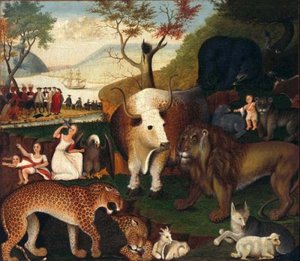
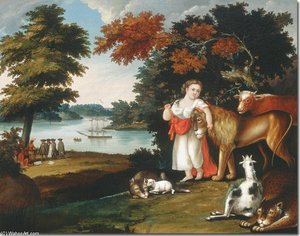
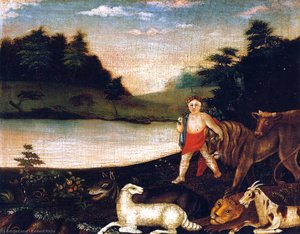
Edward Hicks is most celebrated today for his series of paintings known collectively as *The Peaceable Kingdom*. Comprising over sixty variations created throughout his life, these works are arguably the most iconic examples of American folk art. Inspired by Isaiah 11:6-9 – a passage foretelling a time when natural predators would coexist peacefully – Hicks depicted scenes of wild animals and children living in idyllic harmony. The paintings often feature figures from colonial Pennsylvania history, such as William Penn negotiating treaties with Native Americans, further grounding the biblical vision within an American context. *The Peaceable Kingdom* is not simply a charming depiction of animal life; it’s a powerful statement about Hicks's belief that Pennsylvania represented a fulfillment of this prophetic ideal – a place where peace and justice could prevail. Each version of *The Peaceable Kingdom* possesses subtle variations in composition, color palette, and detail, reflecting Hicks’s evolving artistic sensibilities and deepening spiritual understanding. Notable examples include *Peaceable Kingdom (31)* housed at Yale University Art Gallery, and *Peaceable Kingdom (34)* which portrays Noah's Ark amidst a serene landscape.

Beyond the Kingdom: A Broader Artistic Scope

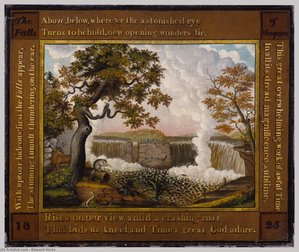
While *The Peaceable Kingdom* remains his signature achievement, Edward Hicks’s artistic output extended beyond this celebrated series. He painted landscapes, portraits, and historical scenes, each imbued with his characteristic folk art style and Quaker sensibility. His *Falls of Niagara*, now at the Abby Aldrich Rockefeller Folk Art Center, demonstrates his ability to capture the grandeur of nature while maintaining a sense of simplicity and reverence. Similarly, his depiction of *George Washington crossing...* – also held at the Abby Aldrich Rockefeller Folk Art Center – offers a unique folk perspective on this iconic moment in American history. Even seemingly mundane subjects like *Grave of William Penn at Jordans in England*, reveal Hicks’s deep connection to Quaker heritage and his ability to find spiritual significance in everyday scenes. These works, taken together, demonstrate the breadth of Hicks's artistic vision and his commitment to using art as a means of expressing his faith and values.

A Lasting Legacy: The Folk Art Icon

Edward Hicks passed away on August 23rd, 1849, in Newtown, Pennsylvania, leaving behind a body of work that continues to resonate with audiences today. He is now recognized as a pivotal figure in American folk art, celebrated for his distinctive style, recurring themes, and profound spiritual depth. His paintings offer invaluable insights into the beliefs and values of the Society of Friends during the 19th century, providing a visual record of their commitment to peace, simplicity, and social justice. Hicks’s unique ability to blend religious faith with artistic expression created a body of work that is both visually compelling and spiritually meaningful. His legacy extends beyond the museums and collections where his paintings are displayed; it lives on in the continued appreciation for his art and the enduring power of his vision – a vision of a “peaceable kingdom” where harmony reigns between humanity, nature, and the divine. He remains a testament to the power of self-taught artistry and the profound impact that faith can have on creative expression.