Portret Eanger Irving Couse

Obrazy: 100 najsłynniejszych dzieł artysty Eanger Irving Couse – spojrzenie galerii

Aktualizacja: Listopad 2026 · ranking według naszego wskaźnika popularności (liczba wyszukiwań, wizyt i zamówień dla każdego dzieła) · 152 dzieł Eanger Irving Couse w naszym katalogu

W skrócie

Według galerii najsłynniejszym obrazem Eanger Irving Couse jest Taos Indian and Pottery (1920). The Harvest Song (1920) i Indian Brave Recording General MacKenzie's Fight with the Cheyenes (1902) dopełniają trio, które zna każde oko. Z 152 dzieł Eanger Irving Couse w naszym katalogu, galeria prezentuje poniżej 100 najsłynniejszych prac – każda z nich jest oryginałem z podaniem roku powstania, muzeum oraz cech wyróżniających ją na tle innych.

1866 – 1936, Saginaw Najwięcej dzieł: Reading Public Museum

10 najlepszych obrazów artysty Eanger Irving Couse w galerii

1
Taos Indian and Pottery (1920) autorstwa Eanger Irving Couse

Taos Indian and Pottery

1920 · Oil On Canvas

In 1920, E. Irving Couse captures a quiet moment of stillness in Taos Indian and Pottery. The scene unfolds within the intimate confines of an indoor space, perhaps a humble room or a traditional hut. A deep red wall provides a warm backdrop to the central figure, grounding the composition in a sense of place and purpose.

2
The Harvest Song (1920) autorstwa Eanger Irving Couse

The Harvest Song

1920 · Oil On Canvas

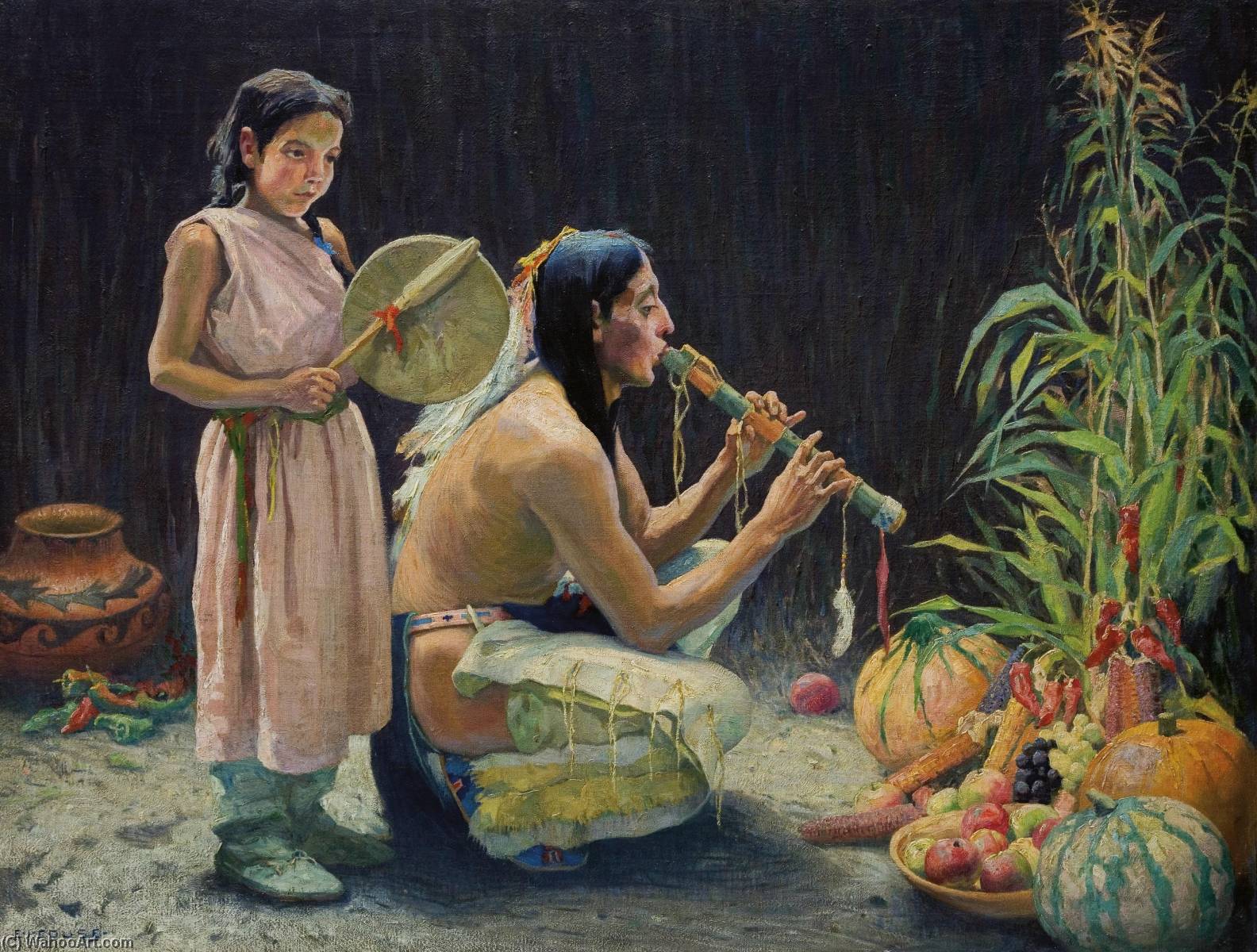
The air feels heavy with the scent of ripening produce in The Harvest Song, a work painted by E. Irving Couse in 1920. Within this sun-drenched field, a man sits amidst an abundance of nature, his breath steady as he plays a flute. Beside him, a woman holds a drum, her presence completing a rhythmic duet that seems to echo through the surrounding crops. They exist in a moment of…

3
Indian Brave Recording General MacKenzie's Fight with the Cheyenes (1902) autorstwa Eanger Irving Couse

Indian Brave Recording General MacKenzie's Fight with the Cheyenes

1902 · Oil

In "Indian Brave Recording General MacKenzie's Fight with the Cheyenes" by E. Irving Couse, a quiet moment of creation unfolds. Two Native American men lean into their task, focused entirely on the act of painting a mural. They work upon a large, stretched animal hide, perhaps deer or buffalo, which serves as the canvas for their story. This central activity anchors the entire scene, drawing the eye directly to the…

4
The Water Course (1910) autorstwa Eanger Irving Couse

The Water Course

1910 · Oil · Reading Public Museum, Reading

In The Water Course, E. Irving Couse presents a quiet moment of interaction with the natural world. Painted around 1910, the work focuses on two Native American figures positioned within a rugged, sunlit landscape. They are situated near a flowing stream, their presence integrated into the terrain rather than imposed upon it. The scene captures a sense of tranquility, focusing on the subtle connection between the individuals and the land…

5
The Sculptor (1914) autorstwa Eanger Irving Couse

The Sculptor

1914 · Oil On Canvas

The Sculptor is an oil painting by E. Irving Couse, executed in 1914. The work focuses on a Native American man engaged in the act of creating petroglyphs or drawings upon a textured surface. The subject is positioned in a central-right profile, kneeling as he works against a shallow, textured background suggesting a rock face or cave wall.

6
The Cooling Stream (1912) autorstwa Eanger Irving Couse

The Cooling Stream

1912 · Oil On Canvas

The air feels heavy and still under a blanket of overcast clouds. Near the edge of a flowing river, a group of indigenous figures gathers, their presence deeply woven into the natural landscape. There is a quiet, somber energy in the way they move, a sense of ritual or perhaps a shared moment of mourning that settles over the scene. The water of the stream ripples softly, catching subtle highlights…

7
The Mountain Stream (1914) autorstwa Eanger Irving Couse

The Mountain Stream

1914 · Oil On Canvas

In The Mountain Stream, E. Irving Couse positions a solitary Indigenous man in the foreground, seated along a riverbank. The figure is the central focus, rendered with a posture and gaze that suggest deep introspection. This quietude is framed by a landscape of flowing water and dense foliage, creating a scene centered on contemplation and a profound connection with the natural world.

9
Indian Hunter (1925) autorstwa Eanger Irving Couse

Indian Hunter

1925 · Oil · Reading Public Museum, Reading

In this 1925 oil painting, a Native American hunter moves through a sun-dappled grove of birch or aspen trees. The composition is oriented vertically, drawing the eye to the profile of the figure on the left as he moves toward the right. There is a stillness here, a sense of quiet tension as the subject navigates the forest floor. Light filters through the canopy in patches of pale yellow, creating…

10
The Blanket Mender (1934) autorstwa Eanger Irving Couse

The Blanket Mender

1934 · Oil · The Owings Gallery, Santa Fe

The Blanket Mender is an oil painting by E. Irving Couse. Created about 1934, this work captures a quiet moment of focused labor. The subject is a Native American figure, depicted in a state of stillness as they attend to a textile. There is a profound sense of patience in the way the figure engages with the fabric, a task requiring steady hands and a calm mind.

Obrazy artysty Eanger Irving Couse, uszeregowane od 11 do 100 miejsca

11Flute Player (1931) autorstwa Eanger Irving CouseFlute Player1931 · Private collection 12Untitled (AQU5U9) (1899) autorstwa Eanger Irving CouseUntitled (AQU5U9)1899 13Indian Weaver (1914) autorstwa Eanger Irving CouseIndian Weaver1914 · American Museum of Western Art 14Untitled (AQU5U3) (1927) autorstwa Eanger Irving CouseUntitled (AQU5U3)1927 · El Paso Museum of Art 15Ambush (1897) autorstwa Eanger Irving CouseAmbush1897 · Briscoe Western Art Museum 16The Pictographs (1919) autorstwa Eanger Irving CouseThe Pictographs1919 17The Captive (1891) autorstwa Eanger Irving CouseThe Captive1891 18The Card Player (1897) autorstwa Eanger Irving CouseThe Card Player1897 19Klikitat Indian with Pony (1898) autorstwa Eanger Irving CouseKlikitat Indian with Pony1898 20Indian Seated by a Campfire (1898) autorstwa Eanger Irving CouseIndian Seated by a Campfire1898 21An Indian Hunter (1897) autorstwa Eanger Irving CouseAn Indian Hunter1897 22The Peace Pipe (1901) autorstwa Eanger Irving CouseThe Peace Pipe1901 · Metropolitan Museum of Art 23Indian Drinking (1903) autorstwa Eanger Irving CouseIndian Drinking1903 24Moki Snake Sance (1904) autorstwa Eanger Irving CouseMoki Snake Sance1904 · American Museum of Western Art 25Walpi Pueblo (1903) autorstwa Eanger Irving CouseWalpi Pueblo1903 · Smithsonian American Art Museum 26The Forest Pool autorstwa Eanger Irving CouseThe Forest PoolThe Owings Gallery 27Quail Hunters autorstwa Eanger Irving CouseQuail Hunters 28Sacred Waters autorstwa Eanger Irving CouseSacred WatersIndianapolis Museum of Art 29Woman in a White Dress autorstwa Eanger Irving CouseWoman in a White Dress 30The Speaker autorstwa Eanger Irving CouseThe Speaker 31Indian Portrait autorstwa Eanger Irving CouseIndian Portrait 32Evening Solitude autorstwa Eanger Irving CouseEvening Solitude 33Western Sunlight autorstwa Eanger Irving CouseWestern Sunlight 34Medicine Man autorstwa Eanger Irving CouseMedicine Man 35Hunting Cranes autorstwa Eanger Irving CouseHunting Cranes 36Klickitat Brave autorstwa Eanger Irving CouseKlickitat Brave 37The Sculptor autorstwa Eanger Irving CouseThe Sculptor 38Ute Waterbottle autorstwa Eanger Irving CouseUte Waterbottle 39Young Kibbey Whitman Couse autorstwa Eanger Irving CouseYoung Kibbey Whitman Couse 40The Thinker autorstwa Eanger Irving CouseThe Thinker 41The Setting Sun autorstwa Eanger Irving CouseThe Setting Sun 42John Concha, Taos Pueblo autorstwa Eanger Irving CouseJohn Concha, Taos Pueblo 43Resting autorstwa Eanger Irving CouseResting 44Moonlight Meditation autorstwa Eanger Irving CouseMoonlight Meditation 45The Master Workman autorstwa Eanger Irving CouseThe Master Workman 46The Evening Meal autorstwa Eanger Irving CouseThe Evening Meal 47Indian By A Stream autorstwa Eanger Irving CouseIndian By A Stream 48The Lovers autorstwa Eanger Irving CouseThe LoversBrigham Young University Museum of Art 49Lamb autorstwa Eanger Irving CouseLamb 50Young Hunter by a Stream autorstwa Eanger Irving CouseYoung Hunter by a Stream 51Portrait Of Kibbey Whitman Couse autorstwa Eanger Irving CousePortrait Of Kibbey Whitman Couse 52Flute Player, Rio Lucero, Taos, NM autorstwa Eanger Irving CouseFlute Player, Rio Lucero, Taos, NM 53The Arrow Maker autorstwa Eanger Irving CouseThe Arrow Maker 54Indians in Moonlight autorstwa Eanger Irving CouseIndians in Moonlight 55The Tom Tom Lesson autorstwa Eanger Irving CouseThe Tom Tom Lesson 56The Lesson autorstwa Eanger Irving CouseThe Lesson 57Lovers (Indian Love Song) autorstwa Eanger Irving CouseLovers (Indian Love Song) 58The Peace Pipe autorstwa Eanger Irving CouseThe Peace Pipe 59Putting on the War Shoes autorstwa Eanger Irving CousePutting on the War Shoes 60Indian Painter autorstwa Eanger Irving CouseIndian Painter 61The Drink autorstwa Eanger Irving CouseThe Drink 62Serenade autorstwa Eanger Irving CouseSerenade 63The Pottery Maker autorstwa Eanger Irving CouseThe Pottery Maker 64Indian by the Fire autorstwa Eanger Irving CouseIndian by the Fire 65Return of the War Party (1910) autorstwa Eanger Irving CouseReturn of the War Party1910 66The Beaded Tobacco Bag autorstwa Eanger Irving CouseThe Beaded Tobacco Bag 67By the Fire autorstwa Eanger Irving CouseBy the Fire 68Beaded Bag autorstwa Eanger Irving CouseBeaded Bag 69Evening Reverie (1911) autorstwa Eanger Irving CouseEvening Reverie1911 70The Love Call (1908) autorstwa Eanger Irving CouseThe Love Call1908 71The Pottery Decorator autorstwa Eanger Irving CouseThe Pottery Decorator 72New Rug (1917) autorstwa Eanger Irving CouseNew Rug1917 73Making Pottery (1912) autorstwa Eanger Irving CouseMaking Pottery1912 74Lone Hunter (1915) autorstwa Eanger Irving CouseLone Hunter1915 75The Sentinel (1912) autorstwa Eanger Irving CouseThe Sentinel1912 76The Successful Hunter (1913) autorstwa Eanger Irving CouseThe Successful Hunter1913 77Indian Girl in a Blanket (1921) autorstwa Eanger Irving CouseIndian Girl in a Blanket1921 78Crow Tent (1918) autorstwa Eanger Irving CouseCrow Tent1918 79The Evening Meal (1918) autorstwa Eanger Irving CouseThe Evening Meal1918 80The Magic Flute (also known as Flute Player at the Spring) (1918) autorstwa Eanger Irving CouseThe Magic Flute (also known as Flute Player at the Spring)1918 81The Flute Ceremony (1922) autorstwa Eanger Irving CouseThe Flute Ceremony1922 82Untitled (AQU5UF) (1921) autorstwa Eanger Irving CouseUntitled (AQU5UF)1921 · El Paso Museum of Art 83Indian Summer (1924) autorstwa Eanger Irving CouseIndian Summer1924 84Moonlight on the Hondo (1928) autorstwa Eanger Irving CouseMoonlight on the Hondo1928 85Hunting the Turkey in the Aspens (1926) autorstwa Eanger Irving CouseHunting the Turkey in the Aspens1926 86Flute Song, Moonlight (1927) autorstwa Eanger Irving CouseFlute Song, Moonlight1927 87Sheep At Sundown autorstwa Eanger Irving CouseSheep At Sundown 88Pottery Vendor (1916) autorstwa Eanger Irving CousePottery Vendor1916 · Philbrook Museum of Art 89The Chief autorstwa Eanger Irving CouseThe Chief 90Chief David Shoppenegons (1911) autorstwa Eanger Irving CouseChief David Shoppenegons1911 · Detroit Institute of Arts 91The Lesson (1902) autorstwa Eanger Irving CouseThe Lesson1902 92Indian Painter autorstwa Eanger Irving CouseIndian PainterMinneapolis Institute of Art 93Hidden House autorstwa Eanger Irving CouseHidden House 94Moving In Clouds autorstwa Eanger Irving CouseMoving In Clouds 95Purple Shore autorstwa Eanger Irving CousePurple Shore 96Boat Alone autorstwa Eanger Irving CouseBoat Alone 97Trees In Snow autorstwa Eanger Irving CouseTrees In Snow 98Lillies autorstwa Eanger Irving CouseLillies 99At The Spring (Sheep In Field) autorstwa Eanger Irving CouseAt The Spring (Sheep In Field) 100Taos Canyon Creek autorstwa Eanger Irving CouseTaos Canyon Creek

Tematy, które przyciągnęły wzrok Eanger Irving Couse

Cztery motywy najczęściej powracające w tych oryginałach, z których każdy doczekał się swojego najdoskonalszego przykładu.

Muzea przechowujące oryginały Eanger Irving Couse

8 muzeów, w których znajduje się najwięcej obrazów z tej strony.

Muzea Miasto Dzieła artysty Eanger Irving Couse Obrazy z tej listy
Reading Public Museum, ReadingReading Public Museum Reading 2 The Water Course, Indian Hunter
The Owings Gallery Santa Fe 2 The Blanket Mender, The Forest Pool
American Museum of Western Art, ColoradoAmerican Museum of Western Art Colorado 2 Indian Weaver, Moki Snake Sance
El Paso Museum of Art, El PasoEl Paso Museum of Art El Paso 2 Untitled (AQU5U3), Untitled (AQU5UF)
Smithsonian American Art Museum, WaszyngtonSmithsonian American Art Museum Waszyngton 2 Walpi Pueblo
Cincinnati Art Museum, CincinnatiCincinnati Art Museum Cincinnati 1 Indian Drinking from a Lake
Private collection, AkronPrivate collection Akron 1 Flute Player
Briscoe Western Art Museum, San AntonioBriscoe Western Art Museum San Antonio 1 Ambush

Eanger Irving Couse, jedno kultowe dzieło na dekadę

Dzieła według dekad

Wybierz dekadę, aby zobaczyć dzieło, które ją definiuje.

Obrazy artysty Eanger Irving Couse: odpowiedzi galerii

Który obraz Eanger Irving Couse jest najsłynniejszy ze wszystkich?Odkryj odpowiedź

Taos Indian and Pottery (1920). Następne są The Harvest Song (1920) oraz Indian Brave Recording General MacKenzie's Fight with the Cheyenes (1902).

Ile lat miał Eanger Irving Couse, gdy ukończył Taos Indian and Pottery?Odkryj odpowiedź

54 lat: Taos Indian and Pottery pochodzi z 1920, a Eanger Irving Couse urodził(a) się w 1866.

Które to 10 najlepszych obrazów Eanger Irving Couse?Odkryj odpowiedź

Taos Indian and Pottery, The Harvest Song, Indian Brave Recording General MacKenzie's Fight with the Cheyenes, The Water Course, The Sculptor, The Cooling Stream, The Mountain Stream, Indian Drinking from a Lake, Indian Hunter i The Blanket Mender. Powyższy ranking zawiera rok powstania oraz muzeum dla każdego z nich.

Ile dzieł stworzył/a Eanger Irving Couse?Odkryj odpowiedź

Nasz katalog zawiera 152 dzieł artysty Eanger Irving Couse, datowanych od 1891 do 1934.

Gdzie można znaleźć najsłynniejsze oryginały autorstwa Eanger Irving Couse?Odkryj odpowiedź

W większości znajdują się w Reading Public Museum (Reading), The Owings Gallery (Santa Fe) i American Museum of Western Art (Colorado). Powyższa tabela muzeów zawiera ich pełną listę.

Kiedy Eanger Irving Couse stworzył swoje najsłynniejsze obrazy?Odkryj odpowiedź

W 1910s: 18 z 100 dzieł na tej stronie powstało w tym czasie, w tym The Water Course.

Które z najsłynniejszych dzieł Eanger Irving Couse należą do jego najwcześniejszych i najpóźniejszych prac?Odkryj odpowiedź

Na tej stronie najwcześniejszy to The Captive (1891), a najpóźniejszy The Blanket Mender (1934).

Do jakich tematów Eanger Irving Couse powracał najczęściej?Odkryj odpowiedź

Native american (14), Native american culture (13) i Southwestern landscape (10), w ramach 100 dzieł na tej stronie.

W jakiej technice najczęściej tworzył Eanger Irving Couse?Odkryj odpowiedź

Oil On Canvas, dla 10 z 100 dzieł na tej stronie.

Które oryginały artysty Eanger Irving Couse znajdują się w zbiorach Reading Public Museum?Odkryj odpowiedź

The Water Course i Indian Hunter: Reading Public Museum, Reading posiada 2 dzieł widocznych na tej stronie.

Eanger Irving Couse: artysta

Eanger Irving Couse: A Bridge Between Worlds

Eanger Irving Couse, urodzony w 1866 roku w Saginaw, Michigan, był artystą, którego losy i twórczość stanowią fascynującą opowieść o spotkaniu dwóch światów – europejskiej tradycji akademickiej i głębokiego szacunku dla kultury Indian Północnej Ameryki. Jego życie nie ograniczało się jedynie do rozwoju artystycznego; to była historia połączenia, w którym rygorystyczne metody malarstwa europejskiego spotkały się z wrażliwością na piękno i sposób życia plemion indiańskich oraz zapierającą dech w piersiach przyrodę Północnego Zachodu. Już od najmłodszych lat Couse wykazywał ogromną ciekawość wobec Chippewa, mieszkańców ziem blisko niego – fascynacja ta przekształciła się w całe życie poświęcone wiernemu oddaniu się malowaniu ich historii i życia. Nie był to jedynie obserwator; to było ziarno głębokiego współczucia, które fundamentalnie ukształtowało jego drogę artystyczną. W wieku szesnaściu lat porzucił tradycyjne szkolnictwo, kierując się niezachwianym poświęceniem sztuce, początkowo studiując w Instytucie Sztuki w Chicago i później w Akademii Sztuk Pięknych w Nowym Jorku, zanim rozpoczął dziesięcioletnią peregrinację po Paryżu.

Paryskie Salony i Przywołanie Zachodu

Paryż okazał się przełomowy. Nauka pod kierunkiem Williama-Adolpha Bouguereau w École des Beaux-Arts oraz Académie Julian nadała Cousej mistrzostwa w technikach akademickich – precyzyjne szkicowanie, wyrafinowane modelowanie i subtelne poczucie kompozycji. Doskonalił swoje umiejętności malując krajobrazy Normandii, jednak nawet w tym otoczeniu europejskich wpływów, silny pociąg na Zachód Ameryki pozostał niezmiennym. Wizyta w ranczu jego teścia wywołała zainteresowanie postaciami indiańskimi, prowadząc do *Captive*, który został zaprezentowany na Salonie Paryskim w 1892 roku. To wczesne i znaczące dzieło, przedstawiające scenę z masakry Whitmana i modelowane przez jego żonę Virginę oraz lokalnego mieszkańca Klikitata, demonstrowało zarówno jego umiejętności techniczne, jak i narastające tematyczne zainteresowania. Po powrocie do Stanów Zjednoczonych Couse kontynuował pracę w Nowym Jorku, równocześnie intensywnie podróżując po zachodzie kraju, co doprowadziło go do Taosu, New Mexico, w 1902 roku. To był moment przełomowy – został oczarowany unikalnym światłem, krajobrazem i kulturą tego regionu, ustanawiając letnie rezydencję, która z czasem przekształciła się w jego stałe miejsce zamieszkania. Nie chodziło jedynie o wizytę; to było zanurzenie się, dążenie do zrozumienia i przedstawienia sposobu życia odległego od zgiełku miast Wschodniego Wybrzeża.

Dusza Taosu: Unikalna Wizja Artystyczna

Taos stał się czymś więcej niż tylko miejscem dla Couse’a – to było zanurzenie w kulturze. Zobowiązał się do studiowania i malowania życia Indian Taosa, nie jako egzotycznych postaci, lecz jako jednostki posiadające godność i wdzięk. W odróżnieniu od niektórych współczesnych, którzy skupiali się na dramatycznych narracjach lub romantyzowanych przedstawieniach, Couse dążył do uchwycenia spokojnych momentów codziennego życia – scen z kontemplacji, rzemiosła i więzi rodzinnej. Jego styl ewoluował w charakterystyczną mieszankę akademickiej precyzji i wyrafinowanego wykorzystania światła i koloru, tworząc obrazy zarówno technicznie doskonałe, jak i emocjonalnie poruszające. Preferował ciepłe, ziemiste odcienie, często malując swoje postacie oświetlone miękkim, złotym blaskiem zachodzącego słońca. Często wykorzystywał dwóch głównych modeli, Ben Lujana i Jerry'ego Mirable, pozwalając mu na uchwycenie poczucia ciągłości i intymności w swoich dziełach. To zaangażowanie doprowadziło do tego, że został członkiem założycielskim i pierwszym prezesem Taos Society of Artists w 1915 roku, umacniając reputację Taosu jako ważnego ośrodka artystycznego. Jego obrazy nie były jedynie reprezentacjami; były interpretacjami nacechowanymi szacunkiem i zrozumieniem – świadectwem jego zaangażowania w wierne przedstawianie życia indiańskiego.

Rozpoznanie, Dziedzictwo i Trwały Wpływ

Talent Couse’a nie pozostał niezauważony. Otrzymał liczne nagrody w całym kraju, w tym Nagrodę Altman z Akademii Sztuk Pięknych, Nagrodę Isidora z Klubu Salmagundi oraz Nagrodę Lippincott z Akademii Sztuki w Pensylwanii. Szczególnie istotne było to, że otrzymał zamówienie na malowanie dwudziestu dwóch obrazów dla Santa Fe Railway między 1914 a 1936 rokiem – dowód jego zdolności do uchwycenia uroku Zachodu dla szerszej publiczności. *Elk-foot of the Taos Tribe* jest powszechnie uważany za jego arcydzieło, ostatecznie zakupiony przez amerykańską kolekcję sztuki narodowej, umacniając jego pozycję w kanonie amerykańskiej sztuki. Poza tymi nagrodami Couse pozostawił trwałe dziedzictwo poprzez swój wkład w kształtowanie postrzegania życia indiańskiego i ustanowienie unikalnej tożsamości artystycznej dla Taos Society of Artists. Zaoferował perspektywę, która różniła się od bardziej stereotypowych reprezentacji panujących w tamtych czasach, podkreślając pokojowe współistnienie i wrodzoną urodę kultury Puelo. *Jego dzieła stanowią potężny przypomnienie o znaczeniu wrażliwości kulturowej i szacunku w sztuce. Jego dom i studio – obecnie Eanger Irving Couse House and Studio–Joseph Henry Sharp Studios, wpisane na Listę Pomników Kulturowych Nowego Meksyku, zapewniają przyszłym pokoleniom możliwość nawiązania kontaktu z jego wizją artystyczną i docenienia jego wpływu na historię amerykańskiej sztuki.*

Kluczowe Cechy Jego Dzieł

  • Precyzja Akademicka: Podstawowa wiedza Couse’a w europejskiej tradycji akademickiej jest widoczna w precyzyjnym odwzorowaniu postaci i krajobrazów.
  • Wyrafinowane Wykorzystanie Światła: Mistrzowsko wykorzystywał światło i cień, aby tworzyć atmosferę i głębię emocjonalną, często malując sceny oświetlone ciepłymi, złotymi odcieniami.
  • Szacunek dla Reprezentacji: Przedstawienia Couse’a Indian były cechowane godnością i wrażliwością, unikając stereotypowych lub romantyzowanych przedstawień.
  • Skupienie na Codziennym Życiu: Preferował uchwytywanie spokojnych momentów codzienności zamiast dramatycznych narracji, oferując wgląd w zwyczaje i tradycje kultury Puelo.
  • Ograniczona Paleta Kolorów: Couse preferował ciepłą, ziemistą paletę, która odzwierciedlała kolory krajobrazu Zachodu i tworzyła poczucie harmonii i spokoju.

Kluczowe daty

* **3 września 1866:** Urodzony w Saginaw, Michigan. * **1886:** Początek studiów na Instytucie Sztuki w Chicago i Akademii Sztuk Pięknych w Nowym Jorku. * **1889:** Ślub z Virginą Walker w Paryżu. * **1892:** Wystawa *Captive* na Salonie Paryskim. * **1902:** Początek letnich rezydencji w Taos, Nowy Meksyk. * **1915:** Założenie i objęcie funkcji prezesa Taos Society of Artists. * **1936:** Śmierć w Albuquerque, Nowy Meksyk.