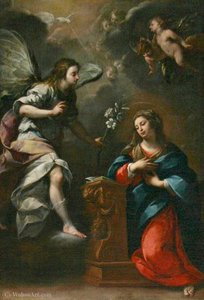
A Vision of the Lombard Baroque
Daniele Crespi stands as one of the most original and compelling voices to emerge from Milan during the 1620s. An Italian painter and draughtsman of profound sensitivity, he played a pivotal role in reshaping the aesthetic landscape of his era. At a time when the region was still deeply entrenched in the exaggerated, often convoluted manner of Lombard Mannerism, Crespi sought a different path. He moved toward an early Baroque style characterized by a striking clarity of form and content, favoring a more naturalistic and direct emotional appeal that resonated with the spiritual needs of his time.
His artistic journey was marked by a rapid ascent and a tragic, premature end. Though his formal training remains somewhat elusive, his early career is anchored by his work alongside Guglielmo Caccia, known as Moncalvo, on significant ecclesiastical commissions in Milan. Through these early endeavors, Crespi began to refine a technique that would eventually define the Lombard school. His development was deeply influenced by the masters of his day, particularly Giovanni Battista Crespi, called Il Cerano, and Giulio Cesare Procaccini. From them, he inherited a sense of monumental stability, yet he infused his work with a unique dynamism and a simplified composition that stripped away unnecessary artifice.
Mastery of Light and Emotion
The true brilliance of Crespi’s oeuvre lies in his ability to bridge the gap between the earthly and the eternal through the masterful use of chiaroscuro. His religious paintings are not merely historical or biblical depictions; they are immersive experiences of devotion. By manipulating light to emerge from deep, impenetrable shadows, he sculpted his figures with a sculptural realism that commands the viewer's attention. This dramatic interplay of shadow and brilliance serves as a powerful spiritual metaphor, symbolizing divine grace piercing through the darkness of human suffering.
In masterpieces such as his Pietà, one can witness the profound depth of human grief captured with exquisite precision. The way light falls softly upon wounded flesh or illuminates the heavy, somber folds of drapery invites a lingering, meditative gaze. Whether through his prolific history paintings or his intimate portraits, Crespi maintained a commitment to clarity and emotional intensity. His work often featured:
- Dramatic Chiaroscuro: The use of intense light and shadow to create depth and spiritual tension.
- Devotional Narratives: A focus on monastic and religious themes that emphasized direct emotional connection.
- Naturalistic Detail: A move away from Mannerist distortion toward a more tangible, human reality.
Legacy and Historical Significance
Though his life was cut short by the Milan plague in 1630 at approximately thirty-two years of age, Crespi’s impact on Italian art remains indelible. He successfully transitioned Lombard painting from the complex rhythms of late Mannerism toward a more accessible, seventeenth-century idiom. His ability to blend classical clarity with Baroque dynamism ensured that his works would find a permanent home in some of the world's most prestigious institutions.
Today, his legacy is preserved within the halls of major encyclopedic museums, including the Metropolitan Museum of Art, the Pinacoteca di Brera, and the Los Angeles County Museum of Art (LACMA). Through these enduring works, Crespi continues to offer a window into the profound depths of human compassion and the timeless beauty of the Baroque spirit.
Pytania i odpowiedzi
Na jakie okresy dzieli się kariera Daniele Crespi?
Kariera Daniele Crespi rozwija się etap po etapie na stronie Osiągnięcia artystyczne: jako pozioma oś czasu dzieł, pogrupowanych w rozdziały odpowiadające poszczególnym okresom twórczości.
Gdzie mogę zobaczyć profil kolorystyczny twórczości Daniele Crespi?
Profil kolorystyczny twórczości Daniele Crespi można zobaczyć na stronie Genom Palety artysty.
Gdzie można znaleźć dzieła Daniele Crespi pogrupowane według techniki?
Aby znaleźć wszystkie dzieła artysty Daniele Crespi wykonane w danej technice, odwiedź stronę Wszystkie techniki.
Gdzie i w którym roku urodził(a) się Daniele Crespi?
Daniele Crespi urodził się w Busto Arsizio w 1598 roku.