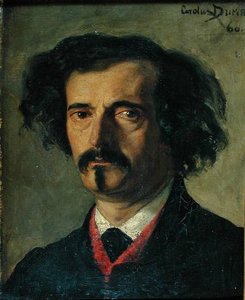
Portret Carolus-Duran

100 najsłynniejszych obrazów artysty Carolus-Duran – wybór z galerii

Aktualizacja: Listopad 2026 · ranking według naszego wskaźnika popularności (liczba wyszukiwań, wizyt i zamówień dla każdego dzieła) · 131 dzieł Carolus-Duran w naszym katalogu

W skrócie

Spośród wszystkich dzieł oryginalnych, które pozostawił Carolus-Duran, najsłynniejszym jest Countess Rattazzi, née Maria-Laetitia Bonaparte-Wyse (1872), znajdujący się w kolekcji Królewskie Muzeum Sztuk Pięknych Antwerpia w Antwerpia. Tuż za nimi znajdują się Merrymakers (1870) oraz Portrait of Madame Edgard Stern (1889). Nasz katalog zawiera 131 dzieł autorstwa Carolus-Duran; galeria zachowała 100 najbardziej podziwianych na świecie prac, z których każda została przedstawiona wraz z datą powstania, informacją o muzeum oraz jej historią.

1837 – 1917, Lille Academic painting Najwięcej dzieł: Petit Palais

10 najlepszych obrazów artysty Carolus-Duran: wybór galerii

1
Countess Rattazzi, née Maria-Laetitia Bonaparte-Wyse (1872) autorstwa Carolus-Duran

Countess Rattazzi, née Maria-Laetitia Bonaparte-Wyse

1872 · Oil On Canvas · Królewskie Muzeum Sztuk Pięknych Antwerpia, Antwerpia

The portrait presents a full-length view of Countess Rattazzi, née Maria-Laetitia Bonaparte-Wyse, positioned slightly to the left of the vertical center. She is depicted in a poised, upright stance against a solid, saturated red background. Her attire consists of a dark navy blue and black gown that reaches the floor, accented by white lace ruffles at the sleeves and neckline. The fabric of the dress exhibits a sheen consistent with…

2
Merrymakers (1870) autorstwa Carolus-Duran

Merrymakers

1870 · Oil

is a portrait executed by Carolus-Duran in 1870. The work belongs to a period in which the artist was refining a style that bridged the gap between the directness of Realism and a more sophisticated, elegant approach to his subjects.

3
Portrait of Madame Edgard Stern (1889) autorstwa Carolus-Duran

Portrait of Madame Edgard Stern

1889 · Oil On Canvas · Petit Palais, Paryż

Portrait of Madame Edgard Stern is an oil on canvas painted by Carolus-Duran in 1889. The work captures Marguerite Stern, née Fould, in a formal presentation of her social standing. As the wife of the banker Edgar Stern, her identity is tied to the high society of the period, a theme reflected in the subject's attire and bearing.

4
Promenade in the Woods (1861) autorstwa Carolus-Duran

Promenade in the Woods

1861 · Oil · Indianapolis Museum of Art, Indianapolis

In "Promenade in the Woods" by Carolus-Duran, a quiet moment unfolds within a lush, shaded woodland. Painted about 1861, the scene captures a couple dressed in nineteenth-century attire as they move through the trees. They exist within a secluded space where the heavy canopy filters the light into soft, dappled patches upon the forest floor. This setting creates a sense of profound tranquility and romance, isolating the pair within the…

5
Henri Fantin Latour (1861) autorstwa Carolus-Duran

Henri Fantin Latour

1861 · Oil On Canvas

Carolus-Duran painted this likeness of Henri Fantin-Latour in 1861. At the time, the subject was a twenty-five-year-old art student. The two men had met around 1855 while copying masterpieces at the Louvre. This portrait is one of two pictures created by Carolus-Duran in 1861 to celebrate their friendship.

6
Portrait of Alexandre Falguière (1870) autorstwa Carolus-Duran

Portrait of Alexandre Falguière

1870 · Oil On Canvas · Petit Palais, Paryż

The Portrait of Alexandre Falguière is an oil painting by the French artist Carolus-Duran. It captures the likeness of Alexandre Falguière, a man whose presence is anchored within the frame. This work was executed on 22 March 1870. The image resides within the collection of the Musée des Beaux-Arts de la Ville de Paris, Petit Palais.

7
Portrait of a Man (1871) autorstwa Carolus-Duran

Portrait of a Man

1871 · Oil On Canvas · Indianapolis Museum of Art, Indianapolis

In the Portrait of a Man by Carolus-Duran, the composition is organized around a close-up profile view. The subject is positioned slightly to the left of center, facing toward the right of the frame. This placement leaves a specific amount of negative space in front of the subject's face. The background remains dark and indistinct, providing no specific setting or environmental detail. This lack of background detail focuses the viewer's…

8
Portrait of Hector Hanoteau (1870) autorstwa Carolus-Duran

Portrait of Hector Hanoteau

1870 · Oil

In the Portrait of Hector Hanoteau by Carolus-Duran, the artist turns the gaze inward. This self-portrait captures a man in a three-quarter view, his presence anchored firmly within the frame. The composition centers heavily on the face and the upper torso, pulling the viewer into a private encounter. A dark, shadow-filled background recedes into nothingness, pushing the subject forward and sharpening the edges of his silhouette. It is a study…

9
Portrait of Madame Goldschmith (1874) autorstwa Carolus-Duran

Portrait of Madame Goldschmith

1874 · Oil On Canvas · Musée Des Beaux, Marsylia

The 1874 oil on canvas titled Portrait of Madame Goldschmith captures a moment of stillness. This work was executed by Carolus-Duran, a French painter and art instructor who shaped the vision of many students in his Paris studio. The subject is presented with the quiet dignity of a formal portrait, rendered during a period when the artist was establishing his reputation among the high society of the Third Republic.

10
Portrait of Etienne Haro (1873) autorstwa Carolus-Duran

Portrait of Etienne Haro

1873 · Oil On Canvas · Petit Palais, Paryż

In this bust-length portrait, Carolus-Duran presents Etienne Haro with a quiet, commanding presence. The subject is positioned centrally against a textured, dark green background that recedes into shadow, allowing the sitter to emerge with a sense of physical weight. The color palette is dominated by deep, somber tones, primarily the dark navy or black of the man's coat, which anchors the composition. This sobriety is balanced by the warm flesh…

Kontynuacja zestawienia Carolus-Duran, od 11 do 100

11Portrait of Léonie Dufresne, Baroness le Vavasseur, then Marchioness de Vaucouleurs de Lanjamet (1875) autorstwa Carolus-DuranPortrait of Léonie Dufresne, Baroness le Vavasseur, then Marchioness de Vaucouleurs de Lanjamet1875 · Musée Carnavalet 12Portrait of Jean-François Berthelier (1830-1888), singer (1877) autorstwa Carolus-DuranPortrait of Jean-François Berthelier (1830-1888), singer1877 · Musée Carnavalet 13Portrait of James Carroll Beckwith (1877) autorstwa Carolus-DuranPortrait of James Carroll Beckwith1877 · Heckscher Museum 14Portrait de Jules Claretie (1874) autorstwa Carolus-DuranPortrait de Jules Claretie1874 · Palais des Beaux-Arts de Lille 15Portrait of Philippe Burty (1874) autorstwa Carolus-DuranPortrait of Philippe Burty1874 · Allen Memorial Art Museum 16Portrait of Gustave Doré (1877) autorstwa Carolus-DuranPortrait of Gustave Doré1877 · Musée d'Art Moderne et Contemporain de Strasbourg 17Triumph of Maria de' Medici, (1875) autorstwa Carolus-DuranTriumph of Maria de' Medici,1875 18Portrait of Madame Alice Hoschede (1875) autorstwa Carolus-DuranPortrait of Madame Alice Hoschede1875 · Museum of Fine Arts 19Mrs Harry Vane Milbank, née Alice Sidonie Van den Bergh (1877) autorstwa Carolus-DuranMrs Harry Vane Milbank, née Alice Sidonie Van den Bergh1877 20Portrait of Mathilde Metman (1878) autorstwa Carolus-DuranPortrait of Mathilde Metman1878 21Spanish Woman (Portrait of Eva Gonzalès?) (1876) autorstwa Carolus-DuranSpanish Woman (Portrait of Eva Gonzalès?)1876 22French Mademoiselle de Lancey (1876) autorstwa Carolus-DuranFrench Mademoiselle de Lancey1876 23Portrait of Baron Antoine d'Ezpeleta (1882) autorstwa Carolus-DuranPortrait of Baron Antoine d'Ezpeleta1882 · Petit Palais 24Portrait of the Wife of Christos Zografos (1883) autorstwa Carolus-DuranPortrait of the Wife of Christos Zografos1883 · National Gallery 25Portrait of Christakis Zografos (1883) autorstwa Carolus-DuranPortrait of Christakis Zografos1883 · National Gallery 26Portrait (1881) autorstwa Carolus-DuranPortrait1881 · National Gallery 27Portrait Sketch of a Young Girl (1885) autorstwa Carolus-DuranPortrait Sketch of a Young Girl1885 · National Gallery of Ireland 28Portrait of Madame Georges Petit (1879) autorstwa Carolus-DuranPortrait of Madame Georges Petit1879 · Palais des Beaux-Arts de Lille 29Retrato de D. Maria Pia (1880) autorstwa Carolus-DuranRetrato de D. Maria Pia1880 30Madame Pauline Marie Charlotte Carolus Duran (1885) autorstwa Carolus-DuranMadame Pauline Marie Charlotte Carolus Duran1885 31Portrait of Marguerite (1883-1973) and Robert (1880-1956) de Broglie (1890) autorstwa Carolus-DuranPortrait of Marguerite (1883-1973) and Robert (1880-1956) de Broglie1890 · Musée Carnavalet 32Portrait of Frits Thaulow (1890) autorstwa Carolus-DuranPortrait of Frits Thaulow1890 · Oslo Museum 33Carolus Duran (1900) autorstwa Carolus-DuranCarolus Duran1900 · Smithsonian American Art Museum 34The Artist's Gardener (1893) autorstwa Carolus-DuranThe Artist's Gardener1893 35After the Swimming (1899) autorstwa Carolus-DuranAfter the Swimming1899 36Portrait of Arsène Alexandre (1859-1935), art historian and critic (1902) autorstwa Carolus-DuranPortrait of Arsène Alexandre (1859-1935), art historian and critic1902 · Musée Carnavalet 37Portrait of María Reyna de Fernández Blanco (1899) autorstwa Carolus-DuranPortrait of María Reyna de Fernández Blanco1899 · National Museum of Fine Arts 38Child in a Red Hat (Michel Feydeau, son of Georges) (1905) autorstwa Carolus-DuranChild in a Red Hat (Michel Feydeau, son of Georges)1905 · Palais des Beaux-Arts de Lille 39Portrait Édouard Manet (1880) autorstwa Carolus-DuranPortrait Édouard Manet1880 · Musée d'Orsay 40Mrs. Leonard Lewisohn (Rosalie Jacobs) (1901) autorstwa Carolus-DuranMrs. Leonard Lewisohn (Rosalie Jacobs)1901 · New York Historical Society 41Leonard Lewisohn (1899) autorstwa Carolus-DuranLeonard Lewisohn1899 · New York Historical Society 42Portrait of Augustus Gurnee (1910) autorstwa Carolus-DuranPortrait of Augustus Gurnee1910 · Petit Palais 43Natalie Barney (1900) autorstwa Carolus-DuranNatalie Barney1900 · Smithsonian American Art Museum 44The Painter Matías Moreno (1867) autorstwa Carolus-DuranThe Painter Matías Moreno1867 · Museo del Prado 45The Lady with the Glove (1869) autorstwa Carolus-DuranThe Lady with the Glove1869 46Vision autorstwa Carolus-DuranVision 47The Artist's Daughter, Marie-Anne autorstwa Carolus-DuranThe Artist's Daughter, Marie-AnneFine Arts Museums of San Francisco 48Henri Oulevay and Henri Fantin Latour (1861) autorstwa Carolus-DuranHenri Oulevay and Henri Fantin Latour1861 49La plage d'Ambleteuse (1869) autorstwa Carolus-DuranLa plage d'Ambleteuse1869 50Henri Regnault Dead on the Field of Battle (1870) autorstwa Carolus-DuranHenri Regnault Dead on the Field of Battle1870 51M. Berthon (1870) autorstwa Carolus-DuranM. Berthon1870 · Ashmolean Museum 52View in the Lower Church of San Francesco, Assisi (1876) autorstwa Carolus-DuranView in the Lower Church of San Francesco, Assisi1876 · The Clark Art Institute 53Madamoiselle de Lancy, Alice Tahl (1876) autorstwa Carolus-DuranMadamoiselle de Lancy, Alice Tahl1876 54The "Chinese" Dog (1884) autorstwa Carolus-DuranThe "Chinese" Dog1884 · Petit Palais 55La Fille De L'Emir (1883) autorstwa Carolus-DuranLa Fille De L'Emir1883 56The Flower Girl (1880) autorstwa Carolus-DuranThe Flower Girl1880 · Dundee Art Gallery And Museum 57The Entertainer (1888) autorstwa Carolus-DuranThe Entertainer1888 58Natalie at Ten (1887) autorstwa Carolus-DuranNatalie at Ten1887 · Smithsonian American Art Museum 59Laura at Seven (1887) autorstwa Carolus-DuranLaura at Seven1887 60Mrs. William Astor (Caroline Webster Schermerhorn, 1831 1908) (1890) autorstwa Carolus-DuranMrs. William Astor (Caroline Webster Schermerhorn, 1831 1908)1890 61Margaret Anderson, The Honourable Mrs Ronald, Later Dame Margaret, Greville, DBE (1891) autorstwa Carolus-DuranMargaret Anderson, The Honourable Mrs Ronald, Later Dame Margaret, Greville, DBE1891 · Polesden Lacey 62Pasteur (1887) autorstwa Carolus-DuranPasteur1887 · Musée Pasteur 63Madame Faydou and Her Children (1897) autorstwa Carolus-DuranMadame Faydou and Her Children1897 · Narodowe Muzeum Sztuki Zachodniej 64Les pommiers (1900) autorstwa Carolus-DuranLes pommiers1900 65Nude Woman Standing autorstwa Carolus-DuranNude Woman StandingMusée des Beaux-Arts 66Portrait of a Man autorstwa Carolus-DuranPortrait of a ManNational Gallery 67A study of a head. autorstwa Carolus-DuranA study of a head.Muzeum Narodowe w Warszawie 68Portrait de Madame Vigeant autorstwa Carolus-DuranPortrait de Madame Vigeant 69Merrymakers autorstwa Carolus-DuranMerrymakersDetroit Institute of Arts 70Portrait of a Woman autorstwa Carolus-DuranPortrait of a Woman 71Studies for a Crucifixion autorstwa Carolus-DuranStudies for a Crucifixion 72Portrait De L'acteur Mounet-Sully autorstwa Carolus-DuranPortrait De L'acteur Mounet-Sully 73Portrait of an artist autorstwa Carolus-DuranPortrait of an artist 74Portrait D'henri Bouchard, Sculpteur autorstwa Carolus-DuranPortrait D'henri Bouchard, Sculpteur 75Portrait Of General William F. Draper autorstwa Carolus-DuranPortrait Of General William F. Draper 76Portrait Of Lucy Lee Robbins autorstwa Carolus-DuranPortrait Of Lucy Lee Robbins 77Margaret Anderson, Wife of the Honorable Ronald Grenville autorstwa Carolus-DuranMargaret Anderson, Wife of the Honorable Ronald Grenville 78Lilia (1889) autorstwa Carolus-DuranLilia1889 · Musée d'Orsay 79Lady with a Glove (1869) autorstwa Carolus-DuranLady with a Glove1869 80Hébé (1895) autorstwa Carolus-DuranHébé1895 81Head of a Bearded Man (1862) autorstwa Carolus-DuranHead of a Bearded Man1862 82The Kiss autorstwa Carolus-DuranThe Kiss 83Study of Lilia (1887) autorstwa Carolus-DuranStudy of Lilia1887 · National Gallery of Art 84Portrait of a Woman autorstwa Carolus-DuranPortrait of a WomanMetropolitan Museum of Art 85Souvenir de Voyage autorstwa Carolus-DuranSouvenir de Voyage 86Queen Maria Pia of Portugal autorstwa Carolus-DuranQueen Maria Pia of Portugal 87Female nude autorstwa Carolus-DuranFemale nude 88A portrait of helena modjeska chlapowski autorstwa Carolus-DuranA portrait of helena modjeska chlapowski 89Lady In White With A Fan autorstwa Carolus-DuranLady In White With A Fan 90Danae autorstwa Carolus-DuranDanaeMusée des Beaux-Arts de Bordeaux 91Portrait of Clara Babbitt Hyde at the age of five, in a white dress autorstwa Carolus-DuranPortrait of Clara Babbitt Hyde at the age of five, in a white dress 92Une femme nue assise vue de dos regardant la mer autorstwa Carolus-DuranUne femme nue assise vue de dos regardant la mer 93Hébé autorstwa Carolus-DuranHébé 94Portrait de femme au chignon de profil autorstwa Carolus-DuranPortrait de femme au chignon de profil 95Portrait de Louis Florestan Myionnet autorstwa Carolus-DuranPortrait de Louis Florestan Myionnet 96Study for a portrait of a lady autorstwa Carolus-DuranStudy for a portrait of a lady 97Madame Carolus-Duran autorstwa Carolus-DuranMadame Carolus-Duran 98The doughter of the emir autorstwa Carolus-DuranThe doughter of the emir 99Jules Barbey d'Aurevilly autorstwa Carolus-DuranJules Barbey d'Aurevilly 100Anna Gould autorstwa Carolus-DuranAnna Gould

Słynne obrazy Carolus-Duran epoka po epoce

Tematy, które przyciągnęły wzrok Carolus-Duran

Cztery motywy najczęściej powracające w tych oryginałach, z których każdy doczekał się swojego najdoskonalszego przykładu.

Muzea przechowujące oryginały Carolus-Duran

8 muzeów, w których znajduje się najwięcej obrazów z tej strony.

Muzea Miasto Dzieła artysty Carolus-Duran Obrazy z tej listy
Petit Palais, ParyżPetit Palais Paryż 7 Portrait of Madame Edgard Stern, Portrait of Alexandre Falguière, Portrait of Etienne Haro
Musée Carnavalet, ParyżMusée Carnavalet Paryż 4 Portrait of Léonie Dufresne, Baroness le Vavasseur, then Marchioness de Vaucouleurs de Lanjamet, Portrait of Jean-François Berthelier (1830-1888), singer, Portrait of Marguerite (1883-1973) and Robert (1880-1956) de Broglie
National Gallery, AtenyNational Gallery Ateny 4 Portrait of the Wife of Christos Zografos, Portrait of Christakis Zografos, Portrait
Palais des Beaux-Arts de Lille, LillePalais des Beaux-Arts de Lille Lille 6 Portrait de Jules Claretie, Portrait of Madame Georges Petit, Child in a Red Hat (Michel Feydeau, son of Georges)
Smithsonian American Art Museum, WaszyngtonSmithsonian American Art Museum Waszyngton 3 Carolus Duran, Natalie Barney, Natalie at Ten
Musée d'Orsay, ParyżMusée d'Orsay Paryż 4 Portrait Édouard Manet, Lilia
Indianapolis Museum of Art, IndianapolisIndianapolis Museum of Art Indianapolis 2 Promenade in the Woods, Portrait of a Man
New York Historical Society, Nowy JorkNew York Historical Society Nowy Jork 2 Mrs. Leonard Lewisohn (Rosalie Jacobs), Leonard Lewisohn

Carolus-Duran dekada po dekadzie: oryginały definiujące każdy okres

Dzieła według dekad

Wybierz dekadę, aby zobaczyć dzieło, które ją definiuje.

Pytania kolekcjonerów o obrazy Carolus-Duran

Z jakiego dzieła najbardziej znany jest Carolus-Duran?Odkryj odpowiedź

Countess Rattazzi, née Maria-Laetitia Bonaparte-Wyse (1872), Królewskie Muzeum Sztuk Pięknych Antwerpia, Antwerpia. Następne są Merrymakers (1870) oraz Portrait of Madame Edgard Stern (1889).

W jakim wieku był Carolus-Duran, gdy powstało Countess Rattazzi, née Maria-Laetitia Bonaparte-Wyse?Odkryj odpowiedź

35 lat: Countess Rattazzi, née Maria-Laetitia Bonaparte-Wyse pochodzi z 1872, a Carolus-Duran urodził(a) się w 1837.

Jakie są dziesięć najsłynniejszych obrazów, których autorem jest Carolus-Duran?Odkryj odpowiedź

Countess Rattazzi, née Maria-Laetitia Bonaparte-Wyse, Merrymakers, Portrait of Madame Edgard Stern, Promenade in the Woods, Henri Fantin Latour, Portrait of Alexandre Falguière, Portrait of a Man, Portrait of Hector Hanoteau, Portrait of Madame Goldschmith i Portrait of Etienne Haro. Powyższy ranking zawiera rok powstania oraz muzeum dla każdego z nich.

Ile obrazów pozostawił po sobie Carolus-Duran?Odkryj odpowiedź

Nasz katalog zawiera 131 dzieł artysty Carolus-Duran, datowanych od 1861 do 1910.

W których muzeach znajdują się arcydzieła Carolus-Duran?Odkryj odpowiedź

W większości znajdują się w Petit Palais (Paryż), Musée Carnavalet (Paryż) i National Gallery (Ateny). Powyższa tabela muzeów zawiera ich pełną listę.

W których latach Carolus-Duran namalował swoje najsłynniejsze dzieła?Odkryj odpowiedź

W 1870s: 24 z 100 dzieł na tej stronie powstało w tym czasie, w tym Countess Rattazzi, née Maria-Laetitia Bonaparte-Wyse.

Jakie są pierwsze i ostatnie słynne oryginały Carolus-Duran?Odkryj odpowiedź

Na tej stronie najwcześniejszy to Promenade in the Woods (1861), a najpóźniejszy Portrait of Augustus Gurnee (1910).

Jakie tematy Carolus-Duran wybierał najczęściej?Odkryj odpowiedź

Woman (26), Portrait (26) i Man (19), w ramach 100 dzieł na tej stronie.

Której techniki Carolus-Duran używał najczęściej?Odkryj odpowiedź

Oil On Canvas, dla 33 z 100 dzieł na tej stronie.

Do jakiego nurtu artystycznego należy Carolus-Duran?Odkryj odpowiedź

Academic painting, sądząc po oryginałach na tej stronie.

Które dzieła Carolus-Duran znajdują się w Petit Palais?Odkryj odpowiedź

Portrait of Madame Edgard Stern, Portrait of Alexandre Falguière i Portrait of Etienne Haro: Petit Palais, Paryż posiada 6 dzieł widocznych na tej stronie.

Carolus-Duran: życie i twórczość

Carolus-Duran: Życie i dziedzictwo

Historia Carolusa-Durana to fascynująca opowieść o artystycznej metamorfozie, która rozpoczęła się w Lille, we Francji. Urodzony 4 lipca 1837 roku jako Charles Auguste Émile Durand, od najmłodszych lat wykazywał niezwykły talent, który rozwijał pod okiem lokalnego rzeźbiarza, Augusta-Phidiasa Cadeta de Beaupré w Académie de Lille. Jego edukacja nabrała jednak prawdziwego tempa, gdy pod okiem François Souchona, ucznia samego Jacques-Louis Davida, zgłębiał tajniki techniki malarskiej. Przełomowym momentem w jego życiu był rok 1853, kiedy to przeprowadzka do Paryża i przyjęcie pseudonimu Carolus-Duran stały się fundamentem jego nowej, artystycznej tożsamości.

Ewolucja stylu tego mistrza portretu była procesem niezwykle dynamicznym. Choć początkowo jego twórczość przesiąknięta była surowym realizmem w duchu Gustave'a Courbeta, to podróż do Rzymu i Hiszpanii w latach 1862–1866 na zawsze odmieniła jego wrażliwość. To właśnie w Hiszpanii spotkanie z dziedzictwem Diego Velázqueza stało się kluczowym punktem zwrotnym. Carolus-Duran z zachwytem chłonął mistrzostwo Velázqueza w operowaniu światłem, kolorem oraz psychologiczną głębią spojrzenia. W efekcie jego styl ewoluował od surowego realizmu ku wyrafinowanej elegancji, charakteryzującej się niezwykle subtelnym prowadzeniem pędzla i dbałością o najdrobniejsze detale.

Sława Carolusa-Durana niosła się po salonach Paryża, gdzie stał się on ulubionym portrecistą elit Trzeciej Republiki. Z niezwykłą biegłością potrafił uchwycić nie tylko status społeczny, ale przede wszystkim szyk i dostojeństwo swoich modeli. Wśród jego najważniejszych dzieł odnaleźć można Lady z rękawiczką (1869), będącą kwintesencją jego wyrafinowanego stylu, czy poruszający portret Pani William Astor (1890). Jego talent objawiał się również w chwilach mniej formalnych, jak w dziele Po kąpieli (1899), gdzie artysta po mistrzowsku oddawał ruch i atmosferę, czy w bardziej intymnym, pełnym miękkości portrecie Córki artysty, Marie-Anne (1874). Co ciekawe, potrafił on również odejść od salonowej etykiety, malując np. swojego ogrodnika przy użyciu swobodniejszych pociągnięć pędzla i ziemistych tonów.

Jako pedagog, Carolus-Duran pozostawił po sobie nieśmiertelną legendę. Jego pracownia przy Boulevard du Montparnasse stała się tętniącym życiem centrum artystycznego kształcenia, z którego wyszli tacy giganci jak John Singer Sargent, Irving Ramsey Wiles czy Kenyon Cox. Jego autorytet potwierdzały liczne funkcje, w tym członkostwo w jury na Wystawach Światowych w 1889 i 1900 roku oraz prestiżowe wybranie do Académie des Beaux-Arts w 1904 roku. Za swoje zasługi dla kultury otrzymał liczne odznaczenia, w tym stopień Wielkiego Ofera Legii Honorowej.

W ostatnich latach życia Carolus-Duran często odwiedzał Fréjus, gdzie posiadał willę. Jego śmierć w 1917 roku zamknęła pewną epokę, lecz jego wpływ pozostał żywy – to właśnie on stał się pomostem łączącym realizm z impresjonizmem. Dzięki swojej zdolności do oddawania osobowości i społecznego prestiżu, na zawsze zapisał się w historii jako jedna z najważniejszych postaci francuskiej sztuki XIX wieku.

Wczesne lata i edukacja

Historia artysty, którego imię na zawsze zapisało się w kanonie malarstwa, rozpoczęła się 4 lipca 1837 roku w Lille, we Francji, gdzie przyszedł na świat Charles Auguste Émile Durand. Jego droga do mistrzostwa nie była dziełem przypadku, lecz wynikiem wczesnego, żarliwego zapału do sztuki. Pierwsze kroki w świecie formy i materii stawiał pod okiem lokalnego rzeźbiarza, Augusta-Phidiasa Cadeta de Beaupré, w murach Académie de Lille. To tam, wśród zapachu gliny i kamienia, kształtowało się jego wrażliwe oko. Jednak prawdziwy przełom nastąpił, gdy pod okiem François Souchona, wybitnego ucznia samego Jacques-Louis Davida, zgłębiał tajniki techniki malarskiej. To właśnie te fundamenty pozwoliły mu w 1853 roku na odważny krok w stronę wielkiego świata – przeprowadzkę do Paryża. To właśnie w stolicy Francji, podejmując decyzję o przyjęciu pseudonimu „Carolus-Duran”, dokonał on symbolicznego aktu narodzin swojej nowej, artystycznej tożsamości, która miała wkrótce zachwycić Europę.

Rozwój artystyczny i inspiracje

Początkowo pod wpływem realizmu Gustave'a Courbeta, styl Carolusa-Durana przeszedł znaczącą ewolucję po tym, jak dzięki stypendium mógł udać się w podróż do Rzymu i Hiszpanii w latach 1862–1866. To właśnie podczas pobytu w Hiszpanii Diego Velázquez stał się dla niego kluczowym źródłem inspiracji; artysta z ogromnym podziwem przyglądał się mistrzostwu Velázqueza w operowaniu światłem, kolorem oraz jego niezwykłej zdolności do psychologicznej głębi portretu. W efekcie Carolus-Duran odszedł od surowego realizmu Courbeta w stronę bardziej wyrafinowanego i eleganckiego stylu, który charakteryzował się wyrafinowanym sposobem prowadzenia pędzla oraz niezwykłą dbałością o najdrobniejsze detale.

Kariera i wybitne dzieła

Carolus-Duran zdobył szerokie uznanie dzięki portretom przedstawiającym zamożnych członków wyższych sfer francuskiej Republiki Trzeciej. Z niezwykłą biegłością potrafił uchwycić ich elegancję oraz wysoki status społeczny, nadając postaciom niemal namacalną godność.
Wśród jego najbardziej znaczących dzieł należy wymienić:

  • Lady with a Glove (1869) – dzieło to stanowi doskonały przykład jego wyrafinowanego stylu portretowego.
  • Mrs. William Astor (1890) – uderzający w swej sile wizerunek wpływowej damy salonowej.
  • After the Swimming (1899) – obraz ukazujący jego niezwykłą zdolność do oddania ruchu oraz ulotnej atmosfery chwili.
  • The Artist's Daughter, Marie-Anne (1874) – bardziej intymny portret, który odsłania łagodniejsze oblicze jego twórczości.

Artysta nie ograniczał się jednak wyłącznie do salonowych elit; tworzył również portrety stojące w całkowitej sprzeczności z jego typowymi tematami. Przykładem może być wizerunek jego ogrodnika, w którym Carolus-Duran porzucił precyzję na rzecz swobodniejszych pociągnięć pędzla i ziemistych tonów barwnych.

Nauczanie i dziedzictwo

Carolus-Duran był niezwykle szanowanym pedagogiem, którego pasja do sztuki przyciągała rzesze ambitnych twórców. Jego pracownia, położona przy Boulevard du Montparnasse, stała się tętniącym życiem centrum kształcenia artystycznego, gdzie tradycja spotykała się z nowoczesnością. To właśnie tam, pod jego czujnym okiem, kształtowały się talenty, które na zawsze zmieniły oblicze malarstwa.

Wśród jego najbardziej znamienitych uczniów znaleźli się:

  • John Singer Sargent
  • Irving Ramsey Wiles
  • Kenyon Cox

Prestiż artysty w świecie sztuki potwierdzały liczne wyróżnienia oraz zaufanie środowiska, czego dowodem były jego prace w jury podczas wystaw światowych Expositions Universelles w 1889 i 1900 roku. Jego wpływ na kulturę był niepodważalny, co zaowocowało w 1890 roku współzałożeniem drugiej Société Nationale des Beaux-Arts, a w 1904 roku prestiżowym wyborem do Académie des Beaux-Arts.

Wyróżnienia i ostatnie lata

Carolus-Duran w trakcie swojej niezwykłej kariery został uhonorowany licznymi odznaczeniami, które potwierdzały jego niepodważalną pozycję w świecie sztuki. Już w 1872 roku został mianowany Kawalerem Legionu Honorowego, a z biegiem lat jego prestiż rósł, aż w 1900 roku osiągnął zaszczytny stopień Wielkiego Oficera tego orderu.

Artysta był również stałym gościem w malowniczym Fréjus, gdzie posiadał własną willę, szukając tam wytchnienia od zgiełku życia artystycznego. Jego więź z tym miejscem była tak silna, że po jego śmierci w 1917 roku, kurort zdecydował się upamiętnić go, nadając nazwę placowi oraz plaży na jego cześć.

Znaczenie historyczne: Carolus-Duran odegrał kluczową rolę jako postać łącząca dwa wielkie nurty epoki – realizm oraz impresjonizm. Swoim wyrafinowanym stylem i mistrzowską biegłością techniczną wywarł ogromny wpływ na całe pokolenie artystów. Dzięki niezwykłej zdolności do oddawania głębi osobowości oraz statusu społecznego swoich modeli, stał się jedną z najważniejszych postaci francuskiej sztuki XIX wieku.