Portret Barnett Newman

63 najsłynniejszych obrazów artysty Barnett Newman, każdy niepowtarzalny

Aktualizacja: Listopad 2026 · ranking według naszego wskaźnika popularności (liczba wyszukiwań, wizyt i zamówień dla każdego dzieła) · 69 dzieł Barnett Newman w naszym katalogu

W skrócie

Czarny Ogień I (1963) to obraz autorstwa Barnett Newman, który przyciąga najwięcej spojrzeń. Następnie wzrok kieruje się na Vir Heroicus Sublimis (1950) i Prometheus Bound. Spośród 69 dzieł Barnett Newman w naszym katalogu, tych 63 jest najbardziej znanych – każde z nich to unikatowy oryginał, przedstawiony wraz z rokiem powstania, muzeum oraz powodem, dla którego przetrwało próbę czasu.

1905 – 1970, Nowy Jork Color field Najwięcej dzieł: National Gallery of Art

10 najlepszych obrazów autorstwa Barnett Newman według oka galerii

1
Czarny Ogień I (1963) autorstwa Barnett Newman

Czarny Ogień I

1963 · Obraz olejny na płótnie

W 1963 roku Barnett Newman powołał do życia dzieło Czarny Ogień I. Płótno to stanowi potężną obecność, mierzącą 289 x 213 cm. Zajmuje przestrzeń z ciężką, milczącą siłą, a jego skala wymusza fizyczną reakcję od każdego, kto stanie przed nim twarzą w twarz. Praca ta wyłoniła się jako szczytowe osiągnięcie malarstwa Color Field, odzierając świat z chaosu widzialnych przedmiotów, aby odnaleźć coś znacznie bardziej fundamentalnego.

2
Vir Heroicus Sublimis (1950) autorstwa Barnett Newman

Vir Heroicus Sublimis

1950 · Oil On Canvas

The canvas of Vir Heroicus Sublimis looms large, a monumental presence that demands immediate attention. Created by the American painter Barnett Newman, this work carries a title that translates from Latin as "Man, Heroic and Sublime." It is a massive expanse, reaching nearly 8 feet in height and stretching 18 feet wide, a scale that envelops the viewer's field of vision. The sheer size of the painting transforms the space…

3
Prometheus Bound autorstwa Barnett Newman

Prometheus Bound

Oil On Canvas · Museum Folkwang, Essen

In the vast, quiet landscape of Abstract Expressionism, few works command the room with such profound, understated authority as Barnett Newman’s "Prometheus Bound." To encounter this painting is to step away from the clamor of the material world and enter a space of pure, meditative stillness. Eschewing the traditional impulse to depict recognizable figures or dramatic narratives, Newman invites the viewer into a realm of Color Field Painting, where the…

4
Onement I (1948) autorstwa Barnett Newman

Onement I

1948 · Oil On Canvas · MoMA - Museum of Modern Art, Nowy Jork

In the landscape of twentieth-century modernism, few works possess the quiet, seismic power of Barnett Newman’s Onement I. Completed in 1948, this masterpiece serves as a profound emblem of Abstract Expressionism and stands as a foundational cornerstone for the Color Field movement. To encounter this painting is to witness a pivotal moment in art history where the boundaries of representation were irrevocably dissolved, replaced by an exploration of pure perception.…

5
Be I (1970) autorstwa Barnett Newman

Be I

1970 · Acrylic On Canvas · Detroit Institute of Arts, Detroit

The canvas holds a heavy, dark cadmium red. This color occupies the space like the earth itself, unmodulated and thick with presence. A single white stripe, known as a zip, cuts vertically through the center of the field. It is precise and thin. This line acts as a flash of lightning against the saturated background, an instantaneous moment that breaks the stillness of the red expanse.

6
Onement, III (1949) autorstwa Barnett Newman

Onement, III

1949 · Oil On Canvas

In the vast landscape of mid-20th-century abstraction, few works command the room with such singular, quiet intensity as Barnett Newman’s Onement, III. Created in 1949, this masterpiece stands as a seminal pillar of the Color Field painting movement, offering much more than a mere arrangement of pigment on canvas. It is an invitation to experience the sublime. The painting presents a breathtaking expanse of deep, dominant red, a field of…

7
Be I (1970) autorstwa Barnett Newman

Be I

1970 · Acrylic On Canvas

To stand before Be I is to encounter a profound silence that speaks with startling intensity. Created in 1970, the final year of Barnett Newman’s life, this monumental work serves as a definitive statement of the Color Field movement. The painting does not rely on the traditional vocabulary of figures or landscapes; instead, it commands the viewer's attention through a singular, immersive expanse of deep red. This is not merely…

8
The Third (1964) autorstwa Barnett Newman

The Third

1964 · Oil On Canvas

The canvas breathes through a field of orange. It is a hue that does not merely sit upon the surface but seems to vibrate, a steady heat radiating from the center of the frame. This is the world of 1964, where color is stripped of its duty to represent objects and is instead allowed to exist as pure energy. Through the application of pigment, a flat, non-hierarchical space emerges, inviting…

9
Twelfth Station (1965) autorstwa Barnett Newman

Twelfth Station

1965 · Acrylic On Canvas · National Gallery of Art, Waszyngton

Barnett Newman created Twelfth Station in 1965. This acrylic on canvas exists as a single movement within a larger sequence. It belongs to the series titled The Stations of the Cross / Lema Sabachthani. The work emerged from a period of intense philosophical inquiry, seeking to find a visual language for the silent weight of existence.

10
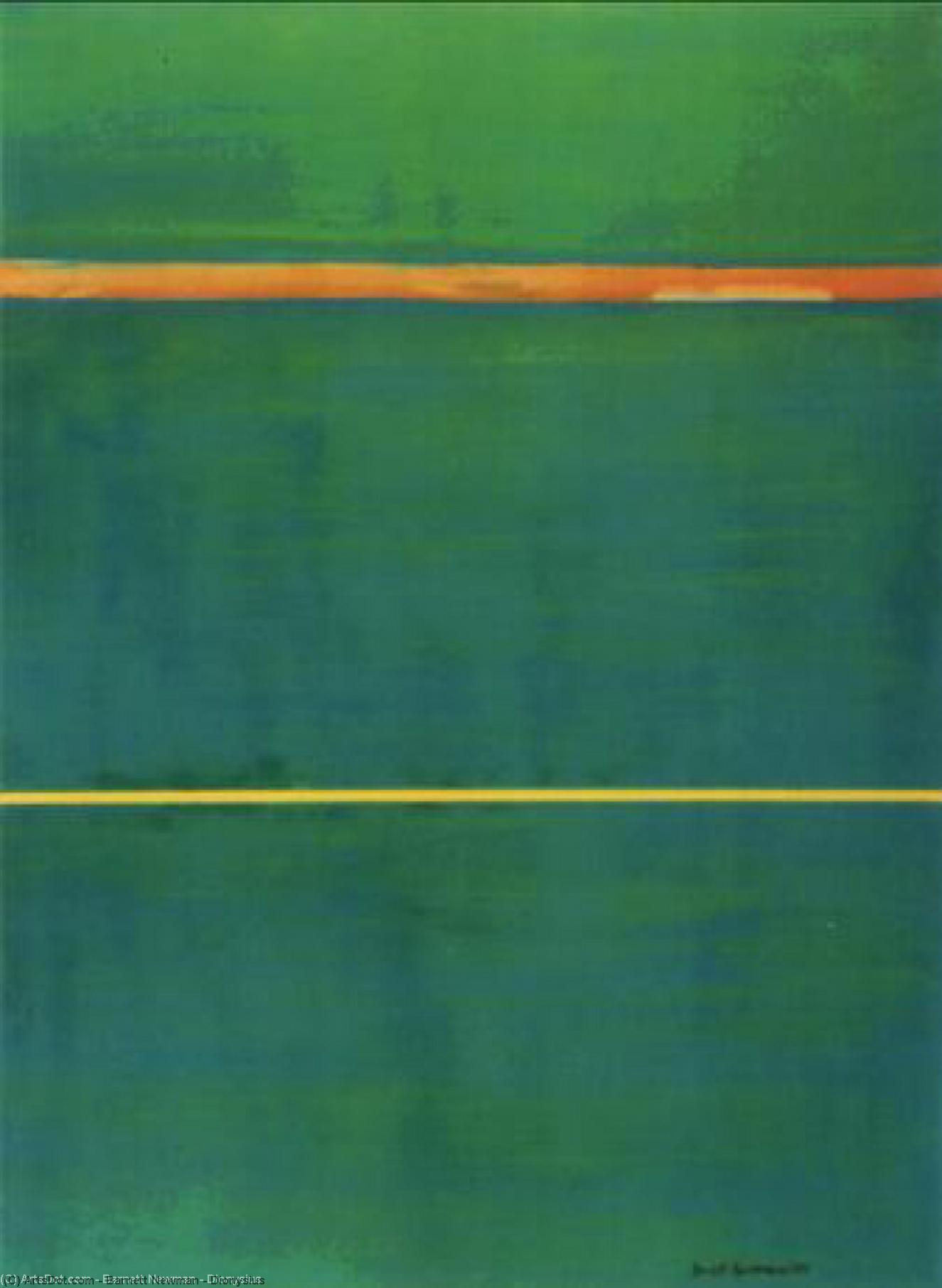
Dionysius (1949) autorstwa Barnett Newman

Dionysius

1949 · Oil On Canvas

Dionysius is a work by Barnett Newman. Created in 1949, this oil on canvas piece belongs to the Color Field style. The artist's approach here focuses on the expansive application of pigment to establish a specific spatial presence.

Słynne obrazy artysty Barnett Newman, od 11 do 63

Słynne obrazy Barnett Newman epoka po epoce

Mid-Career

1944 – 1950 · 3 dzieł na tej liście

Tematy, które przyciągnęły wzrok Barnett Newman

Cztery motywy najczęściej powracające w tych oryginałach, z których każdy doczekał się swojego najdoskonalszego przykładu.

Muzea przechowujące oryginały Barnett Newman

6 muzeów, w których znajduje się najwięcej obrazów z tej strony.

Muzea Miasto Dzieła artysty Barnett Newman Obrazy z tej listy
National Gallery of Art, WaszyngtonNational Gallery of Art Waszyngton 13 Twelfth Station, Fourth Station, Second Station
Museum Folkwang, EssenMuseum Folkwang Essen 1 Prometheus Bound
MoMA - Museum of Modern Art, Nowy JorkMoMA - Museum of Modern Art Nowy Jork 1 Onement I
Detroit Institute of Arts, DetroitDetroit Institute of Arts Detroit 1 Be I
Narodowa Galeria Kanady, OttawaNarodowa Galeria Kanady Ottawa 1 The Way I
Museum Ludwig, KoloniaMuseum Ludwig Kolonia 1 Midnight Blue

Barnett Newman na przestrzeni dekad: jeden unikatowy oryginał dla każdego

Dzieła według dekad

Wybierz dekadę, aby zobaczyć dzieło, które ją definiuje.

Obrazy artysty Barnett Newman: pytania do galerii

Jakie jest najsłynniejsze dzieło artysty Barnett Newman?Odkryj odpowiedź

Czarny Ogień I (1963). Następne są Vir Heroicus Sublimis (1950) oraz Prometheus Bound.

W jakim wieku Barnett Newman stworzył/a Czarny Ogień I?Odkryj odpowiedź

58 lat: Czarny Ogień I pochodzi z 1963, a Barnett Newman urodził(a) się w 1905.

Które dziesięć obrazów Barnett Newman jest najbardziej znanych?Odkryj odpowiedź

Czarny Ogień I, Vir Heroicus Sublimis, Prometheus Bound, Onement I, Be I, Onement, III, Be I, The Third, Twelfth Station i Dionysius. Powyższy ranking zawiera rok powstania oraz muzeum dla każdego z nich.

Ile znanych dzieł stworzył Barnett Newman?Odkryj odpowiedź

Nasz katalog zawiera 69 dzieł artysty Barnett Newman, datowanych od 1944 do 1970.

Gdzie można zobaczyć najsłynniejsze oryginały Barnett Newman?Odkryj odpowiedź

W większości znajdują się w National Gallery of Art (Waszyngton), Museum Folkwang (Essen) i MoMA - Museum of Modern Art (Nowy Jork). Powyższa tabela muzeów zawiera ich pełną listę.

W jakim okresie Barnett Newman stworzył/a swoje najsłynniejsze obrazy?Odkryj odpowiedź

W 1960s: 32 z 63 dzieł na tej stronie powstało w tym czasie, w tym Czarny Ogień I.

Który z najsłynniejszych obrazów artysty Barnett Newman powstał najwcześniej, a który najpóźniej?Odkryj odpowiedź

Na tej stronie najwcześniejszy to The Song of Orpheus (1944), a najpóźniejszy Be I (1970).

Jakie tematy preferował Barnett Newman?Odkryj odpowiedź

Vertical lines (5), Geometric (4) i Spirituality (2), w ramach 63 dzieł na tej stronie.

Jakich materiałów Barnett Newman używał najczęściej?Odkryj odpowiedź

Oil On Canvas, dla 8 z 63 dzieł na tej stronie.

Do jakiego nurtu należy twórczość Barnett Newman?Odkryj odpowiedź

Color field i Abstract expressionism, sądząc po oryginałach na tej stronie.

Jakie oryginały Barnett Newman można zobaczyć w National Gallery of Art?Odkryj odpowiedź

Twelfth Station, Fourth Station i Second Station: National Gallery of Art, Waszyngton posiada 13 dzieł widocznych na tej stronie.

Barnett Newman: portret artysty

A Pioneer of Abstract Expressionism: The Life and Art of Barnett Newman

Barnett Newman, born in 1905 in New York City to Jewish immigrant parents from Poland, emerged as a pivotal figure in the landscape of American art. His journey wasn’t one of immediate recognition but rather a slow burn of artistic exploration and philosophical inquiry that ultimately redefined the possibilities of abstract painting. Initially studying at the Art Students League and later at the City College of New York, Newman absorbed the influences of his time – the burgeoning Cubism of Picasso and the vibrant color palettes of Matisse were early touchstones. However, he soon felt constrained by these established modes of representation, sensing a need to forge a new visual language capable of expressing the anxieties and spiritual longings of the post-war era. He even destroyed much of his earlier representational work, a deliberate act signifying his commitment to an entirely new artistic path. This period of self-imposed creative destruction was crucial; it cleared the ground for the radical simplicity that would come to define his mature style.

Early Influences and Artistic Development

Newman’s formative years were marked by exposure to European avant-garde movements, particularly Cubism and Surrealism. Picasso's fragmented perspectives challenged traditional notions of visual perception, prompting Newman to question conventional artistic conventions. Simultaneously, Matisse’s bold use of color ignited his fascination with exploring the expressive potential of pigment—a passion that would become central to his distinctive aesthetic. Despite initial attempts at representational painting – landscapes and portraits – Newman quickly abandoned these pursuits, recognizing their inadequacy for conveying the profound emotional and intellectual concerns that preoccupied him. This decisive rejection of realism wasn’t merely stylistic preference; it represented a fundamental shift in artistic philosophy—a conviction that art should transcend mere imitation of nature to engage directly with human experience. He famously stated, “I want to paint what I see,” but he insisted that this vision shouldn't be limited to depicting the external world. Instead, he sought to capture something deeper – the inner landscape of consciousness and emotion.

The Birth of the “Zip” and the Expansion of Color

Newman’s breakthrough arrived with the development of what he famously termed "zips"—vertical bands of color that bisect vast fields of monochrome hues. These weren't merely lines; they were dynamic forces, asserting presence within the expansive emptiness of the canvas. His first solo exhibition in 1943 at Betty Parsons Gallery marked a significant step, though initial reactions were mixed. Critics questioned whether his austere compositions truly conveyed any meaningful content. It was with works like Onement VI (1950-51) that Newman truly established his signature aesthetic. The painting’s sheer scale and austere composition—a single red zip dividing the canvas into fields of orange and red—were revolutionary. Vir Heroicus Sublimis (1958-60), a monumental work, further solidified this approach, its multiple zips creating a sense of spatial depth and evoking feelings of awe and contemplation. The “zip” wasn’t simply an aesthetic device; it was a structural element that simultaneously divided and unified the canvas, acting as a symbolic marker of human presence within the infinite. Newman's meticulous attention to surface texture—often achieved through painstaking application of pigment—contributed to the painting's tactile quality and heightened its emotional impact. He sought to create art that resonated with viewers on a visceral level, bypassing intellectual analysis in favor of direct sensory experience.

Spirituality, The Sublime, and Philosophical Underpinnings

Beyond mere aesthetics, Newman’s art was deeply rooted in philosophical and spiritual concerns. He rejected the notion that painting should merely depict the external world, believing instead that it could serve as a vehicle for exploring profound existential questions. He sought to capture what he called “the sublime”—an experience of overwhelming grandeur and transcendence—through his abstract forms. This wasn’t about religious iconography but rather an attempt to evoke a primal sense of awe and wonder in the viewer. Newman was profoundly affected by the horrors of World War II and the dawn of the nuclear age, believing that traditional artistic conventions were inadequate for expressing the anxieties and moral complexities of this new era. His paintings became arenas for confronting these issues, offering not answers but rather spaces for contemplation and emotional resonance. He saw his work as a rejection of societal norms and an affirmation of individual freedom, striving to create art that was both intellectually rigorous and emotionally powerful.

Legacy and Influence on Modern Art

Barnett Newman’s impact on the development of Abstract Expressionism—alongside contemporaries like Mark Rothko and Jackson Pollock—is undeniable. He wasn't simply a painter; he was a theorist, a writer, and an advocate for a new kind of art that prioritized emotional truth over representational accuracy. His innovative use of color and form profoundly influenced subsequent generations of artists, particularly those working in Color Field painting and Minimalism. Artists who followed found inspiration in his reductionist approach and his emphasis on the experiential qualities of art. Today, Newman’s work is held in major museums worldwide, including the Museum of Modern Art in New York and the National Gallery of Art in Washington, D.C., cementing his place as a central figure in 20th-century art history. His paintings continue to challenge and inspire viewers, inviting them to engage with fundamental questions about human existence, spirituality, and the power of abstract form.