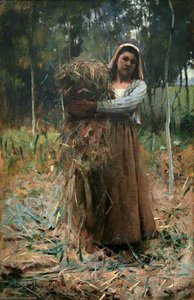
Arthur Melville: życie i twórczość
Arthur Melville: A Nineteenth-Century Artist Ahead of His Time
Arthur Melville, a name perhaps less instantly recognizable than some of his contemporaries, nevertheless occupies a pivotal position in late 19th and early 20th-century British painting. Born in Guthrie, Angus, Scotland, in 1855 (though some sources suggest 1858), Melville’s artistic journey was one defined by an insatiable curiosity, a bold embrace of color, and a profound sensitivity to light – qualities that would ultimately distinguish his work and exert a significant influence on the burgeoning Glasgow Boys movement. His early life offered little indication of the path he would forge; apprenticed as a grocer, Melville nonetheless found himself drawn to visual expression, diligently attending evening art classes in Edinburgh while balancing the demands of his trade. This dedication secured him entry into the Royal Scottish Academy Schools, laying the foundation for further study in Paris and Greece – experiences that proved crucial in shaping his artistic sensibilities.
Early Influences and Artistic Training
Melville’s formative years were marked by a keen interest in art fostered by John Pettie, who also hailed from East Linton and shared Melville's passion for painting. Recognizing Melville’s talent, Pettie encouraged him to pursue formal training at the Trustees Academy in Edinburgh, where he honed his skills alongside fellow aspiring artists. This dedication culminated in acceptance into the Royal Scottish Academy Schools, providing access to invaluable artistic instruction and exposure to established artistic traditions. Crucially, Melville travelled to Paris in 1878, immersing himself in the vibrant atmosphere of the Académie Julian and studying under the guidance of Impressionist masters like Manet – an experience that fundamentally altered his artistic perspective and instilled a fascination with capturing fleeting moments of light and color. He continued his artistic development at Grez-sur-Loing, south-east of Paris, where he perfected his watercolor technique alongside fellow artists who would become pivotal figures in the Glasgow Boys movement.
The Transformative Power of Travel: Persia, Egypt, Turkey
It was Melville’s intrepid travels through Persia, Egypt, and Turkey between 1880 and 1882 that truly ignited his creative fire. Often venturing alone into remote regions, he immersed himself in the cultures and landscapes of the Middle East, a world dramatically different from the muted tones of Victorian Scotland. This wasn’t merely observational; it was deeply experiential. Melville didn't simply *see* these places, he absorbed their atmosphere, their light, their very essence. He sought to capture not just what he saw with his eyes but what he felt in his soul – a quest that would define his artistic output for decades to come. During this period, Melville’s color palette underwent a radical transformation, fueled by the intense hues and dazzling sunlight of the region. He developed a distinctive watercolor technique – applying paint to wet paper with gouache and often employing blotting techniques – allowing him to achieve luminous effects and convey an unparalleled sense of immediacy. This approach rejected academic conventions and embraced spontaneity, aligning Melville squarely with the avant-garde currents shaping European art at the time.
The Glasgow Boys and Artistic Innovation
Melville’s artistic vision resonated deeply with several young Scottish painters who would become known as the Glasgow Boys – James Guthrie, Joseph Crawhall, and G. P. Chalmers. Recognizing Melville's pioneering spirit and his rejection of traditional artistic formulas, they sought inspiration from his bold use of color and atmospheric perspective. Guthrie, in particular, adopted Melville’s technique of blotting paper to create shimmering surfaces that mirrored the brilliance of the Middle Eastern landscapes he himself painted. Melville’s influence extended beyond stylistic imitation; it fostered a broader intellectual engagement with contemporary art movements and encouraged artists to challenge established norms. His work served as a catalyst for artistic experimentation and contributed significantly to the emergence of a distinctly Scottish aesthetic – one characterized by vibrancy, emotional intensity, and an unwavering commitment to capturing the beauty of the natural world.
Legacy: A Pioneer of Watercolor Painting
Arthur Melville’s contribution to British art is undeniable. He stands as a testament to the transformative power of travel, the importance of artistic innovation, and the enduring legacy of a visionary artist who dared to see the world through his own unique lens. His distinctive watercolor technique – dubbed “blottesque” by critics – remains celebrated for its ability to evoke atmosphere and convey emotion with remarkable precision. Melville’s paintings continue to inspire artists today, demonstrating that true artistic greatness lies not in slavishly adhering to convention but in forging one's own path toward expressive truth. He is remembered as a pivotal figure in the Glasgow Boys movement and as an artist who irrevocably altered the course of watercolor painting history.