A Philadelphia Legacy: The Life and Art of Antonio Pietro Martino
Antonio Pietro Martino, born in the vibrant city of Philadelphia in 1902, stands as a compelling figure in American realist painting. His life story is deeply interwoven with the artistic fabric of his family and community—one of eight siblings, all blessed with an innate talent for visual expression, and the son of Italian immigrants who instilled a strong work ethic alongside an appreciation for beauty. Carmine Antonio Martino, his father, was a skilled mason and stonecutter, a trade that perhaps subtly influenced young Antonio’s eye for form and structure. From the tender age of thirteen, he began formal training at the Graphic Sketch Club (now the Samuel S. Fleisher Art Memorial) in South Philadelphia, alongside his brother Giovanni, laying the foundation for a career dedicated to capturing the world around him with remarkable fidelity. His education continued at the Pennsylvania Museum School of Industrial Art—later becoming the University of the Arts—supplemented by weekend courses at both the Spring Garden Institute and La France Institute, solidifying his technical skills and broadening his artistic horizons.
Realism Infused with Impressionistic Light
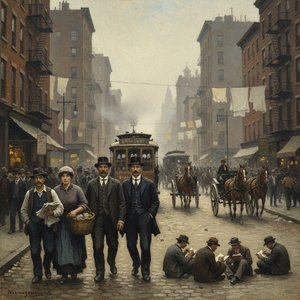
Martino’s artistic style is best described as a refined realism, deeply influenced by the principles of Impressionism. He wasn't merely interested in replicating what he saw; rather, he sought to convey the *feeling* of a place or moment through nuanced observation of light and color. This approach was significantly shaped by his instructor, Albert Jean Adolphe, who himself had studied under the renowned French master Jean-Léon Gérôme—a lineage that connects Martino back to the academic traditions of 19th-century Paris. The echoes of Thomas Eakins, a pivotal figure in Philadelphia’s artistic history, are also palpable in Martino's work; both artists shared an unwavering commitment to depicting everyday life with meticulous detail and a profound sense of dignity. He wasn’t alone in this pursuit—the urban scenes of John Sloan resonated with Martino’s own interest in capturing the essence of ordinary people and places. While firmly rooted in realism, Martino also allowed subtle Cubist influences to inform his approach to form, adding a layer of complexity beneath the surface of his seemingly straightforward depictions. His recurring themes centered on landscapes – particularly those along the Darby Creek and Delaware River – bustling urban scenes of Manayunk, and intimate still lifes, each rendered with a distinctive blend of precision and atmospheric sensitivity.
A Career Marked by Recognition and Affiliations
Martino’s talent quickly garnered recognition. By the age of twenty-three, he was exhibiting at the prestigious Pennsylvania Academy of Fine Arts in Philadelphia, marking the beginning of a prolific exhibition history. In 1941, alongside his brothers, he founded Martino Commercial Art Studios, providing fine art and promotional design services—a testament to both their artistic skill and entrepreneurial spirit. His dedication to the arts extended beyond his own practice; he actively engaged with the artistic community through membership in numerous esteemed organizations including the Philadelphia Sketch Club, the Philadelphia Art Club, the National Arts Club, and the American Watercolor Society. He achieved significant milestones within these circles, becoming an Associate of the National Academy of Design in 1938 and a full National Academician just four years later. His long-standing membership as an artist member of the Salmagundi Club, from 1942 until his death, further cemented his position within the American art world. Martino’s work was showcased at major institutions such as the Metropolitan Museum of Art, the Whitney Museum of American Art, and the Corcoran Gallery of Art, and throughout his career he received over eighty awards—a testament to the consistent quality and impact of his artistic vision.
From Philadelphia to California: A Lasting Legacy
In 1971, a new chapter began as Martino relocated to California, where he continued to paint with unwavering passion until his death in 1988. The Californian landscape inspired a shift in subject matter, leading him to focus on seascapes and coastal scenes, imbued with the bright light and vibrant colors of the Pacific coast. Despite this change in scenery, his core artistic principles remained constant—a dedication to realism, an appreciation for atmospheric effects, and a profound respect for the beauty of the natural world. Today, Martino’s work can be found in notable museum collections including the James A. Michener Art Museum (Bucks County), the Philadelphia Museum of Art, and the Woodmere Art Museum, ensuring his artistic legacy endures for generations to come. Antonio Pietro Martino represents a vital continuation of the Philadelphia tradition of realistic painting—a bridge between the legacy of artists like Eakins and the evolving landscape of American art in the 20th century. His focus on everyday life and landscapes reflects a broader trend within American realism, celebrating the beauty and dignity inherent in ordinary subjects and solidifying his place as a significant figure in American artistic history.