Portret Annibale Carracci

Obrazy: 100 najsłynniejszych dzieł artysty Annibale Carracci – spojrzenie galerii

Aktualizacja: Październik 2026 · ranking według naszego wskaźnika popularności (liczba wyszukiwań, wizyt i zamówień dla każdego dzieła) · 282 dzieł Annibale Carracci w naszym katalogu

W skrócie

Według opinii kuratorów galerii, najsłynniejszym obrazem Annibale Carracci jest The beaneater Sun, którego oryginał znajduje się w Palazzo Colonna w Rome. The Choice of Heracles i Wybor Heraklesa (1596) dopełniają trio, które zna każde oko. Z 282 dzieł Annibale Carracci w naszym katalogu, galeria prezentuje poniżej 100 najsłynniejszych prac – każda z nich jest oryginałem z podaniem roku powstania, muzeum oraz cech wyróżniających ją na tle innych.

1560 – 1609, Bolonia Baroque drama Najwięcej dzieł: Bawarskie Państwowe Zbiory Malarstwa

10 najlepszych obrazów artysty Annibale Carracci w galerii

1
The beaneater Sun autorstwa Annibale Carracci

The beaneater Sun

Oil On Canvas · Palazzo Colonna, Rome

The Beaneater unfolds in a quiet, dimly lit room where the air feels heavy with the scent of simple food. A man sits at a wooden table, his focus entirely consumed by the meal before him. He wears a straw hat that casts a soft shadow over his brow, and his hands move with a practiced, rhythmic grace. One hand grips a spoon, lifting a portion of beans toward his…

2
The Choice of Heracles autorstwa Annibale Carracci

The Choice of Heracles

Oil On Canvas · Museo di Capodimonte, Napoli

The Choice of Heracles emerges from the brush of Annibale Carracci as a profound mythological allegory. Created in 1596, this oil on canvas captures a moment of heavy deliberation. The hero finds himself caught in a spiritual crossroads, forced to weigh the heavy burden of virtue against the seductive, easy pull of vice. It is a scene where the weight of a single decision hangs in the air, suspended between…

3
Wybor Heraklesa (1596) autorstwa Annibale Carracci

Wybor Heraklesa

1596 · Obraz olejny na płótnie · Museo di Capodimonte, Napoli

autorstwa Annibale Carracciego to urzekające arcydzieło, które w sobie zamyka majestat i emocjonalną głębię sztuki baroku. Powstały w 1596 roku obraz stanowi świadectwo niezwykłego talentu Carracciego do łączenia klasycznej mitologii z dramatyczną narracją.

4
Krajobraz rzeki (1589) autorstwa Annibale Carracci

Krajobraz rzeki

1589 · Obraz olejny na płótnie · National Gallery of Art, Waszyngton

Zachwycająca scena pełna naturalnego spokoju Zanurz się w pięknie szczegółowym krajobrazie, który oddaje spokojną esencję świata przyrody. To dzieło przedstawia łagodnie wijącą się rzekę pośród bujnej, zielonej roślinności, zapraszając widza do chwili cichej refleksji. Scena tętni życiem dzięki bogatym teksturom drzew, delikatnemu nurtowi wody i odległym górom, tworząc harmonijną kompozycję celebrującą ponadczasowe piękno natury. Jej kojąca atmosfera przywołuje poczucie spokoju i introspekcji, czyniąc ten obraz idealnym punktem centralnym dla przestrzeni…

5
Mocking of Christ (1596) autorstwa Annibale Carracci

Mocking of Christ

1596 · Oil On Canvas · Pinacoteca Nazionale, Bolonia

Annibale Carracci's "Mocking of Christ," painted around 1596, isn’t merely a depiction of a biblical scene; it’s a visceral exploration of suffering, betrayal, and the agonizing weight of divine sacrifice. Created during a pivotal moment in the artist’s career – a period where he was actively reshaping the trajectory of Italian painting towards the burgeoning Baroque style – this oil on canvas transcends its religious subject matter to become a…

6
Pietà (1599) autorstwa Annibale Carracci

Pietà

1599 · Obraz olejny na płótnie · Museo di Capodimonte, Napoli

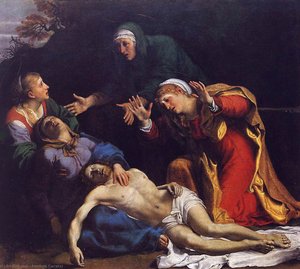
„Pietà” Annibale Carracciego, namalowana w 1599 roku, to poruszające przedstawienie Lamentacji Chrystusa. Obraz ukazuje Maryję Pannę obejmującą martwe ciało Jezusa po jego ukrzyżowaniu, otoczoną dwoma aniołami i inną postacią, prawdopodobnie pomagającą w przygotowaniach do pogrzebu. Kompozycja jest starannie ustrukturyzowana wokół piramidy, z Maryją na jej szczycie, co podkreśla jej centralną rolę w tej scenie głębokiego smutku. Carracci sprawnie wykorzystuje sklepienie łacińskie, aby ujęć postaci, tworząc poczucie zamkniętego przestrzeni i powagi.…

7
The Galleria Farnese (1597) autorstwa Annibale Carracci

The Galleria Farnese

1597 · Fresco · Pałac Farnese, Rzym

To step into the Galleria Farnese within Rome’s Palazzo Farnese is to leave the terrestrial world behind and ascend into a realm of divine drama. Painted by the master Annibale Carracci between 1597 and 1602, this monumental ceiling fresco represents one of the most profound achievements of the Baroque era. It is not merely a decorative surface but an immersive architectural experience that blurs the line between the physical room…

8
Venus, Adonis, and Cupid (1595) autorstwa Annibale Carracci

Venus, Adonis, and Cupid

1595 · Oil On Canvas · Museo del Prado, Madryt

In the grand tapestry of the late sixteenth century, few works capture the burgeoning drama of the Baroque era as intimately as Annibale Carracci’s Venus, Adonis, and Cupid. Painted around 1595, this oil on canvas masterpiece serves as a breathtaking window into the mythological realms of Ovid, where the boundaries between the divine and the mortal blur amidst lush, atmospheric detail. The painting is not merely a depiction of ancient…

9
Assumption of Mary (1587) autorstwa Annibale Carracci

Assumption of Mary

1587 · Oil · Staatliche Kunstsammlungen Dresden, Drezno

The Assumption of Mary by the Italian Baroque artist Annibale Carracci captures a moment of celestial movement. Completed about 1587, the work centers on the religious and triumphal ascent of the Virgin. She rises through the air, leaving the heavy, terrestrial realm behind to enter a space of divine light. The subject matter focuses on this transition from the earthly to the heavenly.

10
Venus with Two Frolicking Cupids (1584) autorstwa Annibale Carracci

Venus with Two Frolicking Cupids

1584 · Oil On Canvas · Bawarskie Państwowe Zbiory Malarstwa, Monachium

In Annibale Carracci’s Venus with Two Frolicking Cupids, the arrangement of figures follows an asymmetrical logic. Venus sits on the left, her body turned toward the two Cupids who occupy the right side of the frame. This weight of presence on one side creates a quiet tension against the movement of the smaller figures. The eye moves from the goddess to the playful, naked forms of the Cupids through a…

Obrazy artysty Annibale Carracci, uszeregowane od 11 do 100 miejsca

11Saint Sebastian (1583) autorstwa Annibale CarracciSaint Sebastian1583 · Staatliche Kunstsammlungen Dresden 12Pietà with St Francis and Mary Magdalene (1607) autorstwa Annibale CarracciPietà with St Francis and Mary Magdalene1607 · Luwr 13Lamentation of Christ (1606) autorstwa Annibale CarracciLamentation of Christ1606 · National Gallery 14Hercules at the Crossroads (1596) autorstwa Annibale CarracciHercules at the Crossroads1596 · Museo di Capodimonte 15Portrait of a Musician (1587) autorstwa Annibale CarracciPortrait of a Musician1587 · Museo di Capodimonte 16The Penitent Magdalen in a Landscape (1598) autorstwa Annibale CarracciThe Penitent Magdalen in a Landscape1598 · Fitzwilliam College 17Lord, whither goest thou. (1602) autorstwa Annibale CarracciLord, whither goest thou.1602 18Polyphemus Attacking Acis and Galatea (1605) autorstwa Annibale CarracciPolyphemus Attacking Acis and Galatea1605 19Hunting (1585) autorstwa Annibale CarracciHunting1585 · Luwr 20Man with Monkey (1591) autorstwa Annibale CarracciMan with Monkey1591 21Pietà (1610) autorstwa Annibale CarracciPietà1610 · Reading Public Museum 22Christ in Glory (1597) autorstwa Annibale CarracciChrist in Glory1597 23Pietà autorstwa Annibale CarracciPietàGaleria Dulwich 24Saint John the Baptist Bearing Witness (1600) autorstwa Annibale CarracciSaint John the Baptist Bearing Witness1600 · Metropolitan Museum of Art 25The Cyclops Polyphemus (1595) autorstwa Annibale CarracciThe Cyclops Polyphemus1595 · Pałac Farnese 26Triumph of Bacchus and Ariadne (1597) autorstwa Annibale CarracciTriumph of Bacchus and Ariadne1597 · Pałac Farnese 27The Flight into Egypt (1603) autorstwa Annibale CarracciThe Flight into Egypt1603 · Galleria Doria Pamphilj 28Christ and the Woman of Samaria (1609) autorstwa Annibale CarracciChrist and the Woman of Samaria1609 · Metropolitan Museum of Art 29Night Bearing Sleep and Death (1602) autorstwa Annibale CarracciNight Bearing Sleep and Death1602 · Musée Condé 30The Baptism of Christ (1603) autorstwa Annibale CarracciThe Baptism of Christ1603 · Kunsthaus Zürich 31Study of a Man's Head (1580) autorstwa Annibale CarracciStudy of a Man's Head1580 · Slovak National Gallery 32The Incredulity of St Thomas (1592) autorstwa Annibale CarracciThe Incredulity of St Thomas1592 · Statens Museum for Kunst 33Il trionfo di Bacco e Arianna. .Galleria Farnese (1598) autorstwa Annibale CarracciIl trionfo di Bacco e Arianna. .Galleria Farnese1598 34The martyre of St Steven Sun (1603) autorstwa Annibale CarracciThe martyre of St Steven Sun1603 35Martyrdom of Saint Andrew (1584) autorstwa Annibale CarracciMartyrdom of Saint Andrew1584 · Bawarskie Państwowe Zbiory Malarstwa 36The Mystical Marriage of St. Catherine (1585) autorstwa Annibale CarracciThe Mystical Marriage of St. Catherine1585 · Museo di Capodimonte 37Mary Magdalene in the Desert autorstwa Annibale CarracciMary Magdalene in the Desert 38Young Bacchante (1584) autorstwa Annibale CarracciYoung Bacchante1584 · Bawarskie Państwowe Zbiory Malarstwa 39The Baptism of Christ (1592) autorstwa Annibale CarracciThe Baptism of Christ1592 · Statens Museum for Kunst 40Male Portrait (1584) autorstwa Annibale CarracciMale Portrait1584 · Bawarskie Państwowe Zbiory Malarstwa 41Omförd till NM 7172. Pietà (1750) autorstwa Annibale CarracciOmförd till NM 7172. Pietà1750 · Nationalmuseum 42Everlasting Father (1604) autorstwa Annibale CarracciEverlasting Father1604 · Museu Nacional d'Art de Catalunya 43The Angel Gabriel in a glory of musician angels and cherubim (1594) autorstwa Annibale CarracciThe Angel Gabriel in a glory of musician angels and cherubim1594 · Musée Condé 44Vision of Saint Francis (1598) autorstwa Annibale CarracciVision of Saint Francis1598 · Detroit Institute of Arts 45Christ Before the Flagellation (1584) autorstwa Annibale CarracciChrist Before the Flagellation1584 · Bawarskie Państwowe Zbiory Malarstwa 46Study for an ignudo (1599) autorstwa Annibale CarracciStudy for an ignudo1599 · National Gallery of Victoria 47The Scholar Agucchi (1584) autorstwa Annibale CarracciThe Scholar Agucchi1584 · Bawarskie Państwowe Zbiory Malarstwa 48Venus with a Satyr and Cupids (1588) autorstwa Annibale CarracciVenus with a Satyr and Cupids1588 · Galleria degli Uffizi 49The Virgin and Child with the Infant Saint John the Baptist (1599) autorstwa Annibale CarracciThe Virgin and Child with the Infant Saint John the Baptist1599 · Museo del Prado 50Love Scattering Flowers (1603) autorstwa Annibale CarracciLove Scattering Flowers1603 · Musée Condé 51Leto (1585) autorstwa Annibale CarracciLeto1585 · Slovak National Gallery 52Domine quo vadis autorstwa Annibale CarracciDomine quo vadis 53Jupiter and Juno autorstwa Annibale CarracciJupiter and Juno 54Landscape with Bathers (1590) autorstwa Annibale CarracciLandscape with Bathers1590 · Bawarskie Państwowe Zbiory Malarstwa 55The Deluge (1584) autorstwa Annibale CarracciThe Deluge1584 · Bawarskie Państwowe Zbiory Malarstwa 56Annunciation (1590) autorstwa Annibale CarracciAnnunciation1590 57Boy Drinking (1582) autorstwa Annibale CarracciBoy Drinking1582 · Cleveland Museum of Art 58Saint Didacus of Alcalá receiving the franciscan habit (1604) autorstwa Annibale CarracciSaint Didacus of Alcalá receiving the franciscan habit1604 · Museo del Prado 59The Holy Family with Saint Francis (1584) autorstwa Annibale CarracciThe Holy Family with Saint Francis1584 60Head of an old woman (1590) autorstwa Annibale CarracciHead of an old woman1590 · Fitzwilliam Museum 61Christ Head (1589) autorstwa Annibale CarracciChrist Head1589 · Staatliche Kunstsammlungen Dresden 62Head of a Man in Profile (1591) autorstwa Annibale CarracciHead of a Man in Profile1591 · Royal Collection 63The Deposition (1592) autorstwa Annibale CarracciThe Deposition1592 · Statens Museum for Kunst 64Madonna with Cherries (1593) autorstwa Annibale CarracciMadonna with Cherries1593 65St. Magdalene in the Desert (1591) autorstwa Annibale CarracciSt. Magdalene in the Desert1591 66Dawn Scattering Flowers and Holding a Torch (1602) autorstwa Annibale CarracciDawn Scattering Flowers and Holding a Torch1602 · Musée Condé 67Portrait of a Young Man with a Goatee (Self-portrait?) (1600) autorstwa Annibale CarracciPortrait of a Young Man with a Goatee (Self-portrait?)1600 · Bawarskie Państwowe Zbiory Malarstwa 68Saint Didacus of Alcalá receiving alms (1604) autorstwa Annibale CarracciSaint Didacus of Alcalá receiving alms1604 · Museo del Prado 69The Vision of St. Francis (1597) autorstwa Annibale CarracciThe Vision of St. Francis1597 · Narodowa Galeria Kanady 70Tobit heals his father's eyes (1600) autorstwa Annibale CarracciTobit heals his father's eyes1600 · Gemäldegalerie Alte Meister im Schloss Wilhelmshöhe 71Christ and the Samaritan Woman (1595) autorstwa Annibale CarracciChrist and the Samaritan Woman1595 · Szépművészeti Múzeum 72The Agony in the Garden (1596) autorstwa Annibale CarracciThe Agony in the Garden1596 · Royal Collection 73Saint Peter (1604) autorstwa Annibale CarracciSaint Peter1604 · Museu Nacional d'Art de Catalunya 74Mural paintings from the Herrera Chapel (1604) autorstwa Annibale CarracciMural paintings from the Herrera Chapel1604 · Museu Nacional d'Art de Catalunya 75Apparition of Saint Didacus above his sepulchre (1605) autorstwa Annibale CarracciApparition of Saint Didacus above his sepulchre1605 · Museu Nacional d'Art de Catalunya 76Saint Paul (1604) autorstwa Annibale CarracciSaint Paul1604 · Museu Nacional d'Art de Catalunya 77Saint Didacus Preaching (1605) autorstwa Annibale CarracciSaint Didacus Preaching1605 · Museu Nacional d'Art de Catalunya 78Miracle of the Roses (1605) autorstwa Annibale CarracciMiracle of the Roses1605 · Museu Nacional d'Art de Catalunya 79Assumption of the Virgin Mary (1604) autorstwa Annibale CarracciAssumption of the Virgin Mary1604 · Museu Nacional d'Art de Catalunya 80Apostles around the Sepulchre of the Virgin Mary (1604) autorstwa Annibale CarracciApostles around the Sepulchre of the Virgin Mary1604 · Museu Nacional d'Art de Catalunya 81Nativity (1600) autorstwa Annibale CarracciNativity1600 82Infant Hercules Strangling the Serpents (1599) autorstwa Annibale CarracciInfant Hercules Strangling the Serpents1599 83Venus and Anchises (1600) autorstwa Annibale CarracciVenus and Anchises1600 84Römische Landschaft (1600) autorstwa Annibale CarracciRömische Landschaft1600 85Hercules at the Crossroads (1595) autorstwa Annibale CarracciHercules at the Crossroads1595 86The Flight into Egypt (1603) autorstwa Annibale CarracciThe Flight into Egypt1603 · Galleria Doria Pamphilj 87San Diego saves the boy asleep in the oven (1604) autorstwa Annibale CarracciSan Diego saves the boy asleep in the oven1604 · Museo del Prado 88St John the Baptist (1592) autorstwa Annibale CarracciSt John the Baptist1592 · Statens Museum for Kunst 89The Crucifixion (1587) autorstwa Annibale CarracciThe Crucifixion1587 · Yale University Art Gallery 90Christ and the Woman of Samaria (1605) autorstwa Annibale CarracciChrist and the Woman of Samaria1605 · Kunsthistorisches Museum 91Venus, Adonis and Cupid (1591) autorstwa Annibale CarracciVenus, Adonis and Cupid1591 · Museo del Prado 92Portrait of Giovanni Gabrieli with the lute (1600) autorstwa Annibale CarracciPortrait of Giovanni Gabrieli with the lute1600 · Staatliche Kunstsammlungen Dresden 93Sheet of caricatures (1595) autorstwa Annibale CarracciSheet of caricatures1595 · British Museum 94Translation of the Holy House (1605) autorstwa Annibale CarracciTranslation of the Holy House1605 · Sant'Onofrio 95Rinaldo and Armida (1601) autorstwa Annibale CarracciRinaldo and Armida1601 · Museo di Capodimonte 96Landscape with River Scene (1590) autorstwa Annibale CarracciLandscape with River Scene1590 · Bawarskie Państwowe Zbiory Malarstwa 97a man with a monkey - oil on canvas - (1591) autorstwa Annibale Carraccia man with a monkey - oil on canvas -1591 98venus with satyr and cupids - oil on paper - (1588) autorstwa Annibale Carraccivenus with satyr and cupids - oil on paper -1588 99Baptism of Christ (1584) autorstwa Annibale CarracciBaptism of Christ1584 100Mercury protecting Ulysses from the charms of Circe (1590) autorstwa Annibale CarracciMercury protecting Ulysses from the charms of Circe1590

Słynne obrazy Annibale Carracci epoka po epoce

Tematy, które przyciągnęły wzrok Annibale Carracci

Cztery motywy najczęściej powracające w tych oryginałach, z których każdy doczekał się swojego najdoskonalszego przykładu.

Muzea przechowujące oryginały Annibale Carracci

8 muzeów, w których znajduje się najwięcej obrazów z tej strony.

Muzea Miasto Dzieła artysty Annibale Carracci Obrazy z tej listy
Bawarskie Państwowe Zbiory Malarstwa, MonachiumBawarskie Państwowe Zbiory Malarstwa Monachium 10 Venus with Two Frolicking Cupids, Martyrdom of Saint Andrew, Young Bacchante
Museu Nacional d'Art de Catalunya, BarcelonaMuseu Nacional d'Art de Catalunya Barcelona 10 Everlasting Father, Saint Peter, Mural paintings from the Herrera Chapel
Museo di Capodimonte, NapoliMuseo di Capodimonte Napoli 15 The Choice of Heracles, Wybor Heraklesa, Pietà
Museo del Prado, MadrytMuseo del Prado Madryt 12 Venus, Adonis, and Cupid, The Virgin and Child with the Infant Saint John the Baptist, Saint Didacus of Alcalá receiving the franciscan habit
Staatliche Kunstsammlungen Dresden, DreznoStaatliche Kunstsammlungen Dresden Drezno 5 Assumption of Mary, Saint Sebastian, Christ Head
Musée Condé, ChantillyMusée Condé Chantilly 5 Night Bearing Sleep and Death, The Angel Gabriel in a glory of musician angels and cherubim, Love Scattering Flowers
Statens Museum for Kunst, KopenhagaStatens Museum for Kunst Kopenhaga 5 The Incredulity of St Thomas, The Baptism of Christ, The Deposition
Pałac Farnese, RzymPałac Farnese Rzym 5 The Galleria Farnese, The Cyclops Polyphemus, Triumph of Bacchus and Ariadne

Annibale Carracci, jedno kultowe dzieło na dekadę

Dzieła według dekad

Wybierz dekadę, aby zobaczyć dzieło, które ją definiuje.

Obrazy artysty Annibale Carracci: odpowiedzi galerii

Który obraz Annibale Carracci jest najsłynniejszy ze wszystkich?Odkryj odpowiedź

The beaneater Sun, Palazzo Colonna, Rome. Następne są The Choice of Heracles oraz Wybor Heraklesa (1596).

Które to 10 najlepszych obrazów Annibale Carracci?Odkryj odpowiedź

The beaneater Sun, The Choice of Heracles, Wybor Heraklesa, Krajobraz rzeki, Mocking of Christ, Pietà, The Galleria Farnese, Venus, Adonis, and Cupid, Assumption of Mary i Venus with Two Frolicking Cupids. Powyższy ranking zawiera rok powstania oraz muzeum dla każdego z nich.

Ile dzieł stworzył/a Annibale Carracci?Odkryj odpowiedź

Nasz katalog zawiera 282 dzieł artysty Annibale Carracci, datowanych od 1580 do 1609.

Gdzie można znaleźć najsłynniejsze oryginały autorstwa Annibale Carracci?Odkryj odpowiedź

W większości znajdują się w Bawarskie Państwowe Zbiory Malarstwa (Monachium), Museu Nacional d'Art de Catalunya (Barcelona) i Museo di Capodimonte (Napoli). Powyższa tabela muzeów zawiera ich pełną listę.

Kiedy Annibale Carracci stworzył swoje najsłynniejsze obrazy?Odkryj odpowiedź

W 1590s: 36 z 100 dzieł na tej stronie powstało w tym czasie, w tym Wybor Heraklesa.

Które z najsłynniejszych dzieł Annibale Carracci należą do jego najwcześniejszych i najpóźniejszych prac?Odkryj odpowiedź

Na tej stronie najwcześniejszy to Study of a Man's Head (1580), a najpóźniejszy Christ and the Woman of Samaria (1609).

Do jakich tematów Annibale Carracci powracał najczęściej?Odkryj odpowiedź

Man (38), Woman (29) i Drapery (18), w ramach 100 dzieł na tej stronie.

W jakiej technice najczęściej tworzył Annibale Carracci?Odkryj odpowiedź

Oil On Canvas, dla 46 z 100 dzieł na tej stronie.

Z jakim nurtem związany jest Annibale Carracci?Odkryj odpowiedź

Baroque drama, sądząc po oryginałach na tej stronie.

Które oryginały artysty Annibale Carracci znajdują się w zbiorach Bawarskie Państwowe Zbiory Malarstwa?Odkryj odpowiedź

Venus with Two Frolicking Cupids, Martyrdom of Saint Andrew i Young Bacchante: Bawarskie Państwowe Zbiory Malarstwa, Monachium posiada 10 dzieł widocznych na tej stronie.

Annibale Carracci: artysta

Early Life and the Bolognese Roots

Annibale Carracci, born on November 3, 1560, in Bologna, was a product of a family deeply intertwined with the artistic traditions of his city. His early life wasn’t marked by privilege or formal training in the conventional sense; rather, it unfolded within the nurturing environment of his father’s workshop—a modest tailor’s shop—where he absorbed the values and skills associated with craftsmanship. This grounding in practical artistry laid a crucial foundation for his later development as a painter, instilling in him an appreciation for meticulous detail, skillful execution, and a connection to the tangible world.

Bologna at the close of the 16th century was a city brimming with intellectual ferment—a vibrant crossroads where humanist ideals mingled with burgeoning artistic innovation. Yet, it also possessed a certain provincialism, a sense that it lagged behind the dominant currents flowing from Rome and Venice, centers of unparalleled artistic power. This awareness fueled within Annibale and his brother Agostino, along with their cousin Ludovico Carracci, a desire to forge their own path—to create an art that would not merely imitate the masters but also revitalize Italian painting by drawing upon the legacy of the High Renaissance while simultaneously embracing a more naturalistic approach.

The Carracci family’s artistic lineage extended beyond Annibale himself. His grandfather, Francesco Carracci, had been a painter for the Gonzaga court in Mantua, and his father, Antonio, continued this tradition, working as a tailor before transitioning to painting. This familial connection provided Annibale with an early exposure to the world of art, fostering within him a deep respect for artistic skill and a sense of belonging to a creative lineage.

The Accademia degli Incamminati: A Crucible of Innovation

In 1582, this ambition materialized in the establishment of the *Accademia degli Incamminati*, initially known as the Academy of the Desiderosi. This wasn’t simply a studio; it was a revolutionary institution—a crucible for artistic innovation, a space dedicated to rigorous life drawing, spirited debate, and a collective pursuit of artistic excellence. The academy's name itself—the “Progressives”—signified their intent: to move beyond the stylistic complexities of Mannerism and chart a new course toward a more grounded, emotionally resonant form of expression.

The Incamminati became a model for art academies across Europe, emphasizing observation from life as the cornerstone of artistic training. They rejected the prevailing reliance on memory drawings and idealized forms, advocating instead for direct engagement with the human body—a radical shift that would profoundly influence the course of Italian painting. The academy’s members—Annibale, Agostino, and Ludovico—collaborated closely, sharing ideas, critiquing each other's work, and pushing one another to strive for greater technical mastery and artistic vision.

The *Accademia degli Incamminati* wasn’t merely a place of instruction; it was also a social hub where artists engaged in lively discussions about art history, theory, and technique. They studied the works of the Old Masters—Raphael, Andrea del Sarto, Michelangelo—analyzing their compositions, color palettes, and methods of rendering form. This intellectual engagement informed their own artistic practice, allowing them to synthesize diverse influences and develop a unique style that would distinguish them from their contemporaries.

A Synthesis of Styles and Influences

Carracci’s artistic vision wasn't born in a vacuum; it was meticulously crafted through a deep engagement with the legacies of past masters. He possessed an extraordinary ability to synthesize diverse influences, creating a style that felt both deeply rooted in tradition and strikingly original. He admired the clarity of line and compositional balance found in the works of Raphael and Andrea del Sarto, seeking to emulate their grace and harmony. Yet, he also recognized the power of color and atmospheric effects championed by Venetian painters like Titian, infusing his own work with a vibrant luminosity and emotional depth.

The influence of Correggio was particularly profound, evident in Carracci’s dynamic compositions and illusionistic techniques—especially those showcased in his frescoes. He wasn't simply copying these masters; he was absorbing their strengths and forging them into something new. This eclectic blend became the hallmark of the Bolognese School, a significant branch of Baroque art that emphasized both classical ideals and naturalistic observation. Carracci’s genius lay in his ability to reconcile seemingly disparate elements, creating a harmonious whole that resonated with both intellectual rigor and emotional power.

The Roman Triumph: Palazzo Farnese and Beyond

The invitation to decorate the Palazzo Farnese in Rome marked a pivotal moment in Annibale Carracci’s career. This monumental commission—a vast fresco cycle depicting scenes from mythology—provided him with an unparalleled opportunity to showcase his artistic prowess and establish his reputation on a grand scale. The *Triumph of Bacchus and Ariadne*, arguably his masterpiece, is a breathtaking display of illusionistic technique, dynamic composition, and vibrant color. The frescoes seem to dissolve the boundaries between painting and reality, drawing the viewer into a world of mythic grandeur.

Alongside the *Triumph*, Carracci also undertook *The Loves of the Gods* at Palazzo Farnese, further exploring themes of mythology and love with a blend of classical idealism and keen observation. These works weren’t merely decorative; they were statements about the power of art to elevate the human spirit and celebrate the beauty of the natural world. His success in Rome solidified his position as one of the leading artists of his time, attracting a stream of commissions and influencing generations of painters.

Legacy and Historical Significance

Annibale Carracci’s impact on art history is immeasurable. He played a crucial role in bridging the gap between the High Renaissance and the Baroque period, moving away from the stylized complexities of Mannerism toward a more dynamic, emotionally charged aesthetic. His emphasis on naturalism—on depicting figures with anatomical accuracy and psychological depth—paved the way for artists like Caravaggio, who would further revolutionize Italian painting with their dramatic use of light and shadow.

The Accademia degli Incamminati, founded by Carracci and his associates, served as a model for art academies across Europe, promoting artistic training based on observation and classical principles. His frescoes at Palazzo Farnese remain iconic examples of Baroque illusionism and artistic grandeur, continuing to inspire awe and admiration centuries after their creation. The collective legacy of the Carracci family—Annibale, Agostino, and Ludovico—is one of profound innovation and enduring influence, establishing Bologna as a major center for artistic creativity.