A Florentine Renaissance Polymath: The World of Andrea del Verrocchio
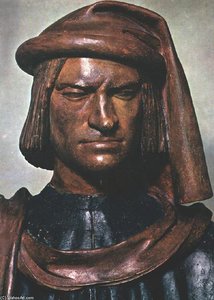
Andrea di Michele di Francesco de’ Cioni, a name forever intertwined with the brilliance of the Italian Renaissance, is best known as Andrea del Verrocchio. Born in Florence around 1435, his life coincided with an era of unprecedented artistic and intellectual transformation – a period he profoundly shaped through his extraordinary talent as a sculptor, painter, goldsmith, and master craftsman. While today celebrated for monumental works like the equestrian statue of Bartolomeo Colleoni, Verrocchio’s legacy extends far beyond individual masterpieces; it resides in the very foundation he laid for generations of artists, most notably Leonardo da Vinci. His early training remains somewhat shrouded in mystery, though his family background – a lineage rooted in goldsmithing – undoubtedly provided an initial grounding in the meticulous techniques and aesthetic sensibilities of Florentine artisanal traditions. Speculation persists regarding apprenticeships under masters like Donatello or Fra Filippo Lippi, yet concrete evidence is scarce. Regardless, Verrocchio rapidly demonstrated a remarkable aptitude for both sculpture and painting, seamlessly blending these disciplines into a cohesive artistic vision that would define his career.From Goldsmith to Sculptor: A Rising Star in Florence
Verrocchio’s ascent within the Florentine art world was fueled by an exceptional skill set combined with the patronage of some of the city's most powerful families, particularly the influential Medici clan. His early works reveal a developing mastery of form and a growing ambition to tackle increasingly complex subjects. The *Putto with a Dolphin*, created around 1470, exemplifies his ability to capture movement and emotion in bronze – qualities that would become hallmarks of his distinctive style. However, it was through larger-scale commissions that Verrocchio truly established his reputation. He wasn’t merely executing designs; he was overseeing an entire workshop, meticulously coordinating the efforts of assistants while maintaining a consistently high level of artistic quality. This organizational prowess, coupled with his visionary approach, enabled him to undertake ambitious projects like the *David*, a marble sculpture that reflects both classical influences and a uniquely Florentine sensibility. The equestrian statue of Bartolomeo Colleoni, commissioned for Venice and completed posthumously in 1488, stands as Verrocchio’s undisputed masterpiece – a colossal bronze monument embodying Renaissance ideals of civic virtue and military prowess. Its dynamic composition, anatomical accuracy, and sheer scale demonstrate an unparalleled technical skill and artistic ambition. The statue remains a powerful symbol of Florentine power and artistry.A Painter's Hand: Collaboration and Legacy
While primarily recognized as a sculptor, Verrocchio’s contributions to painting should not be underestimated, particularly considering his pivotal role in the development of one of history’s greatest artists – Leonardo da Vinci. The *Baptism of Christ*, painted around 1472-1475, is perhaps his most famous painted work, though it's renowned for what it reveals about another: Leonardo. Verrocchio initially painted John the Baptist and one angel within the composition, while Leonardo – then a young apprentice in his workshop – was entrusted with painting the other angel and portions of the background landscape. The sheer quality of Leonardo’s contribution is said to have so profoundly impressed Verrocchio that he allegedly abandoned painting altogether—a story likely embellished but indicative of the transformative impact Verrocchio had on Leonardo's artistic journey. Other paintings attributed primarily to Verrocchio, such as *The Virgin and Child with Two Angels*, demonstrate his ability to create serene and emotionally resonant religious scenes. These works reveal a delicate touch and a sensitivity to light and color that further solidify his position as a versatile and accomplished artist. The influence of Verrocchio’s artistic principles can be seen in Leonardo's early works, particularly the subtle sfumato technique he pioneered.Technique and Materials: A Master Craftsman
Verrocchio’s mastery extended beyond mere aesthetic sensibility; he was a meticulous craftsman deeply knowledgeable about materials and techniques. His work with bronze is particularly noteworthy – he developed innovative methods for casting and patinating, achieving remarkable effects of texture and luminosity. He employed lost-wax casting, a complex process that allowed him to create intricate details and achieve a stunningly realistic finish. His use of marble was equally impressive, demonstrating an understanding of the stone’s inherent qualities and how to exploit them to create dynamic forms. Verrocchio's workshop was a hub of experimentation, where assistants like Leonardo were encouraged to explore new techniques and materials. This collaborative environment fostered innovation and contributed to the development of Renaissance art as a whole. The use of tempera on panel in his paintings demonstrates an understanding of layering pigments and achieving depth and richness of color.The Enduring Influence of the Verrocchio Workshop
Andrea del Verrocchio’s legacy extends far beyond his individual artworks. His greatest contribution may well have been the workshop he established, which served as a training ground for a generation of talented artists. Leonardo da Vinci is, of course, the most celebrated pupil, but others – including Pietro Perugino and Lorenzo di Credi – also honed their skills under Verrocchio’s guidance. The workshop system itself was crucial to the flourishing artistic environment of Renaissance Florence, fostering collaboration, innovation, and a shared pursuit of excellence. Verrocchio's influence can be seen in the works of his students, who carried forward his emphasis on anatomical accuracy, dynamic composition, and technical mastery. He played a vital role in shaping the direction of Florentine sculpture, blending classical influences with innovative techniques to create a style that was both elegant and powerful. His work embodies the spirit of the Early Renaissance – a renewed interest in classical art, humanism, and naturalistic representation – while simultaneously paving the way for the artistic achievements of the High Renaissance. He died in Venice around 1488, leaving behind a legacy that continues to inspire artists and captivate audiences centuries later.Pytania i odpowiedzi
Czy mogę przeglądać dzieła Andrzej del Verrocchio według spektrum kolorów?
Strona Indeks barwny grupuje dzieła Andrzej del Verrocchio według kolorów.
Gdzie można znaleźć dzieła Andrzej del Verrocchio pogrupowane według palety barw?
Prace artysty Andrzej del Verrocchio można przeglądać według palety kolorystycznej na stronie Według palet kolorystycznych artysty.
Pod jakimi innymi nazwiskami znany jest Andrzej del Verrocchio?
Andrzej del Verrocchio występuje również pod innymi nazwiskami: Andrea del Verrocchio, Andrea di Michele di Francesco de Cioni.