Portret Aleksandra Ekster

49 najsłynniejszych obrazów artysty Aleksandra Ekster, każdy niepowtarzalny

Aktualizacja: Listopad 2026 · ranking według naszego wskaźnika popularności (liczba wyszukiwań, wizyt i zamówień dla każdego dzieła) · 49 dzieł Aleksandra Ekster w naszym katalogu

W skrócie

Venice (1924) to obraz autorstwa Aleksandra Ekster, który przyciąga najwięcej spojrzeń. Następnie wzrok kieruje się na Color construction (1912) i Bridge. Sevres (1912). Spośród 49 dzieł Aleksandra Ekster w naszym katalogu, tych 49 jest najbardziej znanych – każde z nich to unikatowy oryginał, przedstawiony wraz z rokiem powstania, muzeum oraz powodem, dla którego przetrwało próbę czasu.

1882 – 1949, Białystok Cubo-futurism Najwięcej dzieł: MoMA - Museum of Modern Art

10 najlepszych obrazów autorstwa Aleksandra Ekster według oka galerii

1
Venice (1924) autorstwa Aleksandra Ekster

Venice

1924 · Painting

The painting titled Venice was created by the artist Aleksandra Ekster. This work was produced in 1924. The piece was inspired by the city of Venice, following the artist's presence in that location during the spring of 1924. During this period, Ekster traveled to Venice to participate in the organization of the 14th Venice Biennale.

2
Color construction (1912) autorstwa Aleksandra Ekster

Color construction

1912 · Painting

To stand before Aleksandra Ekster's Color construction is not merely to observe paint on canvas; it is to step into a vibrant, intellectual dialogue with the dawn of modern abstraction. Created in 1912, this seminal work stands as a breathtaking testament to the burgeoning power of geometric form and pure color. It captures a moment in art history when representation began to dissolve, giving way to an exhilarating exploration of…

3
Bridge. Sevres (1912) autorstwa Aleksandra Ekster

Bridge. Sevres

1912 · Painting

is a work by Aleksandra Ekster, executed in 1912. The artist, born in 1882 in Białystok, Poland, was a central figure in the early 20th-century avant-garde. Her practice bridged various international movements, integrating diverse stylistic currents into a singular visual language.

4
City (1913) autorstwa Aleksandra Ekster

City

1913 · Painting

Aleksandra Ekster’s City, painted about 1913, presents a fractured urban landscape composed of diverse buildings and structures. The composition utilizes a variety of colors and geometric shapes to define the architectural forms. Amidst the structural density, several umbrellas are scattered throughout the scene, providing rhythmic visual interruptions to the verticality of the buildings.

5
Venice (1915) autorstwa Aleksandra Ekster

Venice

1915 · Painting

Aleksandra Ekster produced Venice in 1924. The work emerged from the artist's presence in the city during the spring of that year. Her time in Venice was marked by her involvement in the organization of the 14th Venice Biennale.

6
'Costume Design for the play ''Famira Kifared''' (1916) autorstwa Aleksandra Ekster

'Costume Design for the play ''Famira Kifared'''

1916 · Gouache

A single figure dominates the composition, captured in a moment of dramatic tension. The subject wears a striking red hat that anchors the viewer's gaze against a deep blue background. A black vest provides a dark, structured contrast to the intensity of the headwear, while a sword held in hand suggests a character of action or conflict. The facial expression is fierce, bordering on the grotesque, signaling a departure from…

7
Futuristic composition (1918) autorstwa Aleksandra Ekster

Futuristic composition

1918 · Oil

The canvas presents Futuristic composition, a work that pulses with the energy of 1918. Aleksandra Ekster, the hand behind this piece, captures a moment of intense movement through her unique vision. Born in 1882 in Białystok, Poland, she brings a cosmopolitan perspective to this specific arrangement of form and color. The work exists as a snapshot of a world in transition, where the boundaries of traditional representation begin to dissolve…

8
City at Night (1919) autorstwa Aleksandra Ekster

City at Night

1919 · Painting

In City at Night by Aleksandra Ekster, the urban landscape is rendered through a series of colorful buildings that dominate the view. These structures are defined by numerous windows, creating a rhythmic pattern across the facade. The palette is lively, using intense colors to define the architectural forms and the energy of the nocturnal setting. It is a scene that captures the pulse of a bustling environment through a careful…

9
Cubist Nude (1912) autorstwa Aleksandra Ekster

Cubist Nude

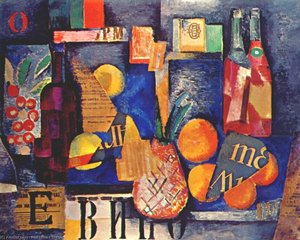
1912 · Oil On Canvas · MoMA - Museum of Modern Art, Nowy Jork

In Cubist Nude, Aleksandra Ekster deconstructs the human form into a complex arrangement of intersecting geometric planes. The composition centers on a seated nude figure, whose anatomy is fragmented into various angular facets. Lines serve a dual purpose, defining the contours of the limbs while establishing sharp, intersecting boundaries between distinct colored planes. Shapes vary significantly across the canvas, ranging from large, sweeping curves in the torso to small, jagged…

10
Satanic Ballet (1922) autorstwa Aleksandra Ekster

Satanic Ballet

1922 · Ink On Paper

In this work, titled Satanic Ballet, we encounter the precise, energetic vision of Aleksandra Ekster. Created in 1922, the piece reflects a moment of profound transition in the early twentieth-century avant-garde. Ekster was a painter who navigated the complexities of both Suprematism and Constructivism, moving through these radical movements with a distinct sense of purpose. Her approach to form and space suggests a deep understanding of the structural logic that…

Słynne obrazy artysty Aleksandra Ekster, od 11 do 49

Tematy, które przyciągnęły wzrok Aleksandra Ekster

Cztery motywy najczęściej powracające w tych oryginałach, z których każdy doczekał się swojego najdoskonalszego przykładu.

Muzea przechowujące oryginały Aleksandra Ekster

6 muzeów, w których znajduje się najwięcej obrazów z tej strony.

Muzea Miasto Dzieła artysty Aleksandra Ekster Obrazy z tej listy
MoMA - Museum of Modern Art, Nowy JorkMoMA - Museum of Modern Art Nowy Jork 3 Cubist Nude, Theatrical Composition, Construction
Minneapolis Institute of Art, MinneapolisMinneapolis Institute of Art Minneapolis 1 Italian Town by the Sea
National Gallery of Australia, CanberraNational Gallery of Australia Canberra 1 The music lesson
Cleveland Museum of Art, ClevelandCleveland Museum of Art Cleveland 1 Landscape with Houses and Trees
Thyssen-Bornemisza Museum, MadrytThyssen-Bornemisza Museum Madryt 1 Still Life
Państwowe Muzeum Sztuki Ukrainy, KyivPaństwowe Muzeum Sztuki Ukrainy Kyiv 1 Three Female Figures

Aleksandra Ekster na przestrzeni dekad: jeden unikatowy oryginał dla każdego

Dzieła według dekad

Wybierz dekadę, aby zobaczyć dzieło, które ją definiuje.

Obrazy artysty Aleksandra Ekster: pytania do galerii

Jakie jest najsłynniejsze dzieło artysty Aleksandra Ekster?Odkryj odpowiedź

Venice (1924). Następne są Color construction (1912) oraz Bridge. Sevres (1912).

W jakim wieku Aleksandra Ekster stworzył/a Venice?Odkryj odpowiedź

42 lat: Venice pochodzi z 1924, a Aleksandra Ekster urodził(a) się w 1882.

Które dziesięć obrazów Aleksandra Ekster jest najbardziej znanych?Odkryj odpowiedź

Venice, Color construction, Bridge. Sevres, City, Venice, 'Costume Design for the play ''Famira Kifared''', Futuristic composition, City at Night, Cubist Nude i Satanic Ballet. Powyższy ranking zawiera rok powstania oraz muzeum dla każdego z nich.

Ile znanych dzieł stworzył Aleksandra Ekster?Odkryj odpowiedź

Nasz katalog zawiera 49 dzieł artysty Aleksandra Ekster, datowanych od 1910 do 1938.

Gdzie można zobaczyć najsłynniejsze oryginały Aleksandra Ekster?Odkryj odpowiedź

W większości znajdują się w MoMA - Museum of Modern Art (Nowy Jork), Minneapolis Institute of Art (Minneapolis) i National Gallery of Australia (Canberra). Powyższa tabela muzeów zawiera ich pełną listę.

W jakim okresie Aleksandra Ekster stworzył/a swoje najsłynniejsze obrazy?Odkryj odpowiedź

W 1910s: 27 z 49 dzieł na tej stronie powstało w tym czasie, w tym Color construction.

Który z najsłynniejszych obrazów artysty Aleksandra Ekster powstał najwcześniej, a który najpóźniej?Odkryj odpowiedź

Na tej stronie najwcześniejszy to Still life (1910), a najpóźniejszy View of the bridge (1938).

Jakie tematy preferował Aleksandra Ekster?Odkryj odpowiedź

Buildings (10), Arts (8) i Designs and sketches (8), w ramach 49 dzieł na tej stronie.

Jakich materiałów Aleksandra Ekster używał najczęściej?Odkryj odpowiedź

Painting, dla 6 z 49 dzieł na tej stronie.

Do jakiego nurtu należy twórczość Aleksandra Ekster?Odkryj odpowiedź

Cubo-futurism, sądząc po oryginałach na tej stronie.

Jakie oryginały Aleksandra Ekster można zobaczyć w MoMA - Museum of Modern Art?Odkryj odpowiedź

Cubist Nude, Theatrical Composition i Construction: MoMA - Museum of Modern Art, Nowy Jork posiada 3 dzieł widocznych na tej stronie.

Aleksandra Ekster: portret artysty

Aleksandra Ekster: A Pioneer of Russian Avant-Garde

Aleksandra Ekster, a name now synonymous with the vibrant energy and radical experimentation of early 20th-century Russia, was far more than simply a painter; she was a pivotal figure in shaping the cultural landscape of her time. Born Aleksandra Aleksandrovna Grigorovich on January 6, 1882, in Białystok – then part of the Russian Empire, now Poland – her life unfolded against a backdrop of profound social and artistic transformation. Her upbringing within a prosperous Belarusian family provided her with an exceptional education, nurturing a keen intellect and a deep appreciation for art, music, and languages—qualities that would prove instrumental throughout her remarkable career. The move to Kyiv proved to be a crucial turning point, as it was there she received formal training at the Kyiv School of Art, encountering fellow artists like Alexander Bogomazov and Alexander Archipenko – individuals who would become lifelong collaborators and intellectual sparring partners, forming the core of a burgeoning artistic community. Even in her early works, Ekster demonstrated an innate ability to synthesize diverse influences, foreshadowing the complex and layered style that would define her later career. Her studio quickly became a hub for creative exchange, attracting poets like Anna Akhmatova and Osip Mandelstam, writers such as Ilya Ehrenburg, and dancers including Bronislava Nijinska—a testament to her magnetic personality and artistic vision.

Embracing Innovation: From Cubo-Futurism to Suprematism

Ekster’s artistic journey was characterized by an insatiable curiosity and a willingness to embrace the most radical innovations of her time. A pivotal moment arrived with her relocation to Paris in 1907, alongside her husband Nikolai Ekster. The Parisian art scene—a crucible of experimentation and intellectual ferment—proved to be profoundly transformative. Exposure to the groundbreaking work of Pablo Picasso, Georges Braque, and other Cubist pioneers ignited a passion for fragmentation, geometric abstraction, and the exploration of multiple perspectives. Returning to Russia in 1908, Ekster immediately immersed herself in the vibrant artistic circles of St. Petersburg and Kyiv, contributing significantly to exhibitions that showcased the latest developments in avant-garde art. Her early paintings reflect this Cubist influence, characterized by fractured forms, dynamic compositions, and a deliberate rejection of traditional representational techniques. However, she quickly moved beyond mere imitation, incorporating elements of Futurism—with its emphasis on movement, speed, and the dynamism of modern life—into her work. This fusion of influences – Cubo-Futurism – resulted in paintings that were both intellectually stimulating and visually arresting, capturing the energy and uncertainty of a rapidly changing world. Crucially, she wasn’t simply adopting these movements; she was actively shaping them, bringing a distinctly Russian sensibility to their core principles.

A Synthesis of Styles: Constructivism and Beyond

The tumultuous years following the 1917 Revolution saw Ekster at the forefront of Russia's artistic experimentation. The collapse of the old order created an unprecedented opportunity for artists to reimagine society through art, leading to the rise of Constructivism—a movement that sought to integrate art into everyday life and serve practical purposes. Influenced by figures like Kazimir Malevich, Ekster embraced the principles of geometric abstraction and explored new ways of representing space and form. She collaborated with other Constructivist artists on ambitious projects, including designing abstract motifs for street decorations in Kyiv—a bold statement of artistic expression within a rapidly transforming urban landscape. Her work during this period is characterized by its clarity, precision, and functional aesthetic, reflecting the Constructivist ideal of creating art that was both beautiful and useful. However, Ekster’s artistic vision remained remarkably diverse, encompassing stage design, book illustrations, and fashion—demonstrating her versatility and willingness to experiment with different media. Her designs for theatrical productions, particularly those created in collaboration with Alexander Tairov, were groundbreaking, transforming the visual experience of opera and ballet through abstract sets and innovative costumes.

The Legacy of a Parisian Visionary

Following the Revolution, Ekster sought refuge in Paris, where she continued to teach and exhibit her work. This period marked a shift towards greater refinement and decorative elegance, as evidenced by her exquisite *Callimaque* manuscript—a stunning translation of Callimachus’ hymns adorned with intricate gouache illustrations. Her Parisian studio became a gathering place for artists, writers, and intellectuals from around the world, solidifying her position as a leading figure in the international art scene. She mentored numerous young artists, fostering a spirit of experimentation and innovation that would continue to shape the course of modern art. Despite facing challenges during her lifetime—including periods of exile and financial hardship—Ekster’s legacy has grown steadily over time, recognized for its profound influence on Russian and European art history. Her work continues to inspire artists today, demonstrating the enduring power of artistic vision and the importance of embracing innovation.

A Lasting Influence: Ekster's Enduring Impact

Aleksandra Ekster’s significance lies not in adherence to a single style, but rather in her ability to synthesize diverse artistic currents – Cubo-Futurism, Suprematism, and Constructivism – into a uniquely personal visual language. Her paintings embody the spirit of experimentation and innovation that defined the Russian avant-garde, while simultaneously reflecting a cosmopolitan sensibility shaped by her travels and interactions with artists across Europe. She was a master colorist, employing bold hues and dynamic compositions to create works that are both intellectually stimulating and emotionally resonant. Her contributions to stage design were equally groundbreaking, transforming the theatrical experience through abstract sets and innovative costumes. Ekster’s legacy extends beyond her paintings; she was a dedicated educator who inspired countless students to embrace artistic freedom and explore new possibilities. Her influence can be seen in the work of subsequent generations of artists – her ideas continue to resonate with contemporary designers and thinkers. She remains a vital figure in the history of modern art, a testament to the power of creativity and the enduring allure of artistic innovation.