Vibrant Abstraction: A Pioneering Work of Modern Art Wassily Kandinsky's *First Abstract Watercolor* is a landmark piece in the history of modern art, marking his transition into pure abstraction. Created in 1910, this dynamic composition embodies th...
The mid-twentieth century did not merely witness a change in style; it experienced a seismic rupture from the traditions of representation. Following the profound displacements of the Great Depression and the global trauma of World War II, the center of the art world migrated from the established salons of Paris to the restless energy of New York. This shift was driven by an urgent need to articulate a reality that could no longer be captured through literal depiction. Artists began to look inward, utilizing the legacies of European Modernism, Cubism, and Surrealism not as templates for imitation, and instead as tools for mining the subconscious.
This period of transition found its early echoes in the works of Wassily Kandinsky, whose First Abstract Watercolor signaled a departure from the objective world toward a spiritualized abstraction. Much like the later Abstract Expressionists, Kandinsky sought to convey unseen energies through color and form. The movement that followed would take this impulse further, stripping away all narrative constraints to find truth in pure, non-objective expression. It was an era where the canvas ceased to be a window onto a scene and became a site of profound psychological exploration.
The Canvas as Arena: Decoding the Mechanics of Action Painting
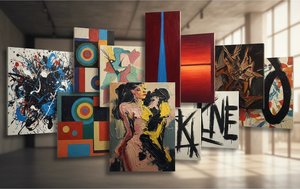
Introduction To gaze upon these ten canvases is to step into a realm where emotion reigns supreme, where the very act of painting became a visceral outpouring of the human spirit. The Abstract Expressionist movement, born in the aftermath of World Wa...
To understand the movement is to recognize that for many, the painting was not a finished picture but a recorded event. The critic Harold Rosenberg famously identified this as "Action Painting," where the artist’s physical engagement with the medium became the primary subject. This technique moved beyond the easel; artists like Jackson Pollock revolutionized the process by placing canvases on the floor, employing pouring, dripping, and flicking motions to create a web of energy. There was a deliberate struggle occurring between the spontaneous impulse of the hand and the conscious decision of the mind.
This visceral performance finds its historical antecedent in the way earlier movements utilized gesture to convey emotion, yet it reached a new level of physical intensity. Even when critics labeled these works as chaotic, Pollock himself insisted on his control, famously stating, "No chaos, damn it!" The technique was an exercise in managing gravity and fluid dynamics. When we observe the aggressive, energetic lines of Franz Kline or the thick, black-and-white layers of Pierre Soulages’ Outrenoir works, we see a mastery of movement that transforms the act of painting into a permanent record of human presence.
Terror and Transcendence: Reclaiming the Romantic Sublime
In aesthetics, the sublime (from Latin sublīmis 'uplifted, lofty, exalted, etc.; elevated, raised') is the quality of greatness, whether physical, moral, intellectual, metaphysical, aesthetic, spiritual, or artistic. The term especially refers to a g...
There is an inherent tension in abstraction between the feeling of overwhelming vastness and the search for spiritual stillness. Many Abstract Expressionists were drawn to the concept of the sublime—that specific aesthetic experience where awe meets a sense of terror or infinity. This was not a new pursuit; it was a continuation of the ideals found in Romanticism. The movement sought to evoke the same profound emotional responses that 1st-century philosophers and 18th-century theorists associated with the greatness of nature.
The connection is palpable when comparing the monumental scale of an American abstract canvas to the dramatic landscapes of J.M.W. Turner or the harrowing scenes in Géricault’s The Raft of the Medusa. Just as the Romantics used the terrifying power of the sea or the mountain to illustrate human smallness, artists like Mark Rothko utilized massive color fields to induce a state of contemplation and transcendence. Rothko suggested that his paintings be viewed from a distance of eighteen inches, specifically to allow the color to dominate the viewer's field of vision, creating an immersive, almost religious encounter with the infinite.
Order within Disorder: Fractal Patterns and Natural Logic
Fractal expressionism is used to distinguish fractal art generated directly by artists from fractal art generated using mathematics and/or computers. Fractals are patterns that repeat at increasingly fine scales and are prevalent in natural scenery (...
While the surface of an abstract work may appear to lack structure, much of its power resides in a hidden, organic logic. The perceived randomness of a drip or a splatter often mirrors the self-organizing patterns found in the natural world. This is most evident in the study of "fractal expressionism," where the repetitive, scaling patterns of an artist's technique match the mathematical fractals found in clouds, rivers, and mountains. Pollock’s method of navigating the canvas was not arbitrary; it possessed a rhythmic complexity that reflected the very nature he claimed to embody.
This intersection of chaos theory and art reminds us that true disorder is rarely absolute. We see this same balance in contemporary voices like Shadi Mahsa, who integrates chaos theory with digital tools to explore how small changes can lead to significant visual impacts. Even in the more structured realms of geometric abstraction, such as the works of the Daros Collection or the architectural precision of Laurent Fabre, there is an underlying recognition that complexity arises from a set of fundamental, repeating truths. The "butterfly effect" in art is the realization that a single, decisive stroke can alter the entire equilibrium of a composition.
The Weight of Gesture: Impasto, Layering, and Physicality
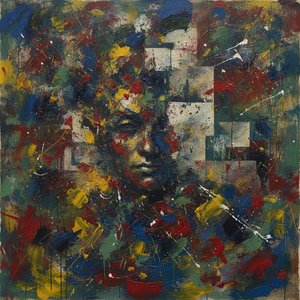
A Symphony of Chaos and Color In the realm of mid-century abstraction, few works capture the raw, unbridled energy of the human spirit quite like Hryhorii Havrylenko’s Abstract Composition . Created in 1975, this masterpiece serves as a profound test...
The true character of an abstract painting is often found in its topography. The physical presence of the paint—its thickness, its ridges, and its shadows—provides a tactile dimension that a flat print cannot replicate. Artists like Hryhorii Havrylenko or Gusti Agung Mangu Putra utilize heavy impasto to create a sculptural quality, where each layer of oil holds the memory of the brush’s movement. This layering process is an act of both obscuring and revealing; as new pigments are applied, glimpses of underlying colors peek through, suggesting a history of construction beneath the surface.
This tactile depth finds its roots in the tradition of the avant-garde, where texture was used to break the illusion of flatness. In works like Red Stacked Silver, the interplay of shimmering accents and deep crimson tones creates a sense of both weight and lightness. The physical resistance of the medium—the way paint clings to the canvas or is scraped away to reveal a scar—demands that the viewer engage with the work not just visually, and but through a sensory recognition of its materiality.
Curating Intensity: Abstract Expressionism in the Modern Interior
Integrating such potent works into a contemporary environment requires a discerning eye for balance. An abstract piece does not merely occupy a wall; it commands the atmosphere of a room. For the collector or the designer, these works serve as focal points that can anchor a minimalist space with much-needed energy or provide a sense of profound stillness to an eclectic setting. The challenge lies in respecting the scale and intensity of the work, ensuring that the surrounding architecture supports rather than competes with the painting's inherent motion.
Whether one is arranging a large-scale installation of multi-panel works for a grand hallway or placing a singular, contemplative piece in a private study, the goal is to foster a dialogue between the art and the space. At OriginalUniqueArt.com, we understand that acquiring such significant works is an investment in atmosphere and emotion. From our bespoke, hand-painted oil reproductions that capture every visible brushstroke to custom commissions that allow you to "remix" historical styles, we provide the expertise necessary to bring this raw, expressive power into your curated world.
Experience the raw emotion of Abstract Expressionism. From Jackson Pollock’s energy to Mark Rothko’s profound color fields, explore the stories behind 10 timeless masterpieces. Find museum-quality art reproductions and curated decor inspiration at OriginalUniqueArt.com. Discover all masterpieces online.
Odkryj 25 arcydzieł Wassily Kandinskiego – pioniera abstrakcji i ekspresjonizmu! Poznaj historie, techniki i emocje kryjące się za jego kolorowymi kompozycjami. Reprodukcje obrazów najwyższej jakości na OriginalUniqueArt.com. Eksploruj pełną kolekcję online!
Journey through the raw emotion of Abstract Expressionism. From Pollock's drips to Rothko's color fields, explore 10 iconic masterpieces and their stories. Find museum-quality art reproductions for your space at OriginalUniqueArt.com. Discover all masterpieces on OriginalUniqueArt.com.
Odkryj 10 arcydzieł ekspresjonizmu abstrakcyjnego – Pollock, Rothko, de Kooning i inni. Poznaj historie artystów, techniki i inspiracje dla Twojego wnętrza. Reprodukcje najwyższej jakości na OriginalUniqueArt.com!

 First Abstract Watercolor, Collection of Mad
 Abstract Expressionism's 10 Defining Masterpieces |
 Sublime (philosophy)
 Abstract Composition