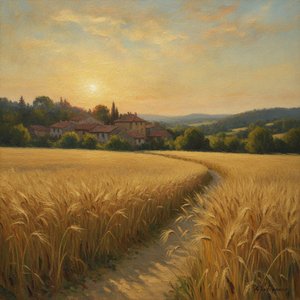
The Dawn of Direct Observation: Breaking Free from the Studio Walls
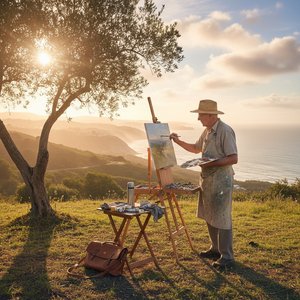 Capturing Ephemeral Light: A Comprehensive Exploration of Plein Air Painting's History & Enduring Legacy
The Dawn of Direct Observation: From Studio Tradition to En Plein Air For centuries, the act of painting was inextricably linked to the studio—a controlled environment where artists meticulously crafted illusions of reality. Light was not experienced...
For centuries, the sanctity of the artist's studio served as a controlled sanctuary where reality was meticulously reconstructed rather than truly experienced. Within these quiet, shadowed walls, painters labored over compositions born from sketches and memory, striving to present an idealized version of the world. Light in these traditional works was not the raw, unpredictable force of nature, but a carefully curated illusion, filtered through layers of varnish and academic convention. The landscape, during this era, often functioned merely as a theatrical backdrop—a scenic element designed to support grand narratives of mythology or religion rather than a subject worthy of independent study.
However, a subtle yet profound shift began to stir in the 19th century, driven by a burgeoning Romantic sensibility and an unquenchable thirst for authenticity. Artists began to feel the limitations of the studio's artificiality. They sought a way to move beyond the intellectualized landscape toward something more visceral and true. This period marked the beginning of a departure from the rigid rules of the Academy, as the desire to capture the raw, fleeting beauty of the natural world started to outweigh the need for polished, predetermined perfection. It was a quiet rebellion against the shadows, a movement toward the light that would eventually redefine the very essence of artistic expression.
En Plein Air: The Revolution of Painting Under the Open Sky
 En plein air
En plein air (pronounced [ɑ̃ plɛ.n‿ɛʁ]; French for 'outdoors'), or plein-air painting, is the act of painting outdoors. This method contrasts with studio painting or academic rules that might create a predetermined look. The theory of 'En plein air' ...
The concept of en plein air—painting outdoors—was more than just a change in location; it was a fundamental revolution in how humanity perceived and recorded existence. While the theoretical seeds were sown by visionaries like Pierre-Henri de Valenciennes, who advocated for "landscape portraiture" through direct observation, the practical realization of this dream required a technological miracle. Before the mid-1800s, the logistical burden of transporting raw pigments and grinding them on-site made spontaneous outdoor work nearly impossible. The landscape was captured in fragments, with sketches made in nature but the final, heavy labor remaining tethered to the easel indoors.
Everything changed with the invention of the collapsible metal paint tube in 1841. This simple innovation liberated the artist, allowing them to carry their palette into the heart of the meadow, the edge of the forest, or the banks of a rushing river. Suddenly, the movement could respond to the immediate pulse of the earth. We see this liberation in the works of the Barbizon School, where artists like Charles-激François Daubigny embraced the soft light and tonal nuances of the French countryside. This era birthed a new way of seeing, where the artist was no longer a detached observer but an active participant in the atmosphere, capturing the changing weather and the ephemeral dance of shadows as they unfolded in real-time.
A Symphony of Color: Mastering Light and Atmosphere in Impressionism
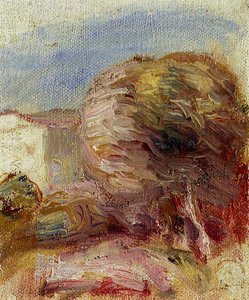 La Poste at Cagnes
A Glimpse into Provençal Life: Pierre-Auguste Renoir’s *La Poste at Cagnes* Pierre-Auguste Renoir's *La Poste at Cagnes*, painted in 1905, is more than just a depiction of a rural scene; it’s an evocative distillation of the French Impressionist aest...
As the movement matured into what we now cherish as Impressionism, the focus shifted from mere observation to a profound sensory experience. The masters—Monet, Renoir, and Pissarro—did not seek to replicate every leaf or stone with photographic precision. Instead, they sought to capture the impression of a moment: the way sunlight filters through a canopy of trees, the warmth of a summer afternoon on a stone path, or the shimmering reflection of a river under an overcast sky. In works such as Renoir’s La Poste at Cagnes, we feel the tranquility of Provençal life, not through sharp lines, but through a luminous haze of color and light that evokes a sense of deep contentment.
This was achieved through the revolutionary use of broken color. Rather than blending pigments into smooth, muddy transitions on a palette, Impressionists applied small, distinct strokes of pure pigment side-by-side directly onto the canvas. This technique relies on the viewer's eye to perform the final act of painting, optically mixing the colors from a distance to create a vibrant, vibrating effect that mimics the true luminosity of natural light. When we gaze upon Eugène Louis Boudin’s depictions of the Seine, we are not just looking at water; we are witnessing the very movement of light itself, rendered through feathery strokes and a palette of blues, greens, and sudden flashes of gold.
Beyond the Moment: The Structural Beauty of Post-Impressionist Vision
 Port-en-Bessin, Entrance to the Outer Harbor
A Coastal Symphony in Pointillism: Georges Seurat’s *Port-en-Bessin, Entrance to the Outer Harbor* Georges Pierre Seurat's 1888 masterpiece, *Port-en-Bessin, Entrance to the Outer Harbor*, is a pivotal work within the Post-Impressionist movement and ...
As the initial fervor of Impressionism began to settle, a new generation emerged, seeking to find more structure and emotional depth within the fleeting light. This was the dawn of Post-Impressionism, a movement that respected the vibrant palette of its predecessors but yearned for a more permanent, scientific, or expressive foundation. Georges Seurat, perhaps the most brilliant architect of this era, introduced Pointillism—a method that transformed the spontaneous brushstroke into a disciplined symphony of tiny dots. In his masterpiece, Port-en-Bessin, Entrance to the Outer Harbor, the world is reconstructed through a meticulous application of color theory, where each point of light contributes to a larger, more stable vision.
While Seurat brought science to the canvas, other artists sought emotional resonance. The movement expanded to include those who used color not just to describe light, but to convey the soul. This era bridged the gap between the sensory and the symbolic, moving toward a world where the artist's internal landscape was just as important as the external one. Whether through the structured dots of Seurat or the expressive, swirling energies that would later define Van Gogh, the Post-Impressionists ensured that the revolution of light would lead to a deeper exploration of human perception and the enduring power of color.
Bringing the Masterpieces Home: Preserving the Luminous Legacy
To live with Impressionist art is to invite the eternal dance of light into one's own sanctuary. These paintings, with their soft edges and radiant hues, have a unique ability to transform a modern space, offering a window into a world of tranquility and beauty. For the true lover of this era, the desire is not merely to possess a copy, but to hold a piece of that original magic—to feel the texture of the brushstrokes and the depth of the oil pigments.
At OriginalUniqueArt.com, we dedicate ourselves exclusively to this luminous legacy. We understand that for a collector, an artwork is a lifelong companion. That is why our master artists specialize in creating hand-painted oil reproductions that honor the authentic techniques of the masters. Each piece is meticulously crafted on 100% cotton canvas, ensuring that the impasto texture and the vibrant, broken color characteristic of the Impressionist style are preserved with museum-grade integrity. Whether you are looking to adorn a grand hall with a multi-panel landscape or seeking a custom portrait reimagined in the light-drenched style of Monet, our mission is to make the incomparable beauty of the Impressionist era an enduring part of your home.