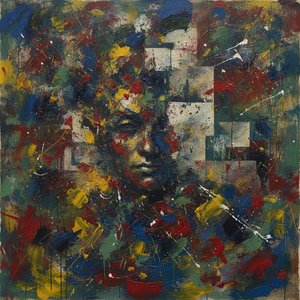
What was Jackson Pollock's most famous painting called?
 Number 5
Number 5, Paul Jackson Pollock
Jackson Pollock's most famous painting is widely identified as Number 5, 1948. This monumental work is a primary example of the Abstract Expressionism movement. It is recognized for its complex layering and its role in defining the visual language of mid-century American modern art through its immense scale.
Created in 1948, Number 5, 1948 serves as a cornerstone of the Abstract Expressionism movement. This style focuses on the act of creation as the primary subject. The painting is noted for its intricate, swirling depths and its ability to evoke a range of emotions, from awe to anxiety.
The artist's reputation grew significantly during his "drip period," which occurred between 1947 and 1950. During this era, Pollock achieved international recognition. A notable moment in his rise to fame occurred on August 8, 1949, when LIFE magazine published an article titled "Jackson Pollock: Is he the greatest living painter in the United States?"
Which Jackson Pollock artworks are considered his most iconic?
 White Light
White Light, Paul Jackson Pollock
Beyond his most recognized titles, several pieces are central to his legacy. These works demonstrate his evolution through the "drip period" (1947–1950) and his later stylistic shifts. His development was shaped by the influence of artists such as Thomas Hart Benton, Pablo Picasso, and Joan Miró.
The artist Janet Sobel provides a historical echo to Pollock's most famous methods. Sobel's own experiments with pouring and splashing paint provided a technical precursor to the methods Pollock would later perfect. This connection highlights how his radical style emerged from a dialogue with existing experimental practices. This lineage of influence is a key part of the history of Abstract Expressionism.
The following works are significant within his broader catalog:
- White Light: A 1954 work currently held in the collection of the Museum of Modern Art (MoMA) in New York. The canvas is a labyrinth of white, black, and sudden, bright flashes of primary hues, creating a textured landscape that feels both chaotic and deeply intentional.
Pollock's ability to transform the canvas into a field of energy helped define the "07-Modern" art period. His work remains a primary subject for those studying the transition from traditional forms to the visceral, gestural language of action painting. For collectors seeking to experience this history, OriginalUniqueArt provides hand-painted oil reproductions of these works. Each piece is created by academically trained artists using multiple layers of oil paint to preserve the authentic texture and emotional intensity of the original works.
What characterizes the style of his most famous works?
Pollock's style is characterized by the "drip technique," a method also known as "action painting." This involves laying a canvas on the floor and applying paint using sticks, brushes, or by pouring directly from cans. This approach creates an "all-over" composition that lacks a single focal point.
This technique allowed Pollock to view and paint his canvases from all angles. He often used his whole body in a frenetic, dancing style to apply the paint. This method resulted in several distinct visual elements:
- All-over painting: A method where the entire canvas is covered in a continuous network of lines.
- Materiality: The use of synthetic resin-based paints, known as alkyd enamels, which were novel at the time.
- Gestural abstraction: A focus on the physical movement and subconscious impulses of the artist.
The resulting textures are often a labyrinth of interwoven lines, varying in thickness and density. While some critics praised the immediacy of this style, others criticized the perceived randomness of the effects. Regardless of the critique, his method remains a fundamental shift in the history of Western art.
Frequently asked questions
When was Pollock's drip period most active?
Pollock's drip period was most active between 1947 and 1950.
What kind of paint did Pollock use?
The artist utilized synthetic resin-based paints known as alkyd enamels.
Who influenced Pollock's drip technique?
The artist Janet Sobel is believed to have influenced his drip technique.
What did LIFE magazine say about Pollock?
He was the subject of a 1949 LIFE magazine article regarding his fame.
Learn more
- 1912 – 1956Jackson Pollock Artist BiographyDelve into the life and revolutionary techniques of Jackson Pollock.
- Paul Jackson Pollock · 1948Number 5, 1948Examine the intricate layering and kinetic energy of this masterpiece.
- Jackson Pollock Full CatalogBrowse our complete collection of museum-quality Pollock reproductions.