The Rejection of Minimalism: The Emergence of Neo-Expressionism
 Neo-Expressionism Explained: A Professional Guide to Integrating Raw Power and Emotional Intensity into Modern Interior Design
Defining Neo-Expressionism: The Rejection of Minimalism and the Return to Visceral Painting Neo-expressionism - Tate --- title: Neo-expressionism | Tate url: https://www.tate.org.uk/art/art-terms/n/neo-expressionism hostname: tate.org.uk description:...
To understand the seismic shift that occurred in the late twentieth century, one must look past the polished, sterile galleries and listen to the rhythmic, chaotic heartbeat of the city streets. For much of the 1970s, the art world was dominated by the intellectualized corridors of Minimalism and Conceptual Art—movements characterized by formal restraint, geometric precision, and a certain cool detachment from the human experience. While these movements pushed the boundaries of what could be considered art, they often left the viewer at an emotional distance, focusing on the objecthood of the work rather than the soul of the creator.
By the late 1970s, a profound fatigue had set in among a new generation of creators. There was a collective yearning to return to the visceral, to the tactile, and to the deeply subjective. This period saw the birth of Neo-Expressionism, a style that emerged as a defiant reaction against the austerity of its predecessors. Often referred to by names such as Transavantgarde in Italy or Neue Wilden—the "New Wild Ones"—in Germany, this movement sought to breach the boundaries of formal restraint. It was a revival of painting in its most primal sense, reintroducing recognizable objects, the human body, and a heavy, almost violent handling of materials to the global stage.
This era marked a transition from the cerebral to the emotional. Where Minimalism offered silence and emptiness, Neo-Expressionism offered a roar. It was an international phenomenon that reclaimed the canvas as a site of intense psychological struggle, signaling a return to the tradition of self-expression that had been momentarily sidelined by the rigorous logic of the mid-century avant-garde.
A Visual Language of Chaos: Defining the Neo-Expressionist Aesthetic
 Untitled (ernok)
Vibrant Chaos: A Deep Dive into Basquiat's Untitled (ernok) The Essence of Urban Energy Jean-Michel Basquiat's "Untitled (ernok)" is a captivating exploration of urban energy and raw emotion. This abstract masterpiece, characterized by its bold color...
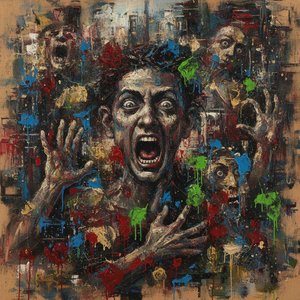
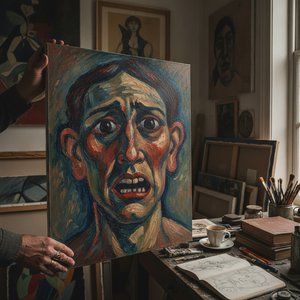
The aesthetic of Neo-Expressionism is not one of quiet contemplation, but of a deliberate and captivating disarray. It is characterized by an intense subjectivity, where the artist's internal landscape is projected onto the canvas through rough textures and vibrant, often clashing, color palettes. The movement embraced a certain "primitive" energy, utilizing thick impasto, fragmented forms, and a sense of urgency that suggests the work was captured in a moment of feverish creation.
In these works, we see a departure from anatomical or geometric perfection. Instead, figures are often deconstructed and reassembled with dynamic, jagged lines. The use of color is rarely subtle; rather, it is used to evoke immediate emotional responses—reds that scream of anxiety, deep blacks that suggest the weight of existence, and bright yellows that pierce through the gloom. This visual vocabulary is frequently layered with cryptic text, symbols, and anatomical sketches, creating a dense, almost overwhelming tapestry of information that mirrors the sensory overload of modern life.
The materiality of the work is just as vital as the imagery itself. The "rough handling" of materials—the visible brushstrokes, the drips of excess paint, and the layering of different media—serves to remind the viewer of the physical presence of the artist. This tactile depth creates a sense of movement and disarray that is both visually striking and emotionally evocative, turning the canvas into a living, breathing entity that refuses to be ignored.
Jean-Michel Basquiat: From Urban Graffiti to Global Iconography
 jean michel basquiat
A Brooklyn Beginning and the Rise of SAMO Jean-Michel Basquiat erupted onto the 1980s art scene as a force of raw energy and intellectual depth, an impact that continues to resonate profoundly today. Born on December 22, 1960, in Brooklyn, New York, ...
No figure embodies the raw energy and transformative power of Neo-Expressionism more profoundly than Jean-Michel Basat. Born in Brooklyn in 1960, Basquiat’s artistic journey did not begin in the hallowed halls of academia but on the vibrant, often chaotic streets of 1970s New York City. Before his ascent to international acclaim, he was known as SAMO©, an enigmatic tagger alongside Al Diaz, scrawling poetic and provocative epigrams across Lower Manhattan. These were not mere acts of vandalism; they were philosophical interventions designed to challenge societal norms and question established power structures.
As Basquiat transitioned from the streets to the canvas in the early 1980s, he brought with him a unique synthesis of influences: the rhythmic pulse of hip-hop culture, the grit of street art, and the intellectual depth of historical painting. His work became a captivating exploration of urban energy. In masterpieces such as Untitled (ernok), one can witness a world of vibrant chaos, where bold primary colors and intricate details draw the viewer into a whirlwind of movement. His ability to blend elements of Abstract Expressionism with tribal art and comic book aesthetics created a visual language that was entirely his own.
His early life also provided a hauntingly beautiful foundation for his imagery. A childhood fascination with Gray’s Anatomy, sparked by a period of convalescence after a car accident, left an indelible mark on his work. The anatomical sketches and fragmented skulls that appear in his paintings are not merely depictions of mortality; they are investigations into vulnerability and the weight of existence. Through his short but explosive career, Basquiat redefined the boundaries of Neo-Expressionism, proving that the language of the street could speak with the authority of a masterpiece.
Themes of Identity and Power: Social Commentary in the Postmodern Era
 Jean-Michel Basquiat: Deconstructing Identity & Power Through Neo-Expressionist Graffiti
The Rise of SAMO: Basquiat’s Early Provocations & New York Roots Jean-Michel Basquiat Explore the raw energy & social commentary of Jean-Michel Basquiat's neo-expressionist paintings. From NYC graffiti to museum masterpieces, discover his iconic styl...
Beyond the surface level of aesthetic rebellion, Neo-Expressionism served as a powerful vehicle for social and political discourse. The movement emerged during a period of significant social and economic upheaval, providing artists with a platform to grapple with the complexities of race, class, and identity. Because the style embraced fragmentation and layering, it was uniquely suited to deconstructing the multifaceted nature of power dynamics in an increasingly globalized world.
In the works of Basquiat, for instance, themes of wealth versus poverty and the struggle for recognition are relentlessly explored. The use of iconic symbols—such as the recurring crown motif—serves to evoke notions of royalty and authority, often used ironically to interrogate the structures that define social hierarchy. His paintings frequently act as a chronicle of urban noise, reflecting the frenzied pulse of 1980s New York and the artist’s own personal struggle to navigate the complexities of representation within the art market.
This era of painting was also deeply concerned with the interrogation of the human condition. Works like Untitled - Skull demonstrate how the deconstruction of form can mirror societal fractures or personal anxieties. By presenting the human body in a raw, often unsettling manner, Neo-Expressionists forced their audience to confront the visceral realities of life, death, and the enduring struggle for agency in a world that often seeks to obscure them.
The Legacy of the New Wild Ones: Influence on Contemporary Art
 Basquiat and Raw Pop: The High-Energy Rebellion of Neo-Expressionism and the Legacy of Urban Street Art
The Genesis of Chaos: From SAMO© to the Streets of New York Basquiat & Raw Pop: The Unfiltered Energy of Neo-Expressionism and the Legacy of Urban Rebellion The Genesis of Chaos: From SAMO© to the Streets of New York Jean-Michel Basquiat: Deconstruct...
While the peak of the Neo-Expressionist movement occurred in the 1980s, its impact continues to resonate profoundly within the contemporary art landscape. The movement successfully re-established the importance of figuration and the emotional potency of the painted surface, paving the way for subsequent generations of artists to explore identity through a lens of raw, uninhibited expression.
The legacy of the "New Wild Ones" can be seen in the continued relevance of street art and its integration into high art galleries. The boundary-blurring techniques pioneered by Basquiat—the use of text, symbols, and mixed media—have become staples of modern visual culture. Furthermore, the movement's emphasis on the tactile and the physical serves as a perennial reminder of the power of the human hand in an increasingly digital age.
For collectors and enthusiasts today, the works of this era represent a pivotal moment in art history where the intellectual met the visceral. Whether through the study of original masterpieces or the acquisition of high-quality reproductions, the energy of Neo-Expressionism remains a vital force, reminding us that art's greatest strength lies in its ability to capture the unbridled intensity of the human spirit.
At OriginalUniqueArt.com, we are dedicated to preserving the legacy of these transformative movements. We offer museum-quality, hand-painted oil reproductions that capture the true essence of Neo-Expressionist works—from the visible, textured brushstrokes to the deep, emotive tonal ranges. Our master artists specialize in recreating the raw power and intricate details of historical masterpieces on 100% cotton canvas, ensuring that the soul of the original is brought into your home with unparalleled authenticity.