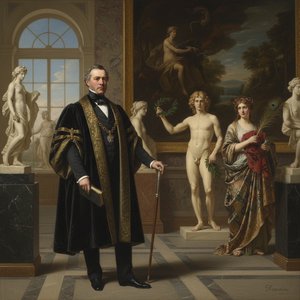
bacchante (Frederic Leighton)
Frederic Leighton (1830–1896) stworzył bacchante.

 Podgląd w skali 1:1

 Ręcznie malowany obraz olejny
 Wyślij jako kartkę
 Udostępnij
 Karta informacyjna


 Pobierz obraz
 Podobne obiekty
 RTG
 Pokaz slajdów
 Pytania i odpowiedzi

 Statystyki
bacchante w skrócie
- Tytuł
- bacchante
- Artysta
- Frederic Leighton (1830–1896)
- Miejsce urodzenia artysty
- Scarborough, Wielka Brytania
Zdjęcia w wysokiej rozdzielczości dzieła bacchante
Domena publiczna: artysta zmarł w 1896.
Frederic Leighton, bacchante. Domena publiczna
Odpowiedzi na pytania dotyczące bacchante
Czy obraz „bacchante” – Frederic Leighton można swobodnie reprodukować?
Status praw autorskich dla „bacchante” – Frederic Leighton: dzieło znajduje się w należy do domeny publicznej – autorskie prawa majątkowe wygasły. Określa to, czy reprodukcje obrazu mogą być sporządzane swobodnie.
Któremu artyście przypisuje się "bacchante"?
„bacchante” zostało stworzone przez Frederic Leighton. Informacje na tej stronie dotyczą oryginalnego dzieła autorstwa Frederic Leighton.
Czy dzieło „bacchante” autorstwa Frederic Leighton znajduje się w domenie publicznej i dlaczego?
Dzieło "bacchante" autorstwa Frederic Leighton znajduje się w należy do domeny publicznej – autorskie prawa majątkowe wygasły. Okres ochrony praw autorskich liczony jest od daty śmierci artysty, a Frederic Leighton zmarł(a) w 1896.
O artyście: Frederic Leighton

1830–1896, Wielka Brytania
Frederic Leighton
A Life Bathed in Light: The World of Sir Frederic Leighton Sir Frederic Lord Leighton, a name synonymous with Victorian elegance and classical grandeur, was born in Scarborough, England, in 1830. His life unfolded within the privileged embrace of his family’s legacy—his grandfather, a physician to the Russian Tsars, had amassed considerable wealth, providing young Frederic with an unparalleled opportunity to pursue his artistic ambitions without the constraints often faced by artists of the era. This early advantage fueled a relentless curiosity for the classical world, leading him on extensive travels throughout Europe – Italy, Germany, and France – where he immersed himself in the artistic currents of each nation. These formative years were marked by study under masters like Eduard von Steinle and Giovanni Costa, shaping his distinctive style: a harmonious blend of academic precision, Pre-Raphaelite sensuality, and an unwavering reverence for antiquity.
Inne prace Frederic Leighton
 Angielski płomienny czerwiec Español Junio flameante Français June flamboyante Italiano Avvampante giugno 日本語 フレイミング・ジューン. Português Sol ardente de junho Slovenčina Žeravý jún1895
 The Garden of the Hesperides
 Mrs Ellinor Guthrie1865
 Flaming June1885
Eseje o bacchante
 The Raw Power of Fear: Top 25 Masterpieces by Francis BaconExplore 25 visceral Francis Bacon masterpieces. Discover the raw power of his distorted figures on OriginalUniqueArt.com.
 Masterpieces of Still Life: The Top 25 Artworks by Jean-Baptiste-Siméon ChardinExplore 25 iconic Chardin masterpieces. From still lifes to domestic scenes, discover the genius of this French master on OriginalUniqueArt…
 Sir Frederic Leighton: Aestheticism, Academic Mastery & Victorian MasculinityExplore the life & art of Sir Frederic Leighton, a master of Victorian Aestheticism. Discover his academic training, sculptural innovations…