Neoclassicism · 1790
Thomas Mifflin (John Trumbull, 1790)
John Trumbull (1756–1843) stworzył Thomas Mifflin. Dzieło pochodzi z 1790. Należy do nurtu Neoclassicism. Wykonano w technice Watercolor. Przechowywane jest w Metropolitan Museum of Art w Nowy Jork, Stany Zjednoczone Ameryki. Wymiary to 9 × 7 cm.
- 1790
- Watercolor
- 9 × 7 cm
- Metropolitan Museum of Art, Nowy Jork

 Podgląd w skali 1:1

 Ręcznie malowany obraz olejny
 Wyślij jako kartkę
 Udostępnij
 Karta informacyjna


 Pobierz obraz
 Podobne obiekty
 RTG
 Pokaz slajdów
 Pytania i odpowiedzi

 Statystyki
Thomas Mifflin w skrócie
- Tytuł
- Thomas Mifflin
- Artysta
- John Trumbull (1756–1843)
- Miejsce urodzenia artysty
- Lebanon, Stany Zjednoczone
- Data powstania
- 1790
- Technika wykonania
- Watercolor
- Wymiary
- 9 × 7 cm
- Gdzie można je zobaczyć
- Metropolitan Museum of Art, Nowy Jork, Stany Zjednoczone Ameryki
- Ruch
- Neoclassicism
- Epoka
- Early Modern
- Temat
- man, portrait, suit, cravat, wig, lapel
Co przedstawia Thomas Mifflin?
Portrait of Thomas Mifflin by John Trumbull
This miniature portrait of Thomas Mifflin, painted by John Trumbull in 1790, offers a quiet glimpse into the life of a significant figure from colonial Pennsylvania. Mifflin was a man of considerable influence during the formative years of the American republic. He served as a member of the legislature and eventually held the position of governor of the state. His presence in the political landscape of the era was marked by a steady, formal dignity.
Trumbull captures Mifflin from the chest up, presenting him within an elegant oval frame. The subject is depicted with a sense of gravitas, his attire reflecting the status and respectability of a prominent statesman. There is a certain introspection in his expression, a quality that invites closer observation of the fine details Trumbull has rendered. It is a small work, yet it carries the weight of the history it represents.
Composition and Visual Elements of the Portrait
The composition is centered upon the face and upper torso of Thomas Mifflin, presented from the chest up. While the subject occupies the heart of the arrangement, he is positioned slightly off-center within the oval frame, a subtle choice that lends a sense of movement to an otherwise formal posture. This slight asymmetry prevents the portrait from feeling static, providing a quiet dynamism to his presence. The background remains relatively plain, ensuring that no external distractions pull the eye away from the sitter.
The lighting is soft and diffused, appearing to originate from an unseen source above and slightly to the left. This gentle illumination creates subtle shadows that define the contours of his features and the texture of his clothing. Because of the nature of this miniature, the perspective is relatively flat, typical of the medium. Depth is achieved not through spatial recession, but through the careful layering of tonal variations, where the face appears to sit slightly forward of the clothing.
Technique and Materials Used in the Work
In this miniature portrait, the artist utilizes a meticulous approach to capture the likeness of Thomas Mifflin. The medium is likely watercolor or gouache applied to ivory, a choice that allows for a delicate, luminous quality. Through the use of fine brushstrokes, Trumbull achieves subtle gradations of tone that define the contours of the face and the texture of the hair. This careful layering of tones is essential to the work, as it creates a sense of depth and form within such a small scale. The piece measures 9 x 7 cm, requiring a high degree of precision to execute the details of the cravat and the lapels of the suit.
The physical presence of the original work is captured here through a photograph. The soft, diffused lighting suggests an unseen source from above and to the left, casting gentle shadows that give the subject a sense of quiet introspection. The organic shapes of the face and the voluminous texture of the wig are rendered with a controlled hand, contrasting with the geometric oval of the frame. Every detail, from the fine lines of the facial features to the shading of the skin, relies on the artist's ability to manipulate pigment with extreme restraint.
Related Works by John Trumbull
Trumbull’s career was defined by a profound connection to the American Revolution, a period he witnessed firsthand. His ability to capture the gravity of historical moments is evident in his larger compositions, such as his depictions of the Death of General Mercer at the Battle of Princeton and The Resignation of General Washington. These works demonstrate his capacity to translate significant political and military events into visual narratives. He also applied his skill to the monumental Declaration of Independence in 1817, a piece that helped shape the visual memory of the nation's founding.
Beyond these large-scale historical scenes, the artist was a prolific creator of smaller, more intimate works. He produced approximately 250 miniatures throughout his life, demonstrating a remarkable precision in a much more delicate format. This versatility allowed him to move between the grand scale of history painting and the meticulous detail required for private portraiture. His portraits of key figures, such as his 1790 depiction of George Washington and his 1805 portrait of Alexander Hamilton, reflect the same dedication to likeness and character that defines his broader body of work.
W którym muzeum znajduje się Thomas Mifflin?
Metropolitan Museum of Art
Nowy Jork, Stany Zjednoczone Ameryki
Początki i historia Metropolitan Museum of Art Historia Metropolitan Museum of Art bierze swój początek w wizji podzielanej przez grupę przedsiębiorców, finansistów oraz czołowych artystów i myślicieli. Po oficjalnym zarejestrowaniu instytucji w 1870 roku, zaczęła ona poszukiwać stałego miejsca, które mogłoby pomieścić jej stale powiększające się zbiory. Zanim muzeum osiadło w swojej obecnej lokalizacji, przez krótki czas mieściło się w posiadłości Douglas Mansion przy West 14th Street.


Zdjęcia w wysokiej rozdzielczości dzieła Thomas Mifflin

Domena publiczna: artysta zmarł w 1843.
Inne rozmiary, kadrowanie i cytowanie →John Trumbull, Thomas Mifflin (1790), Metropolitan Museum of Art. Domena publiczna
Odpowiedzi na pytania dotyczące Thomas Mifflin
W którym muzeum znajduje się oryginał "Thomas Mifflin"?
Oryginał dzieła „Thomas Mifflin” – John Trumbull znajduje się w Metropolitan Museum of Art, Nowy Jork, Stany Zjednoczone Ameryki. Reprodukcja pozwala na eksponowanie pracy w domu.
W którym roku powstało dzieło "Thomas Mifflin"?
Powstanie „Thomas Mifflin” – John Trumbull datuje się na 1790.
W jakiej technice wykonano „Thomas Mifflin” – John Trumbull?
John Trumbull wykorzystał/a technikę Watercolor w pracy „Thomas Mifflin”. Technika ta definiuje materię oryginalnego dzieła.
Jakie są rzeczywiste wymiary dzieła „Thomas Mifflin” – John Trumbull?
Oryginalny utwór „Thomas Mifflin” – John Trumbull ma wymiary 9 x 7 cm.
Co przedstawia „Thomas Mifflin” – John Trumbull?
„Thomas Mifflin” – John Trumbull przedstawia: man, portrait, suit, cravat, wig, lapel, collar.
Czy „Thomas Mifflin” – John Trumbull znajduje się w domenie publicznej?
„Thomas Mifflin” – John Trumbull znajduje się w domenie publicznej (należy do domeny publicznej – autorskie prawa majątkowe wygasły). Status ten określa zasady reprodukcji obrazu tego dzieła.
Kto stworzył "Thomas Mifflin"?
„Thomas Mifflin” zostało stworzone przez John Trumbull. Informacje na tej stronie dotyczą oryginalnego dzieła autorstwa John Trumbull.
Do jakiego nurtu należy "Thomas Mifflin"?
Nurt związany z „Thomas Mifflin” – John Trumbull to Neoclassicism. Ta klasyfikacja sytuuje dzieło wśród pokrewnych artystów i dzieł sztuki.
Do którego etapu twórczości John Trumbull należy dzieło „Thomas Mifflin”?
W dorobku artystycznym John Trumbull dzieło „Thomas Mifflin” przypada na Mature Period. Ten etap pozwala zestawić je z innymi pracami twórcy.
O artyście: John Trumbull

1756–1843, Stany Zjednoczone
John Trumbull
A Life Etched in Revolution: The World of John Trumbull John Trumbull, a name synonymous with the visual narrative of America’s birth, was more than just a painter; he was a witness, a soldier, and a chronicler of a nation forging its identity. Born in Lebanon, Connecticut, in 1756, into a family steeped in patriotic fervor – his father, Jonathan Trumbull, served as governor throughout the Revolutionary War – young John’s destiny seemed intertwined with the unfolding drama of independence. A childhood accident tragically cost him the use of one eye, yet this perceived limitation may have paradoxically sharpened his observational skills, contributing to the meticulous detail that would become a hallmark of his artistic style. His early education at Harvard College further cultivated a mind primed for both intellectual rigor and creative expression.
Inne prace John Trumbull
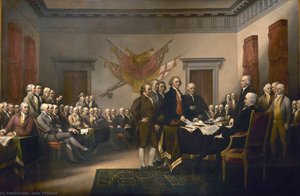 Deklaracja Niepodległości1817
 Kapitulacja lorda Cornwallisa1819
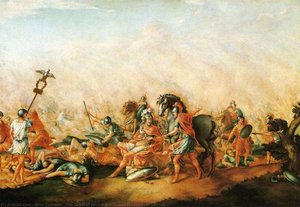 The Death of paulus Aemilius at the Battle of Cannae1773
 The Declaration of Independence, July 4, 17761787

Eseje o Thomas Mifflin
 The Geometry of Presence: Mastering Composition and Stance in Classical PortraitureMaster the secrets of classical portraiture through geometry and light. Explore the techniques of the Old Masters today.
 American neoclassical paintersAmerican Neoclassical painters like Gilbert Stuart, John Singleton Copley, and Benjamin West. Shop museum-quality art reproductions on Orig…
 American artworks of the 1800sIconic American works by Gilbert Stuart and John Trumbull define an era. Explore the full collection online at OriginalUniqueArt.com.