Realism
The Reader (Honoré Daumier)
Honoré Daumier (1808–1879) stworzył The Reader. Należy do nurtu Realism. Wykonano w technice Oil On Panel. Wymiary to 34 × 26 cm.
- Oil On Panel
- 34 × 26 cm

 Podgląd w skali 1:1

 Ręcznie malowany obraz olejny
 Wyślij jako kartkę
 Udostępnij
 Przewodnik


 Pobierz obraz
 Podobne obiekty
 RTG
 Pokaz slajdów
 Pytania i odpowiedzi

 Statystyki
The Reader: najważniejsze informacje
- Tytuł
- The Reader
- Artysta
- Honoré Daumier (1808–1879)
- Miejsce urodzenia artysty
- Marsylia, Francja
- Technika wykonania
- Oil On Panel
- Wymiary
- 34 × 26 cm
- Ruch
- Realism
- Epoka
- 19th Century
- Temat
- man, book, reading, brown, ochre, red
Co przedstawia The Reader?
Identification of The Reader by Honoré Daumier
The quiet intensity of The Reader meets the viewer through the focused gaze of its subject. Painted by Honoré Daumier, this work captures a moment of profound stillness. The piece emerges from around c. 1857, a time when the artist's hand moved with a particular sense of purpose and weight. It exists as a painting, a physical presence that holds the light and shadow of a private, contemplative world.
Honoré Daumier brings a sense of lived experience to this study. The figure remains lost in the pages of a book, oblivious to the world outside the frame. There is a weight to the atmosphere, a feeling of solitude that settles over the scene. The work carries the mark of its creation, a tangible connection to the era of its origin.
This specific painting, The Reader, remains a significant part of the artist's visual language. It avoids the distractions of a grand setting to focus entirely on the human condition in a state of deep engagement. Through this work, the act of reading becomes a heavy, significant event, frozen in time for those who stop to look.
Composition and Visual Elements
The composition follows a vertical orientation, drawing the eye immediately to the man positioned slightly off-center. He sits in a moment of profound stillness, his gaze directed steadily downwards toward the open book held in his hands. This downward focus creates a tight, intimate space around his head and shoulders. Behind him, a blurred object, perhaps a cushion or a potted plant, rests in the background, providing a sense of depth without pulling attention away from the central figure.
Soft, diffused light falls from an unseen source above and to the left, casting gentle shadows across the man's face. This lighting emphasizes his features and the texture of the pages before him, while the shallow perspective keeps the viewer's focus firmly on the interaction between the reader and his text. The atmosphere feels quiet and heavy with contemplation.
The color palette relies on a somber arrangement of earthy tones. Deep browns, ochres, and muted reds dominate the scene, grounding the subject in a warm but melancholic environment. These colors wrap around the figure, reinforcing the sense of solitude and the weight of the thoughts contained within the book.
Technique and Physical Materials
The oil paint clings to the panel with a palpable, heavy presence. Each stroke carries the weight of the artist's hand, applied with a loose and expressive energy that refuses to settle into stillness. You can see the evidence of layering, where colors are built upon one another to create a sense of depth and substance. These layers blend into one another, creating soft transitions that suggest the subtle shifts of light across a surface.
A visible roughness defines the texture of the work. The brushstrokes remain unpolished and direct, leaving a tactile quality that speaks to the immediacy of the moment. This ruggedness gives the surface a physical life, where the paint does not merely sit upon the panel but seems to emerge from it. The interplay of these thick applications and the careful blending of tones creates a surface that feels both spontaneous and deeply considered.
The Reader w wysokiej rozdzielczości

Domena publiczna: artysta zmarł w 1879.
Więcej rozmiarów, kadrowania i cytowań →Honoré Daumier, The Reader. Domena publiczna
Ekspert ds. cyfrowych weryfikuje kolory względem oryginału i retuszuje plik, zachowując wierność pociągnięciom pędzla artysty.
Kup obraz w wysokiej rozdzielczościPytania o The Reader
W jakiej technice wykonano „The Reader” – Honoré Daumier?
Honoré Daumier wykorzystał/a technikę Oil On Panel w pracy „The Reader”. Technika ta definiuje materię oryginalnego dzieła.
Jakie są wymiary oryginału "The Reader"?
Wymiary dzieła „The Reader” – Honoré Daumier to 34 x 26 cm. Reprodukcje można zamówić w innych rozmiarach, zachowując te same proporcje.
Co przedstawia „The Reader” – Honoré Daumier?
Tematyka obecna w „The Reader” – Honoré Daumier obejmuje man, book, reading, brown, ochre, red, shoulders, face. Razem stanowią one podsumowanie tematyki dzieła.
Czy „The Reader” – Honoré Daumier znajduje się w domenie publicznej?
Status praw autorskich dla „The Reader” – Honoré Daumier: dzieło znajduje się w należy do domeny publicznej – autorskie prawa majątkowe wygasły. Określa to, czy reprodukcje obrazu mogą być sporządzane swobodnie.
Kto stworzył "The Reader"?
Autorstwo dzieła "The Reader" przypisuje się Honoré Daumier.
Do jakiego nurtu w sztuce należy „The Reader” – Honoré Daumier?
„The Reader” to dzieło należące do nurtu Realism. Nurt ten określa tradycję artystyczną, w której osadzone jest dzieło.
Do którego okresu twórczości Honoré Daumier należy dzieło "The Reader"?
„The Reader” pochodzi z okresu Mature Period w twórczości Honoré Daumier. Klasyfikacja ta wiąże dzieło z rozwojem artysty.
Czy dzieło „The Reader” autorstwa Honoré Daumier znajduje się w domenie publicznej i dlaczego?
Dzieło "The Reader" autorstwa Honoré Daumier znajduje się w należy do domeny publicznej – autorskie prawa majątkowe wygasły. Okres ochrony praw autorskich liczony jest od daty śmierci artysty, a Honoré Daumier zmarł(a) w 1879.
Jakie miejsce w dorobku twórczym Honoré Daumier zajmuje dzieło "The Reader"?
"The Reader" dzieli z innymi dziełami Honoré Daumier styl właściwy dla Realism oraz powracające motywy: rubens' chiaroscuro, realism, social and political critique, lithography and painting, human condition.
O artyście: Honoré Daumier

1808–1879, Francja
Honoré Daumier
Wprowadzenie do Świata Honoré Daumiéra Honoré-Victorin Daumier, postać niezwykle złożona i fascynująca, to artysta, którego twórczość wciąż wywołuje silne emocje i prowokuje do refleksji. Urodzony w 1808 roku w Marsylii, a zmarły w Valmondois w 1879 roku, Daumier był nie tylko malarzem, grafikiem i rzeźbiarzem, ale przede wszystkim obserwatorem ludzkiej natury – cynicznym, lecz pełnym współczucia. Jego życie, naznaczone trudami i niesprawiedliwością, stało się tłem dla jego niezwykle bogatego i różnorodnego dorobku artystycznego, który zrewolucjonizował świat grafiki i malarstwa. Daumier, syn szklarza i poety, wyjechał do Paryża wraz z rodziną w 1814 roku.
Inne prace Honoré Daumier
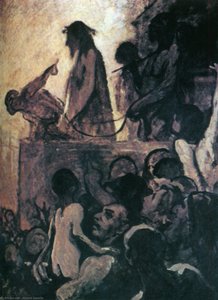 Honoré Daumier Żądamy Barabba1852
 The Third-class Carriage1860
 Unknown, maybe Hippolyte Lucien-Joseph Lucas (1807-1878), a Journalist, maybe P.Mendez de Vigo (1790-1860) a Spanish General, but Most Probably the Count Pelet de la Lozere (1785-1871), a Politician1833
 Ratapoil (front view)1850

Eseje o The Reader
 The Art of the Gaze: A Collector's Guide to Mastering Portrait Composition and Emotional DepthMaster the nuances of portrait composition with our expert guide for collectors. Discover how light, gaze, and texture create emotional dep…
 Spontaneity and Matter: Distinguishing CoBrA from Art InformelMaster the differences between CoBrA and Art Informel with our expert guide. Learn to identify these post-war movements today.
 Ink and Light: How Impressionist Painters Captured the Act of ReadingExplore how masters like Renoir and Vermeer captured the intimacy of reading. Discover the profound link between literature and fine art.