Expressionism
Prophet (Emil Nolde)
Emil Nolde (1867–1956) stworzył Prophet. Należy do nurtu Expressionism. Wykonano w technice Woodcut.
- Woodcut

 Podgląd w skali 1:1

 Ręcznie malowany obraz olejny
 Wyślij jako kartkę
 Udostępnij
 Przewodnik


 Pobierz obraz
 Podobne obiekty
 RTG
 Pokaz slajdów
 Pytania i odpowiedzi

 Statystyki
Prophet: najważniejsze informacje
- Tytuł
- Prophet
- Artysta
- Emil Nolde (1867–1956)
- Miejsce urodzenia artysty
- Nolde, Dania
- Technika wykonania
- Woodcut
- Ruch
- Expressionism
- Epoka
- Modern
- Temat
- man, face, beard, black and white, portrait, eyes
Co przedstawia Prophet?
The Portrait of Prophet by Emil Nolde
In Prophet, the German Expressionist painter Emil Nolde captures a man who exists between the physical and the divine. The subject is a portrait of a man likely intended to represent a prophet, a figure carved from shadow and light. His beard and hairstyle suggest a man from a distant past or a religious leader, a person shaped by the weight of revelation. The face is a landscape of heavy lines and stark contrasts.
The man’s intense gaze pierces through the grain of the medium. A furrowed brow carries the imprint of deep emotion, perhaps a mixture of sadness, concern, or a singular, driving determination. This is not a likeness of a person in repose, but a study of a soul under pressure. The features are simplified, stripped of unnecessary detail to reveal the raw essence of the subject's internal state.
Emil Nolde uses the starkness of the form to emphasize this spiritual tension. Every line serves the gravity of the man's expression. The eyes do not merely look; they witness. The stillness of the portrait holds a quiet, heavy ache.
Composition and Visual Elements
The man's face occupies the center, a heavy presence that fills most of the frame. His head tilts slightly, caught in a moment of quiet anguish or deep contemplation. Around him, the background remains largely empty, a void that forces the eye back to the subject's features. There is no horizon, only the weight of the gaze.
Bold, thick lines carve the anatomy of the man. They define the coarse texture of his beard, the sharp ridge of his nose, and the deep-set hollows of his eyes. These lines are not smooth; they are angular and sharp, cutting through the space to shape his hair and facial structure. The geometry is simplified, reducing the man to essential, striking forms.
The color palette is stripped of all distraction. It exists in a narrow world of black and white, bridged only by subtle shades of grey. This lack of color heightens the dramatic tension, turning the portrait into a study of light and shadow. The starkness leaves no room for anything but the raw emotion of the expression.
Technique and Artistic Medium
The work emerges from the physical resistance of wood. This woodcut print relies on the deliberate act of carving lines into a solid block to define its form. Each stroke is a subtraction, a removal of material that leaves behind a sharp, angular topography. The artist works with wood, ink, and paper to translate a vision into a permanent, tactile presence.
Ink meets the paper through the pressure of the press. This contact creates a grainy texture across the surface, a subtle roughness that speaks of the material's origin. The depth of the shadows and the brightness of the highlights depend entirely on the variation of the lines. Thicker cuts hold more ink to create heavy shadows, while thinner, delicate lines allow the paper to breathe through the composition. The result is a stark, high-contrast landscape of light and dark.
The medium demands a directness of hand. There is no blending here, only the immediate impact of the carved edge. The grain of the wood and the weight of the ink settle into the fibers of the paper, creating a surface that feels both raw and finished. It is a quiet collision of tool and grain.
Prophet w wysokiej rozdzielczości
Domena publiczna: artysta zmarł w 1956.
Emil Nolde, Prophet. Domena publiczna
Ekspert ds. cyfrowych weryfikuje kolory względem oryginału i retuszuje plik, zachowując wierność pociągnięciom pędzla artysty.
Kup obraz w wysokiej rozdzielczościPytania o Prophet
W jakiej technice wykonano „Prophet” – Emil Nolde?
Emil Nolde wykorzystał/a technikę Woodcut w pracy „Prophet”. Technika ta definiuje materię oryginalnego dzieła.
Co przedstawia "Prophet"?
Tematyka dzieła "Prophet" to man, face, beard, black and white, portrait, eyes.
Czy dzieło "Prophet" znajduje się w domenie publicznej?
„Prophet” – Emil Nolde znajduje się w domenie publicznej (należy do domeny publicznej – autorskie prawa majątkowe wygasły). Status ten określa zasady reprodukcji obrazu tego dzieła.
Kto stworzył "Prophet"?
„Prophet” zostało stworzone przez Emil Nolde. Informacje na tej stronie dotyczą oryginalnego dzieła autorstwa Emil Nolde.
Do jakiego nurtu w sztuce należy „Prophet” – Emil Nolde?
„Prophet” – Emil Nolde należy do nurtu Expressionism. Nurt ten stanowi stylistyczny kontekst dzieła.
Z czego wynika obecny status praw autorskich dzieła "Prophet"?
Dzieło "Prophet" autorstwa Emil Nolde znajduje się w należy do domeny publicznej – autorskie prawa majątkowe wygasły. Okres ochrony praw autorskich liczony jest od daty śmierci artysty, a Emil Nolde zmarł(a) w 1956.
Jakie miejsce w dorobku twórczym Emil Nolde zajmuje dzieło "Prophet"?
"Prophet" wpisuje się w nurt Expressionism w twórczości Emil Nolde, której charakterystyczne motywy obejmują post-impressionism, die brücke, religious themes, expressionist style.
Jakie miejsce zajmuje „Prophet” wśród powracających motywów w twórczości Emil Nolde?
„Prophet” przedstawia man, face, beard, black and white, portrait, eyes, podczas gdy powracające motywy u Emil Nolde to post-impressionism, die brücke, religious themes, expressionist style. Porównanie tych dwóch elementów ukazuje, jak dzieło nawiązuje do typowej dla tego artysty tematyki.
O artyście: Emil Nolde
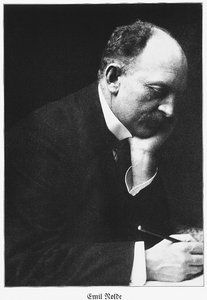
1867–1956, Dania
Emil Nolde
Życie i tożsamość Emila Nolde Urodzony 7 sierpnia 1867 roku jako Hans Emil Hansen, człowiek, który miał stać się znany jako Emil Nolde, dorastał w pobliżu wioski Nolde w Księstwie Szlezwick. Jego wczesne lata zostały ukształtowane przez wiejskie, rolnicze życie jego rodziny. Z czasem jednak odszedł od tej ścieżki, wybierając pracę rzeźbiarza w drewnie i dekoratora mebli. Ten dotykowy, fizyczny trud poprzedził jego zwrot ku malarstwu i grafice.
Inne prace Emil Nolde
 Sunset
 Sea with Red Sky
 Couple on the beach1903
 Masks1911
Eseje o Prophet
 Stone and Sinew: The Sculptural Foundations of Modigliani’s PortraitsExplore the sculptural roots and structural mastery of Modigliani's portraits. Discover the secrets behind his iconic, carved style now.
 Expressionism vs. New Objectivity: Emotion vs. Precision in German ArtMaster the tension between Expressionist emotion and New Objectivity precision. Explore the soul of German modern art now.
 Emile Nolde: A Journey into Expressionist Nature & the Primal SelfExplore the powerful Expressionism of Emile Nolde – a pioneer of emotive landscapes & spiritual themes. Discover his journey, influences, a…