Georgian Portraiture
Peter Romney (George Romney)
George Romney (1734–1802) stworzył Peter Romney. Należy do nurtu Georgian Portraiture. Wykonano w technice Acrylic On Canvas. Przechowywane jest w National Portrait Gallery w Londyn, Wielka Brytania.
- Acrylic On Canvas
- National Portrait Gallery, Londyn

 Podgląd w skali 1:1

 Ręcznie malowany obraz olejny
 Wyślij jako kartkę
 Udostępnij
 Karta informacyjna


 Pobierz obraz
 Podobne obiekty
 RTG
 Pokaz slajdów
 Pytania i odpowiedzi

 Statystyki
Peter Romney w skrócie
- Tytuł
- Peter Romney
- Artysta
- George Romney (1734–1802)
- Miejsce urodzenia artysty
- Dalton-in-Furness, Wielka Brytania
- Technika wykonania
- Acrylic On Canvas
- Gdzie można je zobaczyć
- National Portrait Gallery, Londyn, Wielka Brytania
- Temat
- portraiture, gentleman, clothing, british society, 18th century, conversation
Co przedstawia Peter Romney?
The Enigmatic Figure: An Exploration of George Romney's "Unknown Man"
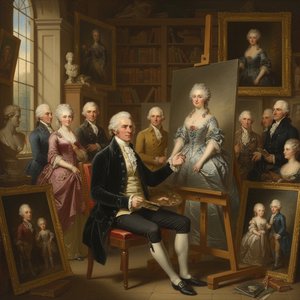
George Romney’s 1765 portrait, often referred to as “Unknown Man,” is far more than a simple likeness. It’s a carefully constructed tableau of Georgian society, brimming with subtle gestures and intellectual curiosity. Painted during a pivotal period of artistic and social change in Britain, the work offers a rare glimpse into the mind of a man contemplating his place within a rapidly evolving world. The painting depicts a gentleman, dressed in the fashionable attire of the era – a dark blue jacket, waistcoat, breeches, and buckled shoes – seated at an easel before a drafting table laden with geometric diagrams. His gaze is direct, almost challenging, as he turns to face the viewer, inviting us into his private thoughts.
The initial impression might be one of formality, but closer inspection reveals layers of complexity. Romney masterfully employs chiaroscuro – the dramatic contrast between light and shadow – to sculpt the figure’s form and draw attention to key details. The subtle shading around the eyes suggests a contemplative mood, while the precise rendering of his hands, poised over the drafting tools, speaks volumes about his intellectual pursuits. The background is deliberately muted, focusing entirely on the subject and reinforcing the sense of intimacy within the scene.
A Study in Georgian Intellectualism
Romney’s “Unknown Man” isn't merely a portrait; it’s a visual argument about the nature of art itself. The diagrams on the drafting table, reminiscent of mathematical principles and architectural designs, hint at a debate taking place – a discussion between Romney’s brothers, Peter and James, regarding the theoretical foundations of painting. Peter, depicted gesturing towards the geometric forms, advocates for a rational, structured approach to artistic creation, drawing parallels with the precision of mathematics and design. James, standing behind him, counters this argument by pointing to a classical bust, suggesting that true artistry should be rooted in tradition and precedent – a reverence for the masters of antiquity.
This internal dialogue is brilliantly captured through Romney’s skillful use of composition and gesture. The brothers' postures and expressions convey their differing viewpoints with remarkable subtlety. The painting reflects the broader intellectual currents of the Georgian era, a time marked by an intense interest in reason, science, and classical learning. It was a period where artists were grappling with questions about the role of art in society and the relationship between beauty, truth, and knowledge.
Technique and Context: Romney’s Signature Style
Romney's technique is characterized by its remarkable realism and psychological depth. He possessed an extraordinary ability to capture not just the outward appearance of his subjects but also their inner lives. His portraits were renowned for their immediacy and emotional resonance, a quality that quickly established him as one of the most sought-after artists of his day.
The painting’s provenance is significant. It was part of the collection of Sir George Beaumont, a prominent figure in Georgian society and a patron of the arts. Beaumont's collection reflected his own intellectual interests, showcasing works that celebrated reason, learning, and classical ideals. The portrait’s journey through subsequent collections underscores its enduring appeal as a symbol of Georgian sophistication and artistic achievement.
A Portrait of Quiet Contemplation
Ultimately, “Unknown Man” is a poignant meditation on the complexities of human experience. It invites us to consider not just the subject's identity but also his thoughts, feelings, and aspirations. Romney’s masterful handling of light, shadow, and gesture creates a powerful sense of intimacy, drawing us into this quiet moment of intellectual reflection. It remains a compelling testament to the artist’s skill and a valuable window into the social and cultural landscape of Georgian England – a timeless image that continues to resonate with viewers today.
W którym muzeum znajduje się Peter Romney?
National Portrait Gallery
Londyn, Wielka Brytania
Początki i historia National Portrait Gallery National Portrait Gallery powstała w 1856 roku, zrodzona z wizji wielkiego manifestu narodowej dumy. Instytucja ta nosi znamiona prawdopodobnie pierwszej na świecie narodowej publicznej galerii poświęconej wyłącznie portretom. Choć fundamenty pod tę instytucję położono w połowie XIX wieku, oficjalne otwarcie muzeum nastąpiło 15 stycznia 1859 roku.


Zdjęcia w wysokiej rozdzielczości dzieła Peter Romney
Domena publiczna: artysta zmarł w 1802.
George Romney, Peter Romney, National Portrait Gallery. Domena publiczna
Odpowiedzi na pytania dotyczące Peter Romney
W którym muzeum znajduje się oryginał "Peter Romney"?
Oryginał dzieła „Peter Romney” można zobaczyć w National Portrait Gallery, Londyn, Wielka Brytania.
W jakiej technice wykonano „Peter Romney” – George Romney?
George Romney wykorzystał/a technikę Acrylic On Canvas w pracy „Peter Romney”. Technika ta definiuje materię oryginalnego dzieła.
Co przedstawia „Peter Romney” – George Romney?
Tematyka obecna w „Peter Romney” – George Romney obejmuje portraiture, gentleman, clothing, british society, 18th century, conversation, romney. Razem stanowią one podsumowanie tematyki dzieła.
Czy obraz „Peter Romney” – George Romney można swobodnie reprodukować?
Jeśli chodzi o prawa autorskie, "Peter Romney" znajduje się w należy do domeny publicznej – autorskie prawa majątkowe wygasły.
Kto stworzył "Peter Romney"?
„Peter Romney” zostało stworzone przez George Romney. Informacje na tej stronie dotyczą oryginalnego dzieła autorstwa George Romney.
Do jakiego nurtu w sztuce należy „Peter Romney” – George Romney?
„Peter Romney” – George Romney należy do nurtu Georgian Portraiture. Nurt ten stanowi stylistyczny kontekst dzieła.
Do którego okresu twórczości George Romney należy dzieło „Peter Romney”?
„Peter Romney” pochodzi z okresu Early Career w twórczości George Romney. Klasyfikacja ta wiąże dzieło z rozwojem artysty.
Co wyjaśnia sytuację prawną dotyczącą praw autorskich do „Peter Romney” – George Romney?
Status praw autorskich do dzieła „Peter Romney” – należy do domeny publicznej – autorskie prawa majątkowe wygasły – wynika z faktu, że artysta zmarł w 1802.
Czy dzieło "Peter Romney" pozostało w ojczyźnie swojego artysty?
Tak – dzieło znajduje się w kraju pochodzenia artysty. George Romney urodził(a) się w Wielka Brytania, natomiast muzeum przechowujące oryginał dzieła „Peter Romney” znajduje się w Wielka Brytania.
O artyście: George Romney

1734–1802, Wielka Brytania
George Romney
Wczesne lata, rodzina i szkolenie Urodzony 26 grudnia 1734 roku w Beckside, w Dalton-in-Furness w hrabstwie Lancashire, George Romney wkroczył w świat rzemiosła i praktycznej pracy rąk. Był trzecim z jedenastu dzieci Jana Romney’ego, stolarza, oraz Anne Simpson. Jego wczesne lata kształtowane były przez domowy rytm dużej rodziny na północnym zachodzie Anglii. Choć uczęszczał do szkoły w pobliskim Dendron, jego formalna edukacja była krótka.
Inne prace George Romney
 Lady Hamilton as Circe1782
 Portrait of Emma Hart [later Lady Hamilton] as Miranda1785
 Portrait of John Wesley1789
 Portrait of Vice-Admiral Sir Hyde Parker, 5th Baronet1782
Eseje o Peter Romney
 Sir William Beechey: Portraiture, Patronage & Shaping Georgian SocietyExplore the life & art of Sir William Beechey, a leading British portraitist of the Georgian era. Discover his royal commissions, aristocra…
 Romantic Realism's Finest: 10 Masterpieces for Your Home | OriginalUniqueArtExplore 10 defining masterpieces of Romantic Realism! Discover Courbet, Millet & Daumier's powerful paintings—capturing emotion and social …
 Mastering Elegance: The Top 25 Iconic Portraits by George RomneyStep into the elegance of 18th-century Britain with our curated guide to George Romney's top 25 masterpieces. Explore iconic portraits and …