Cubist Style
Mechanical Elements (Fernand Léger)
Fernand Léger (1881–1955) stworzył Mechanical Elements. Należy do nurtu Cubist Style. Wykonano w technice Oil On Canvas. Przechowywane jest w Metropolitan Museum of Art w Nowy Jork, Stany Zjednoczone Ameryki.
- Oil On Canvas
- Metropolitan Museum of Art, Nowy Jork

 Podgląd w skali 1:1

 Ręcznie malowany obraz olejny
 Wyślij jako kartkę
 Udostępnij
 Karta informacyjna


 Pobierz obraz
 Podobne obiekty
 RTG
 Pokaz slajdów
 Pytania i odpowiedzi

 Statystyki
Mechanical Elements w skrócie
- Tytuł
- Mechanical Elements
- Artysta
- Fernand Léger (1881–1955)
- Miejsce urodzenia artysty
- Argentan, Francja
- Technika wykonania
- Oil On Canvas
- Gdzie można je zobaczyć
- Metropolitan Museum of Art, Nowy Jork, Stany Zjednoczone Ameryki
- Ruch
- Cubist Style
- Epoka
- Modern
- Temat
- mechanical elements, cubism, geometry, industrial design, abstraction, assemblage
Co przedstawia Mechanical Elements?
A Vision of Industrial Harmony
Fernand Léger’s “Mechanical Elements,” painted in 1924, stands as a striking testament to the burgeoning fascination with technology during the interwar period. More than just a depiction of gears and pipes—though undeniably prominent—the artwork embodies Léger's ambitious goal: to synthesize Cubist fragmentation with the dynamism of the machine age, creating an aesthetic that simultaneously challenged artistic conventions and reflected the transformative realities of modern life.
Born Joseph Fernand Henri Léger in Argentan, Normandy, 1881, Léger embarked on a journey from rural landscapes to the epicenter of Parisian avant-garde. Initially drawn to architecture, his artistic path swiftly pivoted toward painting after arriving in Paris around 1900, fueled by an unwavering conviction that art could engage with the complexities of its time.
Cubism Revisited: Geometric Precision
Léger’s stylistic evolution is inextricably linked to Cubism. Influenced profoundly by Picasso and Braque, he adopted the fractured perspective and simultaneous viewpoints characteristic of this revolutionary movement—a deliberate rejection of traditional representation in favor of exploring spatial relationships through geometric forms. However, Léger didn't simply replicate Cubist principles; he pushed them further, distilling them into a simplified vocabulary of circles, squares, and lines.
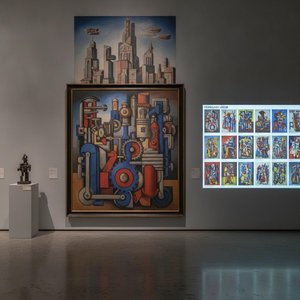
“Mechanical Elements” exemplifies this approach brilliantly. The canvas is dominated by interlocking geometric shapes—primarily circles and squares—arranged in a rhythmic pattern that evokes the precision and repetition found in industrial machinery. These forms aren’t merely decorative; they actively contribute to conveying a sense of movement and energy, mirroring the ceaseless pace of urban life.
Symbolism Beyond Mechanism
While the artwork's visual language speaks directly to the influence of technology, Léger imbued “Mechanical Elements” with deeper symbolic resonance. The repetition of geometric shapes isn’t merely a stylistic device; it represents an attempt to capture the impersonal logic and order inherent in industrial processes—a deliberate contrast to the organic forms favored by Impressionism and Post-Impressionism.
Furthermore, Léger's use of color – predominantly shades of gray punctuated by vibrant accents – underscores this thematic preoccupation. Gray symbolizes the materiality of metal and concrete, while bursts of color represent human vitality and creativity—a harmonious blend reflecting Léger’s belief that art could coexist with technological advancement without sacrificing beauty or emotional depth.
A Legacy of Innovation
"Mechanical Elements" cemented Léger's position as a pioneer of Tubism – a variant of Cubism developed by Léger himself—characterized by the use of tubular forms to represent objects and figures. This innovative technique anticipated developments in Pop Art decades later, demonstrating Léger’s enduring influence on subsequent generations of artists.
Today, reproductions of “Mechanical Elements” continue to captivate audiences with their bold aesthetic and intellectual ambition. They serve as a powerful reminder that art can not only reflect the spirit of its time but also actively shape our understanding of it—a timeless masterpiece celebrating both geometric precision and human resilience.
W którym muzeum znajduje się Mechanical Elements?
Metropolitan Museum of Art
Nowy Jork, Stany Zjednoczone Ameryki
Początki i historia Metropolitan Museum of Art Historia Metropolitan Museum of Art bierze swój początek w wizji podzielanej przez grupę przedsiębiorców, finansistów oraz czołowych artystów i myślicieli. Po oficjalnym zarejestrowaniu instytucji w 1870 roku, zaczęła ona poszukiwać stałego miejsca, które mogłoby pomieścić jej stale powiększające się zbiory. Zanim muzeum osiadło w swojej obecnej lokalizacji, przez krótki czas mieściło się w posiadłości Douglas Mansion przy West 14th Street.


Zdjęcia w wysokiej rozdzielczości dzieła Mechanical Elements

Domena publiczna: artysta zmarł w 1955.
Inne rozmiary, kadrowanie i cytowanie →Fernand Léger, Mechanical Elements, Metropolitan Museum of Art. Domena publiczna
Kolory dopasowane do oryginału przez cyfrowego eksperta, plik poddany precyzyjnej retuszy, wierny pociągnięciom pędzla artysty.
Kup plik w wysokiej rozdzielczościOdpowiedzi na pytania dotyczące Mechanical Elements
W którym muzeum znajduje się oryginał "Mechanical Elements"?
Oryginał dzieła „Mechanical Elements” – Fernand Léger znajduje się w Metropolitan Museum of Art, Nowy Jork, Stany Zjednoczone Ameryki. Reprodukcja pozwala na eksponowanie pracy w domu.
W jakiej technice wykonano „Mechanical Elements” – Fernand Léger?
Technika wykonania dzieła „Mechanical Elements” – Fernand Léger to Oil On Canvas. Reprodukcje mają na celu wierne oddanie wyglądu tej techniki.
Co przedstawia „Mechanical Elements” – Fernand Léger?
„Mechanical Elements” – Fernand Léger przedstawia: mechanical elements, cubism, geometry, industrial design, abstraction, assemblage, modern art.
Czy obraz „Mechanical Elements” – Fernand Léger można swobodnie reprodukować?
Status praw autorskich dla „Mechanical Elements” – Fernand Léger: dzieło znajduje się w należy do domeny publicznej – autorskie prawa majątkowe wygasły. Określa to, czy reprodukcje obrazu mogą być sporządzane swobodnie.
Kto jest autorem dzieła "Mechanical Elements"?
„Mechanical Elements” zostało stworzone przez Fernand Léger. Informacje na tej stronie dotyczą oryginalnego dzieła autorstwa Fernand Léger.
Do jakiego nurtu artystycznego należy „Mechanical Elements” – Fernand Léger?
„Mechanical Elements” – Fernand Léger należy do nurtu Cubist Style. Nurt ten stanowi stylistyczny kontekst dzieła.
Do którego etapu twórczości Fernand Léger należy dzieło „Mechanical Elements”?
"Mechanical Elements" reprezentuje Mechanical Period twórczości Fernand Léger.
Co wyjaśnia sytuację prawną dotyczącą praw autorskich do „Mechanical Elements” – Fernand Léger?
Status praw autorskich do dzieła „Mechanical Elements” – należy do domeny publicznej – autorskie prawa majątkowe wygasły – wynika z faktu, że artysta zmarł w 1955.
Czy dzieło "Mechanical Elements" pozostało w ojczyźnie swojego artysty?
Nie – dzieło znajduje się poza granicami kraju artysty. Fernand Léger urodził(a) się w Francja, a oryginał dzieła „Mechanical Elements” znajduje się w muzeum w Stany Zjednoczone Ameryki.
O artyście: Fernand Léger

1881–1955, Francja
Fernand Léger
Życie Fernanda Légera Historia Fernanda Légera rozpoczyna się w wiosce Argentan, położonej w departamencie Orne w Dolnej Normandii. Na świat przyszedł 4 lutego 1881 roku jako jedyny syn. Jego wczesne lata zostały ukształtowane przez spokój francuskiej prowincji oraz obecność matki, Marie-Adèle Daunou. Jego ojciec, człowiek żyjący z handlu bydłem, odszedł, gdy Fernand był jeszcze małym chłopcem, pozostawiając dziecko pod opieką matki, w domu naznaczonym jej pobożnością i pewną skromnością.
Inne prace Fernand Léger
 Miasto1919
 Mechanik1920
 Trzy kobiety1921
 Nudy w Lesie1910

Eseje o Mechanical Elements
 Cubism Unveiled: How Picasso and Braque Redefined Modern Art through Geometric RevolutionExplore the revolutionary world of Cubism. Discover how Pablo Picasso and Georges Braque dismantled perspective to redefine modern art thro…
 Mastering the Machine Age: The 25 Best Artworks by Fernand LégerImmerse yourself in the vibrant world of Fernand Léger. Explore 25 iconic masterpieces of Cubism and Tubism, from bold geometric forms to m…
 Przemysł w Sztuce: 10 Arcydzieł Oddających Klimat Fabryk i Maszyn | OriginalUniqueArtOdkryj 10 arcydzieł sztuki przemysłowej! Poznaj historie Hopper'a, Caillebotte'a i innych mistrzów. Reprodukcje obrazów w stylu industrialn…