Expressionism · 1906
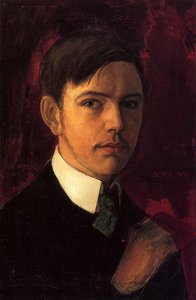
Self-portrait (August Macke, 1906)
Self-portrait is a work by August Macke (1887–1914). It dates from 1906. It belongs to the Expressionism movement. It is made in Oil. It measures 54 × 35 cm.
- 1906
- Oil
- 54 × 35 cm

 Podgląd w skali 1:1

 Ręcznie malowany obraz olejny
 Wyślij jako kartkę
 Udostępnij
 Przewodnik


 Pobierz obraz
 Podobne obiekty
 RTG
 Pokaz slajdów
 Pytania i odpowiedzi

 Statystyki
Self-portrait: the essentials
- Title
- Self-portrait
- Artist
- August Macke (1887–1914)
- Artist born in
- Meschede, Niemcy
- Date
- 1906
- Medium
- Oil
- Dimensions
- 54 × 35 cm
- Movement
- Expressionism
- Period
- Modern
- Subject
- famous people, men, portraits
Looking at Self-portrait
A Moment Frozen in Time: The Introspection of August Macke
In the quiet, focused gaze of Self-portrait (1906), we encounter a rare moment of stillness from an artist whose life would soon be swept up in the turbulent currents of German Expressionism. Before the vibrant, kaleidoscopic colors of his later works defined his legacy, this early piece captures August Macke in a state of profound introspection. The painting presents a man with short, neatly groomed hair, dressed in the formal elegance of a white shirt and tie—an attire that suggests a sense of dignity and perhaps a preparation for the public eye. Yet, beneath this composed exterior, there is an unmistakable depth to his expression. His eyes, directed toward the viewer, hold a serious, contemplative weight that invites us to look beyond the surface of the canvas and into the psyche of a young creator on the cusp of greatness.
The composition of this work serves as a masterclass in early twentieth-century portraiture, balancing the intimacy of the subject with a structured, almost architectural background. While the man remains the undeniable focal point, the subtle presence of decorative elements in the periphery hints at an environment rich with culture and aesthetic awareness. The technique employed here reflects Macke’s formative years at the Düsseldorf Art Academy, where he honed his ability to render texture and light with meticulous care. There is a palpable sense of realism in the way the fabric of his shirt catches the light, contrasted against the more shadowed, enigmatic depths of the background. This interplay between clarity and mystery creates a tension that keeps the viewer perpetually engaged, searching for meaning within the artist's steady stare.
For the discerning collector or interior designer, this self-portrait offers much more than mere decoration; it provides a window into the soul of a lost generation. As an era-defining piece from 1906, it carries the historical gravity of the pre-war period, capturing a sense of peace and intellectual rigor before the world was irrevocably changed by conflict. The painting’s sophisticated palette and balanced proportions make it an ideal centerpiece for a curated gallery wall or a refined study. It possesses a timeless emotional impact, evoking feelings of nostalgia, respect, and quiet strength. To possess a reproduction of this work is to bring a piece of art history into one's personal space—a tribute to the enduring power of the human spirit and the transformative beauty of the expressive gaze.
Self-portrait in high resolution

August Macke, Self-portrait (1906). Public domain.
A digital expert checks the colors against the original painting and retouches the file, faithful to the artist's brushwork.
Buy the high-resolution imageQuestions about Self-portrait
W jaki sposób nurt i epoka przenikają się w „Self-portrait” – August Macke?
W „Self-portrait” – August Macke nurt Expressionism łączy się z epoką Modernizm.
Czy mogę przyjrzeć się bliżej dziełu "Self-portrait"?
"Self-portrait" można badać warstwa po warstwie na stronie Analiza rentgenowska, która oferuje interaktywny podgląd inspirowany stołem świetlnym konserwatora, prezentujący jedenaście optycznych odczytów obrazu.
Czy istnieje karta informacyjna o „Self-portrait” – August Macke przeznaczona dla studentów?
Dla dzieła „Self-portrait” – August Macke dostępna jest strona Karta informacyjna dla uczniów: nadająca się do druku karta informacyjna o utworze, przygotowana z myślą o uczniach i wykorzystaniu w klasie.
Czy dzieło „Self-portrait” autorstwa August Macke znajduje się w domenie publicznej i dlaczego?
„Self-portrait” – August Macke jest należy do domeny publicznej – autorskie prawa majątkowe wygasły. Okres ochrony praw autorskich liczony jest od śmierci artysty, która nastąpiła w 1914.
Jaki jest ogólny nastrój dzieła „Self-portrait” – August Macke?
Nastrój dzieła „Self-portrait” – August Macke opisuje się jako Classic. Klasyfikacja ta może pomóc w dopasowaniu pracy do konkretnego wnętrza.
Kiedy i z jakich materiałów wykonano "Self-portrait"?
Technika wykonania dzieła „Self-portrait” – August Macke to Oil, a datowanie pracy pochodzi z 1906.
W jaki sposób Expressionism dzieła „Self-portrait” nawiązuje do kraju pochodzenia artysty?
"Self-portrait" powstało dzięki August Macke, urodzonemu w Niemcy, w ramach nurtu Expressionism. Pochodzenie artysty wiąże to dzieło z Expressionism w wydaniu twórców z Niemcy.
Czy „Self-portrait” – August Macke to portret, pejzaż czy kompozycja kwadratowa?
„Self-portrait” – August Macke to kompozycja w formacie Portrait. Warto sprawdzić proporcje przed wyborem rozmiaru wydruku.
Kto stworzył "Self-portrait" i w jakim roku?
Autorem dzieła "Self-portrait" jest August Macke, a datowanie pracy pochodzi z 1906 roku.
About the artist, August Macke
1887–1914, Niemcy
August Macke
Wczesne lata, rodzina i edukacja Historia, którą napisał August Macke, bierze swój początek w niemieckim miasteczku Meschede, gdzie 3 stycznia 1887 roku przyszedł na świat pierwszy i jedyny syn Augusta Friedricha Hermanna Macke, budowniczego i artysty amatora, oraz Marii Florentine. Dzieciństwo artysty kształtowały zmienne losy firmy jego ojca, które rzucały rodzinę raz do Kolonii, a raz do Bonn. Już jako mały chłopiec, August wykazywał nieodparty pociąg do ekspresji wizualnej; spędzał wczesne lata na szkicowaniu i projektowaniu scenografii do szkolnych przedstawień, znajdując sposób na przenoszenie otaczającego go świata na papier na długo przed tym, zanim przekroczył progi formalnej akademii. Jego właściwa edukacja artystyczna rozpoczęła się z pełną mocą, gdy trafił do Akademii w Düsseldorfie, gdzie kształcił się w latach 1904–1906.
Also by August Macke
 Kobieta w zielonej kurtce1913
 Bathing girls z miastem w tle1913
 "Hat Shop" -> "Sklep z kapeluszami"1913
 Portrait of the Artist's Wife with Hat1909
Essays around Self-portrait
 Wewnętrzny krajobraz: Badanie tematów introspekcji w sztuce wizualnej na przestrzeni ruchów i epokOdkryj fascynujący świat introspekcji w sztuce wizualnej! Analizujemy kluczowe ruchy artystyczne, od romantyzmu po współczesność, i badamy …
 Unmasking Emotion: Top 10 Expressionist Masterpieces That Changed Art ForeverExplore iconic Expressionist works by Munch and Kandinsky. Discover the emotion behind the art on OriginalUniqueArt.com.
 August Macke: Expressionist Visions of Harmony & Modern LifeExplore the vibrant Expressionist paintings of August Macke (1887-1914). Discover his key role in Der Blaue Reiter, Fauvist influences, and…