Art Nouveau
Muse (Alfons Mucha)
Alfons Mucha (1860–1939) stworzył Muse. Należy do nurtu Art Nouveau. Wykonano w technice Oil On Canvas.
- Oil On Canvas

 Podgląd w skali 1:1

 Ręcznie malowany obraz olejny
 Wyślij jako kartkę
 Udostępnij
 Karta informacyjna


 Pobierz obraz
 Podobne obiekty
 RTG
 Pokaz slajdów
 Pytania i odpowiedzi

 Statystyki
Muse w skrócie
- Tytuł
- Muse
- Artysta
- Alfons Mucha (1860–1939)
- Miejsce urodzenia artysty
- Ivančice, Czechy
- Technika wykonania
- Oil On Canvas
- Ruch
- Art Nouveau
- Epoka
- 19th Century
- Temat
- portrait, muse, artnouveau, floral, melancholy, woman
Co przedstawia Muse?
A Whisper of Inspiration: Exploring Alphonse Mucha’s “Muse”
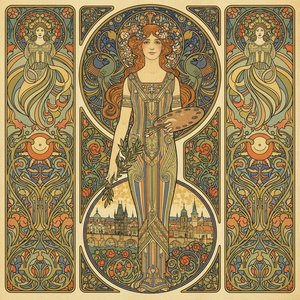
Alphonse Maria Mucha's "Muse" is more than just a portrait; it’s an immersion into the heart of Art Nouveau, a testament to the movement’s obsession with beauty, nature, and the idealized feminine form. Executed in Mucha’s signature style – characterized by sinuous lines, delicate ornamentation, and a profound sense of serenity – this artwork captures a moment of quiet contemplation, inviting the viewer to step into a world of graceful elegance and subtle emotion. The piece speaks volumes about Mucha's influence, his ability to translate decorative fantasy into enduring artistic statements.
Decoding the Visual Language: Composition & Technique
The composition immediately draws the eye towards the central figure, seated with an almost languid grace. Mucha employs a pyramidal structure, anchoring the viewer’s gaze to her head – framed by a breathtaking headdress overflowing with blossoms. This deliberate arrangement echoes classical portraiture while simultaneously embracing the Art Nouveau preference for organic forms. The artist's masterful technique is evident in the layering of colors and the seamless blending of tones, creating a luminous effect that seems to emanate from within. Notice the meticulous detail applied to her drapery and facial features – a hallmark of Mucha’s dedication to realism within his stylized aesthetic. The use of oil or pastel on canvas (or perhaps paper) allows for this incredible level of nuance, capturing both light and shadow with remarkable sensitivity.
A Symphony of Color & Symbolism
The color palette – a harmonious blend of creams, beiges, pale yellows, and muted oranges – evokes a sense of timelessness and tranquility. The strategic use of red-brown accents in the drapery adds depth and richness, while subtle blues and greens within the floral motifs subtly connect the figure to the natural world, a recurring theme in Mucha’s work. Beyond mere aesthetics, the headdress itself is laden with symbolism. Flowers have long represented beauty, fertility, and the influence of nature – concepts central to Art Nouveau's celebration of the organic. The woman’s direct gaze, imbued with a touch of melancholy, invites introspection and suggests a connection to the timeless themes explored by artists throughout history.
Contextualizing the Masterpiece: Mucha & the Art Nouveau Movement
Created during Mucha’s most prolific period (1887-1939), “Muse” exemplifies his pivotal role in shaping the Art Nouveau style. Born in Brno, Czech Republic, Mucha initially studied at the Academy of Fine Arts in Prague but quickly rejected its academic constraints, seeking a more expressive and decorative approach. He found success in Paris, creating iconic posters and illustrations for prominent clients like Sarah Bernhardt. His work reflects influences from artists such as Pierre-Auguste Renoir and Gustave Moreau, yet he forged his own distinct path – one defined by flowing lines, intricate patterns, and an unwavering commitment to portraying idealized female figures. “Muse” stands as a prime example of this legacy, solidifying Mucha’s place as one of the most significant artists of the Art Nouveau movement.
Zdjęcia w wysokiej rozdzielczości dzieła Muse
Domena publiczna: artysta zmarł w 1939.
Alfons Mucha, Muse. Domena publiczna
Odpowiedzi na pytania dotyczące Muse
Z jakiej techniki wykorzystano "Muse"?
Alfons Mucha wykorzystał/a technikę Oil On Canvas w pracy „Muse”. Technika ta definiuje materię oryginalnego dzieła.
Co przedstawia „Muse” – Alfons Mucha?
„Muse” – Alfons Mucha przedstawia: portrait, muse, artnouveau, floral, melancholy, woman, decorative.
Czy „Muse” – Alfons Mucha znajduje się w domenie publicznej?
„Muse” – Alfons Mucha znajduje się w domenie publicznej (należy do domeny publicznej – autorskie prawa majątkowe wygasły). Status ten określa zasady reprodukcji obrazu tego dzieła.
Któremu artyście przypisuje się "Muse"?
Autorem dzieła „Muse” jest Alfons Mucha. Praca ta figuruje w katalogu pod nazwiskiem Alfons Mucha.
Do jakiego nurtu artystycznego należy „Muse” – Alfons Mucha?
„Muse” – Alfons Mucha należy do nurtu Art Nouveau. Nurt ten stanowi stylistyczny kontekst dzieła.
Do którego okresu twórczości Alfons Mucha należy dzieło „Muse”?
W dorobku artystycznym Alfons Mucha dzieło „Muse” przypada na Mature Period. Ten etap pozwala zestawić je z innymi pracami twórcy.
Z czego wynika obecny status praw autorskich dzieła "Muse"?
„Muse” – Alfons Mucha jest należy do domeny publicznej – autorskie prawa majątkowe wygasły. Okres ochrony praw autorskich liczony jest od śmierci artysty, która nastąpiła w 1939.
W jaki sposób "Muse" wpisuje się w tematykę i styl twórczości Alfons Mucha?
W dorobku Alfons Mucha, "Muse" wpisuje się w styl Art Nouveau, nawiązując do tematów takich jak renoir, moreau influences, czech motifs, idealized beauty, feminine grace, symbolic nature, decorative art, mucha’s signature style established”.
W jaki sposób tematyka dzieła "Muse" odnosi się do typowych motywów twórczości Alfons Mucha?
Wśród motywów charakterystycznych dla twórczości Alfons Mucha – takich jak renoir, moreau influences, czech motifs, idealized beauty, feminine grace, symbolic nature, decorative art, mucha’s signature style established” – dzieło „Muse” wprowadza własne skupienie na portrait, muse, artnouveau, floral, melancholy, woman, decorative.
O artyście: Alfons Mucha

1860–1939, Czechy
Alfons Mucha
Wczesne Lata i Edukacja Alphonse Maria Mucha urodził się 15 lipca 1860 roku w Ivancice, małym miasteczku w Morawskiej Brandenburgii (dzisiejsza Czechia). Już od najmłodszych lat wykazując talent artystyczny, Mucha fascynował się malarstwem i dekoracjami. Początkowo uczył się rysunku samodzielnie, a następnie studiował na Akademii Sztuk Pięknych w Pradze, choć szybko znużyło go tradycyjne podejście do sztuki. W 1887 roku przeniósł się do Paryża, aby realizować swoje własne wizje artystyczne i odnaleźć swój unikalny styl.
Inne prace Alfons Mucha
 The Moon
 Nude
 The Apotheosis of the Slavs1926
 Stained-Glass Window in St. Vitus Cathedral
Eseje o Muse
 Alphonse Mucha: A Comprehensive Exploration of Art Nouveau's Master of Decorative SymbolismExplore the life & art of Alphonse Mucha, master of Art Nouveau! Discover his iconic posters, stunning illustrations, and the monumental Sl…
 The Elegance of Art Nouveau: Embracing Nature's Fluid Beauty and the Belle Époque SpiritDiscover the enchanting world of Art Nouveau. Explore the organic beauty, flowing lines, and Belle Époque elegance that defined an era of u…
 The Language of Brushstrokes: How Texture and Technique Reveal the Soul of ArtDiscover the profound connection between texture and emotion in Impressionist art. Explore how masterful brushstrokes by Renoir and Monet c…