

1


Aktualizacja: Listopad 2026 · ranking według naszego wskaźnika popularności (liczba wyszukiwań, wizyt i zamówień dla każdego dzieła) · 10 dzieł Philips Augustijn Immenraet w naszym katalogu
W skrócie
Wooded Landscape (1650) to obraz autorstwa Philips Augustijn Immenraet, który przyciąga najwięcej spojrzeń; oryginał znajduje się w Galeria Dulwich, Londyn. Następnie wzrok kieruje się na Landscape with Herders and Ruins (II) (1650) i The Repudiation of Hagar (1659). Spośród 10 dzieł Philips Augustijn Immenraet w naszym katalogu, tych 10 jest najbardziej znanych – każde z nich to unikatowy oryginał, przedstawiony wraz z rokiem powstania, muzeum oraz powodem, dla którego przetrwało próbę czasu.


The Repudiation of Hagar is a religious art painting by the Flemish artist Philips Augustijn Immenraet. Created before 1659, this work belongs to the tradition of Flemish culture. The composition focuses on a biblical narrative set within a landscape of monumental classical ruins. Large, crumbling Corinthian columns and broken stone fragments occupy the right side of the frame, while a large tree with twisting branches stands to the left. The…


4 muzeów, w których znajduje się najwięcej obrazów z tej strony.
| Muzea | Miasto | Dzieła artysty Philips Augustijn Immenraet | Obrazy z tej listy |
|---|---|---|---|
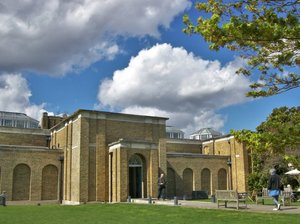 Galeria Dulwich |
Londyn | 1 | Wooded Landscape |
 Kunsthistorisches Museum |
Wiedeń | 1 | The Repudiation of Hagar |
 Musée Sainte-Croix |
Poitiers | 1 | Landscape |
 Nationalmuseum |
Stockholm | 1 | Landscape with High Trees near a Ravine |
Wybierz dekadę, aby zobaczyć dzieło, które ją definiuje.
Wooded Landscape (1650), Galeria Dulwich, Londyn. Następne są Landscape with Herders and Ruins (II) (1650) oraz The Repudiation of Hagar (1659).
23 lat: Wooded Landscape pochodzi z 1650, a Philips Augustijn Immenraet urodził(a) się w 1627.
Wooded Landscape, Landscape with Herders and Ruins (II), The Repudiation of Hagar, A wooded landscape with a herder by a stream, Cartouche with floral decoration and two parrots around a landscape, Landscape with Herders and Ruins, Landscape with figures, Landscape, Landscape with a company on a bridge crossing a water fall, 1678 i Landscape with High Trees near a Ravine. Powyższy ranking zawiera rok powstania oraz muzeum dla każdego z nich.
Nasz katalog zawiera 10 dzieł artysty Philips Augustijn Immenraet, datowanych od 1650 do 1678.
W większości znajdują się w Galeria Dulwich (Londyn), Kunsthistorisches Museum (Wiedeń) i Musée Sainte-Croix (Poitiers). Powyższa tabela muzeów zawiera ich pełną listę.
W 1650s: 6 z 10 dzieł na tej stronie powstało w tym czasie, w tym Wooded Landscape.
Na tej stronie najwcześniejszy to Wooded Landscape (1650), a najpóźniejszy Landscape with a company on a bridge crossing a water fall, 1678 (1678).
In the vibrant heart of the seventeenth-century Flemish Baroque, a period defined by dramatic movement and rich textures, Philips Augustijn Immenraet emerged as a painter of singular vision. Born in Antwerp in 1627 to a German immigrant piano builder, Immenraet was destined for a life steeped in the artistic traditions of his homeland. While many of his contemporaries remained tethered to the heavy, receding planes of traditional landscape composition, Immenlaret sought a different path—one marked by an infusion of light and a burgeoning sense of atmospheric depth. His early training under the landscape specialist Lucas van Uden provided him with a robust foundation in the Flemish style, yet his spirit was far too restless to be confined by established boundaries.
The trajectory of Immenraet’s career suggests a profound engagement with the wider European art scene. It is widely believed that during his formative years, he traveled through Italy, perhaps residing there between 1645 and 1655. This sojourn likely acted as a transformative catalyst, introducing him to the Italianate style characterized by sun-drenched vistas and classical clarity. Upon his return to Antwerp, he did not merely replicate what he had seen; instead, he synthesized these Mediterranean influences with the lush, wooded traditions of the North. His work began to exhibit a remarkable brightness, breaking away from the darker, more somber palettes of his predecessors and hinting at a pre-Romantic sensibility that would not fully bloom in art for decades to come.
One of the most fascinating aspects of Immenraet’s professional life was his mastery of the collaborative spirit, a hallmark of the Antwerp Guild of Saint Luke. In an era where large-scale commissions often required specialized talents, Immenraet frequently acted as the architect of the landscape, providing the sweeping vistas and atmospheric settings that served as the stage for other artists' brilliance. He would meticulously paint the terrain, while specialists were brought in to breathe life into the staffage—the small, vital figures that populate his worlds.
His compositions often featured a delicate interplay of elements:
Immenraet’s contribution to the Flemish Baroque extends beyond mere technical skill; he was a bridge between eras. By introducing a new luminosity and moving away from the rigid, oblique recession of planes, he helped pave the way for a more naturalistic and emotionally resonant approach to landscape painting. His work shares a stylistic kinship with the Sonian Forest Painters and masters like Cornelis Huysmans, yet his unique ability to capture light gives his oeuvre a distinct, almost ethereal quality.
Though he passed away in Antwerp in 1679, leaving behind a legacy of breathtaking vistas and innovative techniques, his influence endured through his pupils, including his son Andries Immenraet. Today, the works of Philips Augustijn Immenraet stand as a testament to a period of profound transition, where the structured grandeur of the Baroque began to yield to the soft, emotive light of a new, approaching era in European art.