Portret Joseph Noel Paton

46 najsłynniejszych obrazów artysty Joseph Noel Paton – wybór z galerii

Aktualizacja: Listopad 2026 · ranking według naszego wskaźnika popularności (liczba wyszukiwań, wizyt i zamówień dla każdego dzieła) · 46 dzieł Joseph Noel Paton w naszym katalogu

W skrócie

Z wszystkich oryginałów pozostawionych przez Joseph Noel Paton, najsłynniejszym jest Hesperus, the Evening Star, Sacred to Lovers (1857). Tuż za nimi znajdują się Puck and Fairies, from "A Midsummer Night's Dream" (1850) oraz Michelangelo's dream. Nasz katalog zawiera 46 dzieł autorstwa Joseph Noel Paton; galeria zachowała 46 najbardziej podziwianych na świecie prac, z których każda została przedstawiona wraz z datą powstania, informacją o muzeum oraz jej historią.

1821 – 1901, Dunfermline Pre-raphaelite Najwięcej dzieł: Scottish National Gallery

10 najlepszych obrazów artysty Joseph Noel Paton: wybór galerii

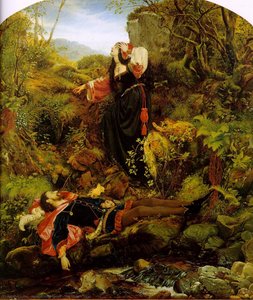
1
Hesperus, the Evening Star, Sacred to Lovers (1857) autorstwa Joseph Noel Paton

Hesperus, the Evening Star, Sacred to Lovers

1857 · Oil On Board

A man kneels before a woman in a secluded natural setting, their figures framed by the dense foliage of trees. He holds her hands in a gesture of devotion, his gaze fixed upon her as she looks down at him. The scene is quiet, set within a clearing where the soft light of the evening begins to settle. A single star hangs in the sky above them, casting a subtle…

2
Puck and Fairies, from "A Midsummer Night's Dream" (1850) autorstwa Joseph Noel Paton

Puck and Fairies, from "A Midsummer Night's Dream"

1850 · Oil On Board · Yale Center for British Art, New Haven

The forest breathes with a secret life as the moonlight filters through a dense canopy of tangled vegetation. In this intimate clearing, the air feels heavy with the scent of damp earth and the hum of unseen magic. Puck leans over the scene from the upper right, his large, rounded form casting a watchful presence over the delicate gathering below. The sprites move with a fluid, organic grace, their soft…

3
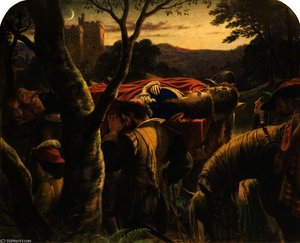
Michelangelo's dream autorstwa Joseph Noel Paton

Michelangelo's dream

Oil On Canvas

The artwork presents a dramatic portrait of a figure draped in a deep red robe, positioned within an archway formed by classical columns. This central figure dominates the vertically oriented composition, creating a sense of enclosure. Through the arch, a landscape is visible, featuring a crescent moon and a distant horizon line suggesting twilight or dawn. The scene is characterized by a strong use of chiaroscuro, with a single light…

4
The Temptations of St. Anthony (1860) autorstwa Joseph Noel Paton

The Temptations of St. Anthony

1860 · Terracotta · Muzeum Izraela, Jerozolima

In this circular, terracotta-colored relief sculpture, Joseph Noel Paton presents a quiet, intimate scene titled The Temptations of St. Anthony. The composition is centered on two figures rendered in classical attire, creating a focused, balanced arrangement. A seated female figure is captured in profile, facing toward the left. She is dressed in a draped garment characterized by fine vertical folds that catch the light. Opposite her, a smaller winged figure…

5
In Memoriam (1863) autorstwa Joseph Noel Paton

In Memoriam

1863 · Watercolor · Royal Collection, Londyn

The scene unfolds within the delicate, translucent layers of In Memoriam, a poignant watercolor or gouache study by the Scottish artist Joseph Noel Paton. Created in 1863, this work captures a quiet, spectral moment where the boundaries between the physical and the spiritual begin to dissolve. The paper holds a vision of memory, rendered with a softness that suggests the fleeting nature of life itself.

6
The Man with the Muck Rake (study) (1872) autorstwa Joseph Noel Paton

The Man with the Muck Rake (study)

1872 · Oil

The Man with the Muck Rake (study) emerges from the brush of Joseph Noel Paton, a man whose hands were shaped by the intricate patterns of the Scottish textile industry. Born in 1821 in Dunfermline, United Kingdom, Paton carries the precision of a weaver into his work as an artist, illustrator, and sculptor. This particular piece, dating to 1872, captures a moment of intense spiritual or moral focus. It exists…

8
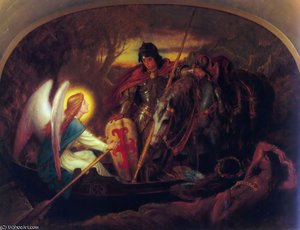
The choice autorstwa Joseph Noel Paton

The choice

In "The choice" by Joseph Noel Paton, a heavy tension hangs in the air, freezing a moment of profound conflict. Three figures dressed in medieval clothing occupy the center of the scene, their bodies angled toward one another in a struggle of words or wills. On the left, a man clad in armor stands as a rigid presence, his metallic attire catching the light amidst the unfolding drama. The others…

9
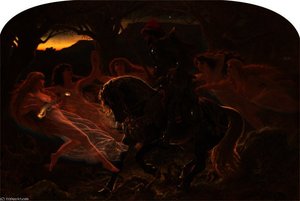
Oskold and the Elle Maids autorstwa Joseph Noel Paton

Oskold and the Elle Maids

Oil

A man sits atop a horse, a solitary figure amidst a sudden surge of movement. Around him, the forest breathes with the presence of the Elle Maids. These women, appearing as nymphs or fairies, drift through the shadows and the light, their forms scattered like fallen petals across the woodland floor. Some linger in the foreground, their presence felt in the immediate air, while others recede into the deep green…

10
The Reconciliation of Oberon and Titania autorstwa Joseph Noel Paton

The Reconciliation of Oberon and Titania

Oil On Canvas · Scottish National Gallery, Edynburg

The Reconciliation of Oberon and Titania emerges from the shadows of a Scottish forest, a scene where magic and emotion collide. Painted in 1847, this oil on canvas work by Sir Joseph Noel Paton captures a moment of profound transition. The air feels heavy with the aftermath of a great dispute, as the fairy rulers move toward a delicate peace. It is a sequel to a previous quarrel, a continuation…

Kontynuacja zestawienia Joseph Noel Paton, od 11 do 46

Tematy, które przyciągnęły wzrok Joseph Noel Paton

Cztery motywy najczęściej powracające w tych oryginałach, z których każdy doczekał się swojego najdoskonalszego przykładu.

Muzea przechowujące oryginały Joseph Noel Paton

7 muzeów, w których znajduje się najwięcej obrazów z tej strony.

Muzea Miasto Dzieła artysty Joseph Noel Paton Obrazy z tej listy
Scottish National Gallery, EdynburgScottish National Gallery Edynburg 3 The Reconciliation of Oberon and Titania, Dawn - Luther at Erfurt, The Quarrel of Oberon and Titania
Royal Collection, LondynRoyal Collection Londyn 2 In Memoriam, 'Home': The Return from the Crimea
Yale Center for British Art, New HavenYale Center for British Art New Haven 1 Puck and Fairies, from "A Midsummer Night's Dream"
Muzeum Izraela, JerozolimaMuzeum Izraela Jerozolima 1 The Temptations of St. Anthony
Laing Art Gallery, New South WalesLaing Art Gallery New South Wales 1 The Man of Sorrows
Sheffield City Art Galleries, SheffieldSheffield City Art Galleries Sheffield 1 The Fairy Queen
Musée de Grenoble, GrenobleMusée de Grenoble Grenoble 1 Beati mundo corde

Joseph Noel Paton dekada po dekadzie: oryginały definiujące każdy okres

Dzieła według dekad

Wybierz dekadę, aby zobaczyć dzieło, które ją definiuje.

Pytania kolekcjonerów o obrazy Joseph Noel Paton

Z jakiego dzieła najbardziej znany jest Joseph Noel Paton?Odkryj odpowiedź

Hesperus, the Evening Star, Sacred to Lovers (1857). Następne są Puck and Fairies, from "A Midsummer Night's Dream" (1850) oraz Michelangelo's dream.

W jakim wieku był Joseph Noel Paton, gdy powstało Hesperus, the Evening Star, Sacred to Lovers?Odkryj odpowiedź

36 lat: Hesperus, the Evening Star, Sacred to Lovers pochodzi z 1857, a Joseph Noel Paton urodził(a) się w 1821.

Jakie są dziesięć najsłynniejszych obrazów, których autorem jest Joseph Noel Paton?Odkryj odpowiedź

Hesperus, the Evening Star, Sacred to Lovers, Puck and Fairies, from "A Midsummer Night's Dream", Michelangelo's dream, The Temptations of St. Anthony, In Memoriam, The Man with the Muck Rake (study), Michelangelo Sculpting the Statue of 'Night', The choice, Oskold and the Elle Maids i The Reconciliation of Oberon and Titania. Powyższy ranking zawiera rok powstania oraz muzeum dla każdego z nich.

Ile obrazów pozostawił po sobie Joseph Noel Paton?Odkryj odpowiedź

Nasz katalog zawiera 46 dzieł artysty Joseph Noel Paton, datowanych od 1849 do 1875.

W których muzeach znajdują się arcydzieła Joseph Noel Paton?Odkryj odpowiedź

W większości znajdują się w Scottish National Gallery (Edynburg), Royal Collection (Londyn) i Yale Center for British Art (New Haven). Powyższa tabela muzeów zawiera ich pełną listę.

W których latach Joseph Noel Paton namalował swoje najsłynniejsze dzieła?Odkryj odpowiedź

W 1850s: 4 z 46 dzieł na tej stronie powstało w tym czasie, w tym Hesperus, the Evening Star, Sacred to Lovers.

Jakie są pierwsze i ostatnie słynne oryginały Joseph Noel Paton?Odkryj odpowiedź

Na tej stronie najwcześniejszy to The Quarrel of Oberon and Titania (1849), a najpóźniejszy The Man of Sorrows (1875).

Jakie tematy Joseph Noel Paton wybierał najczęściej?Odkryj odpowiedź

Man (5), Woman (5) i Forest (5), w ramach 46 dzieł na tej stronie.

Której techniki Joseph Noel Paton używał najczęściej?Odkryj odpowiedź

Oil On Canvas, dla 4 z 46 dzieł na tej stronie.

Do jakiego nurtu artystycznego należy Joseph Noel Paton?Odkryj odpowiedź

Pre-raphaelite i Romanticism, sądząc po oryginałach na tej stronie.

Które dzieła Joseph Noel Paton znajdują się w Scottish National Gallery?Odkryj odpowiedź

The Reconciliation of Oberon and Titania, Dawn - Luther at Erfurt i The Quarrel of Oberon and Titania: Scottish National Gallery, Edynburg posiada 3 dzieł widocznych na tej stronie.

Joseph Noel Paton: życie i twórczość

A Scottish Visionary: The Life and Art of Sir Joseph Noel Paton

Sir Joseph Noel Paton, a name synonymous with evocative fairy paintings, allegorical scenes, and deeply resonant religious depictions, emerged as a singular voice within the vibrant artistic landscape of Victorian Scotland. Born in Dunfermline on December 13, 1821, into a family steeped in the traditions of damask weaving – his parents were skilled designers and artisans – Paton’s early life was inextricably linked to intricate patterns and meticulous craftsmanship. This formative experience instilled within him an unparalleled appreciation for detail and design, qualities that would become hallmarks of his distinctive artistic style. Initially involved in the family business, directing design at a muslin factory, Paton's true passion lay beyond the realm of commercial production; he yearned for the freedom to explore his creative impulses. This desire led him to Dunfermline Art Academy, where he laid the foundation for a career deeply rooted in Scottish folklore, Celtic legends, and profound religious narratives. A brief but significant period of study at the Royal Academy in London during 1843 exposed him to the prevailing artistic currents of the time, yet it was not within the rigid confines of formal training that Paton truly blossomed – rather, it was through independent exploration and a deep connection to his heritage that he forged his unique path.

Weaving Myth and Morality: The Development of a Unique Style

Paton’s artistic journey can be characterized as an extraordinary synthesis of diverse influences, a masterful weaving together of folklore, religion, and Pre-Raphaelite aesthetics. He wasn't merely illustrating tales from ancient myths; he was breathing life into them with breathtaking realism and profound emotional depth. His early works, such as “The Quarrel of Oberon and Titania” (1847), a cornerstone of the National Gallery of Scotland’s collection, immediately established his reputation for capturing fantastical scenes with remarkable precision and psychological complexity. This painting, inspired by Shakespeare's *A Midsummer Night’s Dream*, is not simply a depiction of fairies engaged in a quarrel; it’s a portrayal of their passions, conflicts, and vulnerabilities – a testament to Paton’s ability to imbue mythological subjects with human-like qualities. Crucially, he declined an invitation to join the Pre-Raphaelite Brotherhood, yet his work shares their commitment to meticulous detail, symbolic richness, and narrative storytelling, demonstrating a connection that transcends formal membership. Beyond the realm of folklore, Paton explored religious themes with equal fervor, as evidenced in works like “Luther Discovering Justification by Faith,” revealing a deep engagement with theological concepts and a desire to communicate complex spiritual truths through visual imagery. His paintings are not merely beautiful; they invite contemplation and offer glimpses into the human condition.

Themes and Symbolism: A Window into Victorian Scotland

Paton’s work is profoundly imbued with symbolism, reflecting both his personal beliefs and the broader cultural anxieties of the Victorian era. His fascination with Celtic legends – a growing trend during this period – speaks to a burgeoning interest in national identity and folklore within Scotland. The fairy paintings, while seemingly whimsical, often carry underlying moral messages about temptation, innocence, and the dangers of unchecked desire. Religious works, such as those depicting scenes from the life of Martin Luther, explore themes of faith, redemption, and the struggle against oppression. His meticulous attention to detail – evident in the intricate costumes, landscapes, and facial expressions – adds layers of meaning to his compositions. The use of dramatic lighting and rich color palettes enhances the emotional impact of his paintings. Paton’s works frequently feature allegorical figures representing abstract concepts like love, death, and justice, inviting viewers to interpret their significance within a broader context. He wasn't simply recreating stories; he was using them as vehicles for exploring universal human experiences – faith, morality, and the complexities of life itself.

A Royal Appointment and Enduring Legacy

Recognition of Paton’s exceptional talent came swiftly. In 1865, he received a prestigious appointment as Queen's Limner for Scotland—a position that solidified his status as the foremost artist in the country. Two years later, in 1867, he was knighted, a remarkable honor bestowed upon him for his significant contributions to the arts and Scottish culture. This period saw him continue to produce works that blended historical accuracy with imaginative storytelling, showcasing his versatility and artistic mastery. Paintings like “Puck and Fairies” exemplify his ability to capture the ethereal beauty and mischievous spirit of the fairy world, while "Luther Discovering Justification by Faith" demonstrates his skill in portraying complex religious narratives. His influence extended beyond painting; he was a respected antiquarian, collecting arms and armor, and his poetic endeavors further enriched his artistic vision. He published two volumes of poetry – *By a Painter* (1861) and *Spindrift* (1867) – that beautifully reflected the romantic sensibility found in his paintings. Sir Joseph Noel Paton passed away on December 26, 1901, leaving behind a rich artistic legacy that continues to captivate audiences today. His works are now housed in prominent museums and collections across Scotland and beyond, ensuring that his art remains accessible for generations to come.

Major Achievements and Historical Significance

Sir Joseph Noel Paton’s career was marked by numerous achievements that cemented his place as a pivotal figure in Victorian Scottish art. He was a prize winner in the Westminster Hall Competitions (1845 and 1847), receiving recognition for his artistic skill and talent. Elected an Associate of the Royal Scottish Academy in 1847, he later achieved full membership in 1850. In 1866, he was appointed Queen's Limner for Scotland – a position of immense prestige that underscored his status as the nation’s leading artist. Two years later, in 1867, he received the honor of knighthood, further acknowledging his contributions to Scottish society and culture. His work also gained international recognition, with paintings purchased by Queen Victoria herself. Paton's legacy extends beyond his individual achievements; he played a significant role in shaping the artistic landscape of Victorian Scotland, influencing subsequent generations of artists and contributing to a renewed appreciation for Celtic folklore and religious themes. He stands as a testament to the power of art to capture imagination, explore profound truths, and celebrate the rich cultural heritage of Scotland.