Portret Irving Ramsey Wiles

31 najsłynniejszych obrazów artysty Irving Ramsey Wiles – wybór z galerii

Aktualizacja: Listopad 2026 · ranking według naszego wskaźnika popularności (liczba wyszukiwań, wizyt i zamówień dla każdego dzieła) · 32 dzieł Irving Ramsey Wiles w naszym katalogu

W skrócie

Z wszystkich oryginałów pozostawionych przez Irving Ramsey Wiles, najsłynniejszym jest The Student (1910). Tuż za nimi znajdują się William Sowden Sims (1919) oraz The Sonata (1889). Nasz katalog zawiera 32 dzieł autorstwa Irving Ramsey Wiles; galeria zachowała 31 najbardziej podziwianych na świecie prac, z których każda została przedstawiona wraz z datą powstania, informacją o muzeum oraz jej historią.

1861 – 1948, Utica Impressionism Najwięcej dzieł: Smithsonian American Art Museum

10 najlepszych obrazów artysty Irving Ramsey Wiles: wybór galerii

1
The Student (1910) autorstwa Irving Ramsey Wiles

The Student

1910 · Oil On Canvas

The quiet intensity of The Student finds its expression through the hand of Irving Ramsey Wiles. This oil on canvas, dating from about 1910, captures a singular moment of creative focus. The subject remains suspended in a private world of color and light, a scene that feels as though it is unfolding right before the viewer's eyes.

2
William Sowden Sims (1919) autorstwa Irving Ramsey Wiles

William Sowden Sims

1919 · Oil On Canvas · National Portrait Gallery, Waszyngton

This oil on canvas portrait, executed in 1919, depicts William Sowden Sims in a three-quarter length composition. The subject is positioned slightly off-center, facing forward with a steady, direct gaze directed toward the viewer. He is dressed in a high-ranking naval uniform, characterized by dark tones and detailed with gold stars on the collar and gold braid on the cuffs. His right hand rests upon the hilt of a sword,…

3
The Sonata (1889) autorstwa Irving Ramsey Wiles

The Sonata

1889 · Oil On Canvas · Fine Arts Museums of San Francisco, San Francisco

The oil on canvas work titled The Sonata was executed by Irving Ramsey Wiles. This painting features a scene of musical performance involving two women. While the title refers to a musical form, it does not explicitly identify the women depicted in the composition. One woman is positioned at a piano, and the other stands beside her with a violin. Although the subject matter centers on a musical moment, the…

4
Memories (1890) autorstwa Irving Ramsey Wiles

Memories

1890 · Oil On Canvas

Created in 1890, this work reflects the aesthetic sensibilities of an era defined by its social elegance and psychological nuance. The painting avoids the superficiality of mere flattery, opting instead to explore the quiet dignity of its subjects. Through the careful arrangement of figures and the controlled palette, the artist captures a specific type of intimacy—one that feels both private and profoundly composed. It is a study of character through…

5
The Pianist (1889) autorstwa Irving Ramsey Wiles

The Pianist

1889 · Oil On Canvas · Vanderbilt Museum of Art, Nashville

The Pianist is an oil on canvas work executed by Irving Ramsey Wiles. Created in 1889, this piece captures a quiet, intimate moment of musical engagement. The subject is a young woman seated at a piano, her presence defined by a sense of serene focus. It is a work that reflects the artist's early development during a period of significant stylistic formation.

6
Mildred Morris (1880–1966) (1901) autorstwa Irving Ramsey Wiles

Mildred Morris (1880–1966)

1901 · Oil On Canvas · New York Historical Society, Nowy Jork

In this 1901 portrait, we find ourselves in an intimate encounter with Mildred Morris. The composition is centered and bust-length, drawing the eye immediately to the subject's face and upper torso. She is set against a dark, indistinct background that allows her presence to emerge from the shadows. There is a certain stillness here, a sense of quiet dignity that defines her expression. The lighting, arriving from the front left,…

7
Miss Julia Marlowe (1901) autorstwa Irving Ramsey Wiles

Miss Julia Marlowe

1901 · Oil On Canvas · National Gallery of Art, Waszyngton

The gaze of Miss Julia Marlowe meets the viewer from within this portrait by Irving Ramsey Wiles. She sits with a quiet, poised presence, her likeness captured in oil paint about 1901. There is a sense of stillness in her posture, yet one feels the weight of her theatrical history in the way she holds herself. She is not merely a sitter but a woman of significant presence, known to…

8
The Twins (1907) autorstwa Irving Ramsey Wiles

The Twins

1907 · Oil

In The Twins, Irving Ramsey Wiles presents a formal portrait that captures a quiet moment of childhood. Created about 1907, this oil painting depicts two young children, likely twins, positioned side-by-side. Their presence is anchored by a small dog resting at their feet, completing a scene of domestic stillness. There is a certain dignity in the way the subjects are arranged, moving beyond a simple likeness to capture a specific…

9
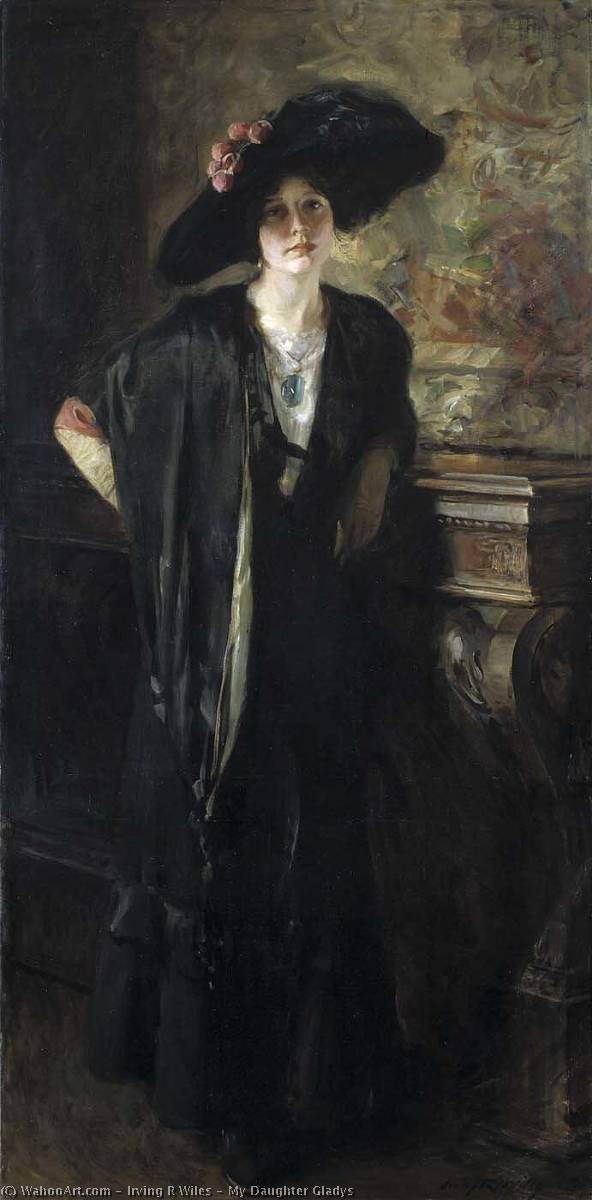
My Daughter Gladys (1913) autorstwa Irving Ramsey Wiles

My Daughter Gladys

1913 · Oil On Canvas · Smithsonian American Art Museum, Waszyngton

Irving Ramsey Wiles executed My Daughter Gladys about 1913. The portrait features the artist's daughter, Gladys, as the central subject. It belongs to the tradition of American grand manner portraiture, a style Wiles utilized to document the social and domestic spheres of the early twentieth century.

Kontynuacja zestawienia Irving Ramsey Wiles, od 11 do 31

Tematy, które przyciągnęły wzrok Irving Ramsey Wiles

Cztery motywy najczęściej powracające w tych oryginałach, z których każdy doczekał się swojego najdoskonalszego przykładu.

Muzea przechowujące oryginały Irving Ramsey Wiles

8 muzeów, w których znajduje się najwięcej obrazów z tej strony.

Muzea Miasto Dzieła artysty Irving Ramsey Wiles Obrazy z tej listy
Smithsonian American Art Museum, WaszyngtonSmithsonian American Art Museum Waszyngton 3 My Daughter Gladys, Ussian Tea, Brown Kimono (Portrait of Kathryn Beta la Forque)
New York Historical Society, Nowy JorkNew York Historical Society Nowy Jork 2 Mildred Morris (1880–1966), Robert Hendre Kelby (1847-1927)
National Portrait Gallery, WaszyngtonNational Portrait Gallery Waszyngton 1 William Sowden Sims
Fine Arts Museums of San Francisco, San FranciscoFine Arts Museums of San Francisco San Francisco 1 The Sonata
Vanderbilt Museum of Art Nashville 1 The Pianist
National Gallery of Art, WaszyngtonNational Gallery of Art Waszyngton 1 Miss Julia Marlowe
Albany Institute of History - Art, AlbanyAlbany Institute of History - Art Albany 1 Walter Launt Palmer (1854-1932)
New Britain Museum of American Art, New BritainNew Britain Museum of American Art New Britain 1 Fifth Avenue, Old Temple Emanu - El

Irving Ramsey Wiles dekada po dekadzie: oryginały definiujące każdy okres

Dzieła według dekad

Wybierz dekadę, aby zobaczyć dzieło, które ją definiuje.

Pytania kolekcjonerów o obrazy Irving Ramsey Wiles

Z jakiego dzieła najbardziej znany jest Irving Ramsey Wiles?Odkryj odpowiedź

The Student (1910). Następne są William Sowden Sims (1919) oraz The Sonata (1889).

W jakim wieku był Irving Ramsey Wiles, gdy powstało The Student?Odkryj odpowiedź

49 lat: The Student pochodzi z 1910, a Irving Ramsey Wiles urodził(a) się w 1861.

Jakie są dziesięć najsłynniejszych obrazów, których autorem jest Irving Ramsey Wiles?Odkryj odpowiedź

The Student, William Sowden Sims, The Sonata, Memories, The Pianist, Mildred Morris (1880–1966), Miss Julia Marlowe, The Twins, My Daughter Gladys i Robert Hendre Kelby (1847-1927). Powyższy ranking zawiera rok powstania oraz muzeum dla każdego z nich.

Ile obrazów pozostawił po sobie Irving Ramsey Wiles?Odkryj odpowiedź

Nasz katalog zawiera 32 dzieł artysty Irving Ramsey Wiles, datowanych od 1889 do 1932.

W których muzeach znajdują się arcydzieła Irving Ramsey Wiles?Odkryj odpowiedź

W większości znajdują się w Smithsonian American Art Museum (Waszyngton), New York Historical Society (Nowy Jork) i National Portrait Gallery (Waszyngton). Powyższa tabela muzeów zawiera ich pełną listę.

W których latach Irving Ramsey Wiles namalował swoje najsłynniejsze dzieła?Odkryj odpowiedź

W 1900s: 5 z 31 dzieł na tej stronie powstało w tym czasie, w tym Mildred Morris (1880–1966).

Jakie są pierwsze i ostatnie słynne oryginały Irving Ramsey Wiles?Odkryj odpowiedź

Na tej stronie najwcześniejszy to The Sonata (1889), a najpóźniejszy John Gellatly (1932).

Jakie tematy Irving Ramsey Wiles wybierał najczęściej?Odkryj odpowiedź

Woman (11), Portrait (5) i Musical instrument (4), w ramach 31 dzieł na tej stronie.

Której techniki Irving Ramsey Wiles używał najczęściej?Odkryj odpowiedź

Oil On Canvas, dla 10 z 31 dzieł na tej stronie.

Do jakiego nurtu artystycznego należy Irving Ramsey Wiles?Odkryj odpowiedź

Impressionism, sądząc po oryginałach na tej stronie.

Które dzieła Irving Ramsey Wiles znajdują się w Smithsonian American Art Museum?Odkryj odpowiedź

My Daughter Gladys, Ussian Tea i Brown Kimono (Portrait of Kathryn Beta la Forque): Smithsonian American Art Museum, Waszyngton posiada 3 dzieł widocznych na tej stronie.

Irving Ramsey Wiles: życie i twórczość

The Elegance of an Era: The Life and Art of Irving Ramsey Wiles

In the golden twilight of the Gilded Age, few artists captured the shimmering prestige and psychological nuance of American high society quite like Irving Ramsey Wiles. Born in 1861 in Utica, New York, Wiles emerged as a premier exponent of the "grand manner" portraiture style, a tradition that sought to elevate its subjects through a sophisticated blend of realism and idealized grace. His journey was one of rigorous academic discipline met with an intuitive, almost poetic, sensitivity to light and character. From his earliest lessons under his father, the landscape painter Lemuel Maynard Wiles, to his transformative years in the great art capitals of Europe, Wiles cultivated a technique that would eventually make him the preferred chronicler of the American leisure class.
The foundation of Wiles’s mastery was laid in the vibrant studios of New York and Paris. After studying at the Art Students League under the legendary William Merritt Chase, Wiles sought the refined atmosphere of the French academies. His time at the Académie Julian and his studies in the atelier of Carolus-Duran—the very man who mentored John Singer Sargent—were pivotal. From these masters, he inherited a profound understanding of tonal harmony and the ability to use fluid, dazzling brushwork to suggest movement and vitality. This European training allowed him to bridge the gap between the meticulous anatomical accuracy of the old masters and the burgeoning Impressionistic interest in atmospheric light, creating a style that felt both timeless and modern.

A Master of Character and Light

Wiles’s ascent to stardom was marked by an extraordinary ability to capture not just a likeness, but a soul. His breakthrough in 1902, with the portrait of the celebrated actress Julia Marlowe, sent ripples through the National Academy of Design, announcing the arrival of a painter who could command both the stage and the canvas. He possessed a rare gift for rendering the textures of silk, lace, and skin with such precision that his subjects seemed to breathe within their frames. Yet, beneath this technical virtuosity lay a deeper commitment to psychological depth; he avoided the superficiality of mere flattery, instead seeking the quiet dignity or the spirited essence of his sitters.

While his fame was anchored in the portraits of political titans like Theodore Roosevelt and William Jennings Bryan, Wiles’s artistic range extended far beyond the studio walls. His oeuvre includes:

  • Intimate Portraits: Capturing the grace of socialites and the theatrical presence of performers with unparalleled elegance.
  • Luminous Landscapes: Works that reflect the influence of his teacher Chase, characterized by a vibrant palette and a sense of seasonal atmosphere.
  • Atmospheric Seascapes: Studies of water and light that demonstrate his command over fluid, expressive brushstrokes.
  • Figure Studies: More informal explorations of the human form that reveal his dedication to anatomical truth.

Legacy Amidst Changing Tides

As the twentieth century progressed, the art world underwent a radical transformation. The rise of modernism and more abstract movements eventually began to eclipse the grand manner style that Wiles so perfectly embodied. By the time of his passing in 1948, the era of the elegant, highly polished society portrait had largely been supplanted by a new, fragmented aesthetic. However, the historical significance of Irving Ramsey Wiles remains undiminuted. He stands as a vital link to a period of American history defined by opulence, ambition, and a profound respect for classical beauty.

Today, his works serve as luminous windows into the Gilded Age, preserved in the hallowed halls of the Smithsonian American Art Museum, the Metropolitan Museum of Art, and the National Gallery of Art. To look upon a Wiles portrait is to experience the quiet majesty of a bygone era, rendered with a hand that understood both the fleeting nature of light and the enduring power of human character.