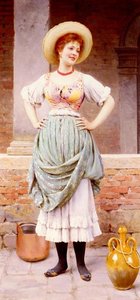
Portret Eugene de Blaas

Obrazy: 100 najsłynniejszych dzieł artysty Eugene de Blaas – spojrzenie galerii

Aktualizacja: Październik 2026 · ranking według naszego wskaźnika popularności (liczba wyszukiwań, wizyt i zamówień dla każdego dzieła) · 137 dzieł Eugene de Blaas w naszym katalogu

W skrócie

Według galerii najsłynniejszym obrazem Eugene de Blaas jest The Serenade. The Friendly Gossips (1901) i Gathering Shells dopełniają trio, które zna każde oko. Z 137 dzieł Eugene de Blaas w naszym katalogu, galeria prezentuje poniżej 100 najsłynniejszych prac – każda z nich jest oryginałem z podaniem roku powstania, muzeum oraz cech wyróżniających ją na tle innych.

1843 – 1931, Albano Laziale Academicism Najwięcej dzieł: Szépművészeti Múzeum

10 najlepszych obrazów artysty Eugene de Blaas w galerii

1
The Serenade autorstwa Eugene de Blaas

The Serenade

Oil

In the tender embrace of The Serenade, we are transported to a sun-drenched corner of nineteenth-century Venice, where the air seems to vibrate with the soft strumming of a guitar. Eugen von Blaas, a master of Academic Classicism, captures more than just a musical performance; he captures a fleeting moment of communal intimacy. The scene unfolds around a central figure—a musician perched upon a stone wall, his instrument serving as…

2
The Friendly Gossips (1901) autorstwa Eugene de Blaas

The Friendly Gossips

1901 · Oil

The painting depicts a domestic interior within a modest Italian dwelling. Three women sit together on a bench, their bodies oriented toward one another in a state of active conversation. They wear dresses consistent with the turn of the twentieth century. To the right, a chair sits near the edge of the frame, while a vase occupies the left side. The composition is divided into two distinct zones. In the…

3
Gathering Shells autorstwa Eugene de Blaas

Gathering Shells

Oil On Canvas

In Gathering Shells, Eugene de Blaas captures a quiet moment of labor on a sandy beach. Two women occupy the foreground, their bodies anchored to the earth. One woman kneels in the sand, her hands busy sorting shells into a wooden bucket. Beside her, another woman stands upright, her gaze drifting toward the horizon. They are immersed in the simple, repetitive rhythm of their task.

4
Gathering Cockles at the Seashore autorstwa Eugene de Blaas

Gathering Cockles at the Seashore

Watercolor

Gathering Cockles at the Seashore is a work by the Italian painter Eugene de Blaas, executed before 1932. The painting captures a scene of everyday life, focusing on the quiet labor of a woman collecting shellfish along a sandy beach. Through this subject, the artist explores the intersection of human activity and the natural coastal environment.

Obrazy artysty Eugene de Blaas, uszeregowane od 11 do 100 miejsca

11The bingo game (1871) autorstwa Eugene de BlaasThe bingo game1871 12A Venetian beauty (1865) autorstwa Eugene de BlaasA Venetian beauty1865 13Feeding the ducks (1874) autorstwa Eugene de BlaasFeeding the ducks1874 14The Secret (1876) autorstwa Eugene de BlaasThe Secret1876 15Portrait of a Woman at a Window (1885) autorstwa Eugene de BlaasPortrait of a Woman at a Window1885 16Girl with fish (1879) autorstwa Eugene de BlaasGirl with fish1879 17Hesitancy (1885) autorstwa Eugene de BlaasHesitancy1885 · Szépművészeti Múzeum 18Venetians at the balcony (1881) autorstwa Eugene de BlaasVenetians at the balcony1881 19Head of a boy (1880) autorstwa Eugene de BlaasHead of a boy1880 · Victoria and Albert Museum 20Festival day, Venice (1879) autorstwa Eugene de BlaasFestival day, Venice1879 21At the Carnival (1879) autorstwa Eugene de BlaasAt the Carnival1879 · Wolverhampton Art Gallery 22Singing Group of Women on the Seashore (1888) autorstwa Eugene de BlaasSinging Group of Women on the Seashore1888 23The young woman called 'Ninetta' (1887) autorstwa Eugene de BlaasThe young woman called 'Ninetta'1887 24Curiosity (1891) autorstwa Eugene de BlaasCuriosity1891 · Te Whare O Rehua Sarjeant Gallery 25The Work autorstwa Eugene de BlaasThe Work 26The Suitor (1887) autorstwa Eugene de BlaasThe Suitor1887 27Young lady with red fan (1897) autorstwa Eugene de BlaasYoung lady with red fan1897 28A Good Catch (1894) autorstwa Eugene de BlaasA Good Catch1894 29The Unseen Suitor (1898) autorstwa Eugene de BlaasThe Unseen Suitor1898 30Love's Labor Lost (1903) autorstwa Eugene de BlaasLove's Labor Lost1903 31Mother's Little Helper (1884) autorstwa Eugene de BlaasMother's Little Helper1884 32The Flower Girl (1911) autorstwa Eugene de BlaasThe Flower Girl1911 33Catch of the Day autorstwa Eugene de BlaasCatch of the Day 34The Seamstress autorstwa Eugene de BlaasThe Seamstress 35In the Sacristy (1877) autorstwa Eugene de BlaasIn the Sacristy1877 36Philip Richard Morris (1865) autorstwa Eugene de BlaasPhilip Richard Morris1865 37The Love Letter (1887) autorstwa Eugene de BlaasThe Love Letter1887 38The Offer (1887) autorstwa Eugene de BlaasThe Offer1887 39Accepted (1887) autorstwa Eugene de BlaasAccepted1887 40The Italian Flower Girl (1887) autorstwa Eugene de BlaasThe Italian Flower Girl1887 41A Venetian Water Carrier (1890) autorstwa Eugene de BlaasA Venetian Water Carrier1890 42A Venetian Courtship (1891) autorstwa Eugene de BlaasA Venetian Courtship1891 · New Walk Museum - Art Gallery 43The Fruit Seller autorstwa Eugene de BlaasThe Fruit Seller 44Portrait of a Boy (1900) autorstwa Eugene de BlaasPortrait of a Boy1900 45Baroness von Scholl autorstwa Eugene de BlaasBaroness von Scholl 46Daydreaming 1 autorstwa Eugene de BlaasDaydreaming 1 47Musette autorstwa Eugene de BlaasMusette 48God's Creatures autorstwa Eugene de BlaasGod's Creatures 49Fruit Vendor autorstwa Eugene de BlaasFruit Vendor 50An Affectionate Glance autorstwa Eugene de BlaasAn Affectionate Glance 51Madchenbildnis autorstwa Eugene de BlaasMadchenbildnis 52Unknown autorstwa Eugene de BlaasUnknown 53Madchen mit Granatapfeln autorstwa Eugene de BlaasMadchen mit Granatapfeln 54Daydreaming autorstwa Eugene de BlaasDaydreaming 55Am Brunnen autorstwa Eugene de BlaasAm Brunnen 56Lisa autorstwa Eugene de BlaasLisa 57The Flower Seller autorstwa Eugene de BlaasThe Flower Seller 58The Farewell autorstwa Eugene de BlaasThe Farewell 59Portrait of a Woman autorstwa Eugene de BlaasPortrait of a Woman 60Die Lauscherin autorstwa Eugene de BlaasDie Lauscherin 61A Pensive Beauty autorstwa Eugene de BlaasA Pensive Beauty 62Balcony autorstwa Eugene de BlaasBalcony 63The Days Catch autorstwa Eugene de BlaasThe Days Catch 64Young Italian Beauty autorstwa Eugene de BlaasYoung Italian Beauty 65An Interesting Story autorstwa Eugene de BlaasAn Interesting Story 66A Young Beauty autorstwa Eugene de BlaasA Young Beauty 67Elegant Lady autorstwa Eugene de BlaasElegant Lady 68Flirtation at the Well autorstwa Eugene de BlaasFlirtation at the Well 69A Viennese Beauty autorstwa Eugene de BlaasA Viennese Beauty 70The Flirtation autorstwa Eugene de BlaasThe Flirtation 71On the Balcony autorstwa Eugene de BlaasOn the Balcony 72Shared Correspondance autorstwa Eugene de BlaasShared Correspondance 73The Flirtation 1 autorstwa Eugene de BlaasThe Flirtation 1 74The Yellow Shawl autorstwa Eugene de BlaasThe Yellow Shawl 75The Grape Picker autorstwa Eugene de BlaasThe Grape Picker 76The Pearl Necklace autorstwa Eugene de BlaasThe Pearl Necklace 77Portrait of a Venetian Lady autorstwa Eugene de BlaasPortrait of a Venetian Lady 78Zwei Kinder autorstwa Eugene de BlaasZwei Kinder 79Die Wassertragerin autorstwa Eugene de BlaasDie Wassertragerin 80Young Beauty autorstwa Eugene de BlaasYoung Beauty 81The Knitting Lesson autorstwa Eugene de BlaasThe Knitting Lesson 82Le Plaisir autorstwa Eugene de BlaasLe Plaisir 83On The Balcony 1 autorstwa Eugene de BlaasOn The Balcony 1 84Head of a Young Boy autorstwa Eugene de BlaasHead of a Young Boy 85The Eavesdropper autorstwa Eugene de BlaasThe Eavesdropper 86Good News autorstwa Eugene de BlaasGood News 87Venetian Beauty on Balcony autorstwa Eugene de BlaasVenetian Beauty on Balcony 88Venetian Flower Seller autorstwa Eugene de BlaasVenetian Flower Seller 89Meeting in the Square autorstwa Eugene de BlaasMeeting in the Square 90Portrait of a Lady autorstwa Eugene de BlaasPortrait of a Lady 91La lavandière (1912) autorstwa Eugene de BlaasLa lavandière1912 92Untitled (AQTQMF) (1931) autorstwa Eugene de BlaasUntitled (AQTQMF)1931 · National Portrait Gallery 93Dressing for the Masquerade (1885) autorstwa Eugene de BlaasDressing for the Masquerade1885 94Young italian girl autorstwa Eugene de BlaasYoung italian girl 95The Laundress autorstwa Eugene de BlaasThe Laundress 96the rose autorstwa Eugene de Blaasthe rose 97Eugen von The Eavesdropper autorstwa Eugene de BlaasEugen von The Eavesdropper 98Gethering Shells autorstwa Eugene de BlaasGethering Shells 99A Venetian Beauty autorstwa Eugene de BlaasA Venetian Beauty 100A Venetian Beauty autorstwa Eugene de BlaasA Venetian Beauty

Tematy, które przyciągnęły wzrok Eugene de Blaas

Cztery motywy najczęściej powracające w tych oryginałach, z których każdy doczekał się swojego najdoskonalszego przykładu.

Muzea przechowujące oryginały Eugene de Blaas

6 muzeów, w których znajduje się najwięcej obrazów z tej strony.

Muzea Miasto Dzieła artysty Eugene de Blaas Obrazy z tej listy
Szépművészeti Múzeum, BudapesztSzépművészeti Múzeum Budapeszt 1 Hesitancy
Victoria and Albert Museum, LondynVictoria and Albert Museum Londyn 1 Head of a boy
Wolverhampton Art Gallery, WolverhamptonWolverhampton Art Gallery Wolverhampton 1 At the Carnival
Te Whare O Rehua Sarjeant GalleryTe Whare O Rehua Sarjeant Gallery 1 Curiosity
New Walk Museum - Art Gallery, LeicesterNew Walk Museum - Art Gallery Leicester 1 A Venetian Courtship
National Portrait Gallery, LondynNational Portrait Gallery Londyn 1 Untitled (AQTQMF)

Eugene de Blaas, jedno kultowe dzieło na dekadę

Dzieła według dekad

Wybierz dekadę, aby zobaczyć dzieło, które ją definiuje.

Obrazy artysty Eugene de Blaas: odpowiedzi galerii

Który obraz Eugene de Blaas jest najsłynniejszy ze wszystkich?Odkryj odpowiedź

The Serenade. Następne są The Friendly Gossips (1901) oraz Gathering Shells.

Które to 10 najlepszych obrazów Eugene de Blaas?Odkryj odpowiedź

The Serenade, The Friendly Gossips, Gathering Shells, Gathering Cockles at the Seashore, Which Came First, Portrait of a Boy, A Pensive Moment, A Young Fishwife, Female portrait i Young Woman with Children on the Beach. Powyższy ranking zawiera rok powstania oraz muzeum dla każdego z nich.

Ile dzieł stworzył/a Eugene de Blaas?Odkryj odpowiedź

Nasz katalog zawiera 137 dzieł artysty Eugene de Blaas, datowanych od 1863 do 1931.

Gdzie można znaleźć najsłynniejsze oryginały autorstwa Eugene de Blaas?Odkryj odpowiedź

W większości znajdują się w Szépművészeti Múzeum (Budapeszt), Victoria and Albert Museum (Londyn) i Wolverhampton Art Gallery (Wolverhampton). Powyższa tabela muzeów zawiera ich pełną listę.

Kiedy Eugene de Blaas stworzył swoje najsłynniejsze obrazy?Odkryj odpowiedź

W 1880s: 13 z 100 dzieł na tej stronie powstało w tym czasie, w tym Portrait of a Woman at a Window.

Które z najsłynniejszych dzieł Eugene de Blaas należą do jego najwcześniejszych i najpóźniejszych prac?Odkryj odpowiedź

Na tej stronie najwcześniejszy to Female portrait (1863), a najpóźniejszy Untitled (AQTQMF) (1931).

Do jakich tematów Eugene de Blaas powracał najczęściej?Odkryj odpowiedź

Women (24), Portraits (13) i Italy (6), w ramach 100 dzieł na tej stronie.

W jakiej technice najczęściej tworzył Eugene de Blaas?Odkryj odpowiedź

Oil, dla 2 z 100 dzieł na tej stronie.

Z jakim nurtem związany jest Eugene de Blaas?Odkryj odpowiedź

Academicism, sądząc po oryginałach na tej stronie.

Eugene de Blaas: artysta

Eugen von Blaas: Wenecki Mistrz Klasycyzmu Akademickiego

Urodzony w 1843 roku w Albano koło Rzymu, Eugen de Blaas (później znany jako Eugene von Blaas) wywodził się z rodziny głęboko zakorzenionej w tradycji artystycznej. Jego ojciec, Karl von Blaas, był szanowanym malarzem i profesorem Akademii Weneckiej, co zapewniło młodemu Eugenowi bezprecedensowe fundamenty w zakresie historii sztuki, technik fresku oraz zasad klasycznej kompozycji. Ta rodzinna inspiracja w sposób fundamentalny ukształtowała jego artystyczną drogę, prowadząc go ku założeniom klasycyzmu akademickiego – stylu charakteryzującego się niezwykłą dbałością o detal, idealizacją form oraz głębokim szacunkiem dla tematów historycznych i mitologicznych.

Wczesne lata Eugena upłynęły pod znakiem zanurzenia w tętniącej życiem atmosferze Wenecji – miasta, które stało się zarówno jego muzą, jak i przedmiotem głębokiego uwielbienia. Przeprowadzka z rodziną do lagunowego grodu w dzieciństwie pozwoliła mu chłonąć unikalną kulturę, architekturę i obyczaje społeczne tego miejsca. Ta intymna więź z Wenecją stała się kamieniem węgielnym jego twórczości, determinując wybór tematów oraz wypracowując jego charakterystyczny język wizualny. W przeciwieństwie do wielu współczesnych mu artystów, którzy starali się uchwycić ulotne chwile czy sceny współczesne, Blaas nieustannie powracał do przedstawień życia weneckiego – ze szczególnym uwzględnieniem eleganckich kobiet z kręgów arystokratycznych – oferując starannie skonstruowaną i wyidealizowaną wizję tego urzekającego miasta.

Sztuka Weneckich Scen Gatunkowych

Kariera artystyczna Blaasa rozkwitła w późnym XIX wieku, w okresie naznaczonym znaczącymi przeobrażeniami w sztuce europejskiej. Podczas gdy w innych częściach kontynentu zyskiwał na sile impresjonizm, Blaas pozostał wierny klasycyzmowi akademickiemu, tworząc dzieła niezwykle szczegółowe i przesycone duchem romantycznej nostalgii. Jego najsławniejsze płótna należą do kategorii „scen gatunkowych”, które utrwalają codzydzień w społeczeństwie weneckim. Nie są to jednak surowe zapisy rzeczywistości, lecz raczej starannie wyreżyserowane witryny, często przedstawiające zamożne kobiety w bogatych kostiumach, oddające się beztroskim czynnościom, takim jak zakupy, udział w spotkaniach towarzyskich czy po prostu delektowanie się pięknem otoczenia.

Jego malarstwo nieustannie zachwyca niezwykłą uwagą poświęconą detalom – od lśniących tkanin i misternych ozdób noszonych przez modelki, po precyzyjnie oddaną architekturę i nastrojowe oświetlenie. Sposób użycia koloru przez Blaasa jest szczególnie godny uwagi; stosuje on bogate, nasycone barwy, aby przywołać ciepło i świetlistość weneckiego słońca, tworząc sceny, które są jednocześnie wizualnie olśniewające i emocjonalnie poruszające. Był prawdziwym mistrzem chwytania esencji arystokratycznej Wenecji, prezentując wyidealizowany obraz bogactwa, piękna i społecznej gracji.

Kluczowe Dzieła i Styl Artystyczny

Wśród najbardziej ikonicznych dzieł Blaasa znajduje się „Mały pomocnik matki” (1884), oferujący uroczy wgląd w rustykalną scenę z weneckiej kuchni, oraz „Na balkonie” (1877) – pełne życia przedstawienie modnego spotkania na balkonie z widokiem na kanały. Kolejnym znamiennym przykładem jest „La forma nuziale in sacrestia”, ukazujące ceremonię ślubną w zakrystii kościelnej z niezwykłą precyzją i elegancją. Prace te stanowią kwintesencję jego autorskiego stylu, cechującego się rygorystycznym realizmem, zrównoważoną kompozycją i subtelną głębią emocjonalną.

Rozwój artystyczny malarza można prześledzić jako ewolucję od tematów jawnie klasycznych ku coraz bardziej intymnym przedstawieniom życia w Wenecji. Choć przez całą karierę kontynuował malowanie portretów, to właśnie sceny gatunkowe ostatecznie ugruntowały jego reputację jako jednego z najzdolniejszych artystów swojego pokolenia. Po mistrzowsku łączył historyczne wpływy z obserwacją współczesności, tworząc dzieła ponadczasowe, a jednocześnie głęboko zakorzenione w ich konkretnym kontekście.

Dziedzictwo i Znaczenie Historyczne

Twórczość Eugena von Blaasa stanowi fascynujące przecięcie tradycji artystycznej i tożsamości kulturowej. Jego przywiązanie do klasycyzmu akademickiego dostarczyło mu technicznych umiejętności i formalnego wykształcenia niezbędnego do osiągnięcia mistrzostwa, podczas gdy głęboka miłość do Wenecji tchnęła w jego sztukę unikalne poczucie miejsca i atmosfery. Jego obrazy stanowią bezcenne źródło wiedzy o zwyczajach społecznych, trendach modowych i estetycznej wrażliwości weneckiego społeczeństwa XIX wieku.

Mimo że za życia nie osiągnął on powszechnej sławy, dzieła Blaasa zostały później docenione za ich wartość artystyczną i znaczenie historyczne. Jego malarstwo znajduje się obecnie w prestiżowych muzeach i prywatnych kolekcjach na całym świecie, służąc jako świadectwo jego trwałego dziedzictwa jako jednego z najsławniejszych artystów Wenecji. Jego drobiazgowa dbałość o detal, w połączeniu z ewokatywnym przedstawieniem życia w tym niezwykłym mieście, nieustannie zachwyca współczesnych odbiorców.