


1


Aktualizacja: Październik 2026 · ranking według naszego wskaźnika popularności (liczba wyszukiwań, wizyt i zamówień dla każdego dzieła) · 38 dzieł Edward Charles Williams w naszym katalogu
W skrócie
Według galerii najsłynniejszym obrazem Edward Charles Williams jest A Gypsy Encampment. A Tranquil Backwater i The Encampment dopełniają trio, które zna każde oko. Z 38 dzieł Edward Charles Williams w naszym katalogu, galeria prezentuje poniżej 37 najsłynniejszych prac – każda z nich jest oryginałem z podaniem roku powstania, muzeum oraz cech wyróżniających ją na tle innych.


Charles Williams (1942-1998) was born in Blue Diamond, Kentucky, a place he described as a “little old country hick town in coal mining territory, eight miles from Hazard, Kentucky, back up in the hollow where the blacks lived.” As a child, Williams taught himself to draw by copying comic book figures like Superman, Dick Tracy, and Captain Marvel. Shown here is a of an early issue of Williams’ first original…


 Figures On A Path In A Wooded Landscape
12
 Landscape -
13
 Landscape -
14
 A Gypsy Encampment In A Wooded Landscape
15
 Old mills on the thames
16
 The Approaching Storm
17
 A Country LaneAnglesey Abbey
18
 Figures On The Bank Of A River With A Cottage Beyond
19
 Barges on the thames at dusk, with windsor castle beyond
20
 Going To Market, View Near West Broughton
21
 The Venerable Thomas Thorp
22
 Figures Beside A Pool Before A Gate, A Cottage Beyond; And Another Similar
23
 Cattle Watering At The Stepping Stones
24
 The Meeting; And The Path From The Village Church, The Isle Of Wight
25
 The swan inn, bossington, somerset
26
 Landscape With A Lane And Figures
27
 Landscape -
28
 A Roadside Inn At Rushington, Sussex
29
 Figures Before A Cottage In A Wooded Landscape
30
 Figures in a punt with sheep watering in a wooded landscape
31
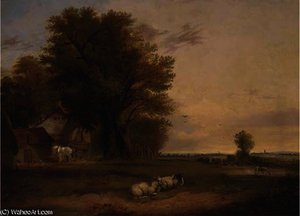 Sheep and cattle in a summer landscape
32
 Figures before a cottage in a wooded river landscape
33
 A Figure On A Track Before A Cottage
34
 Basket Of Roses With Fuschia
35
 Distant View Of Salisbury Cathedral, Wiltshire
36
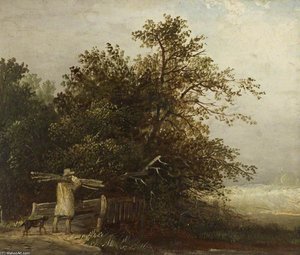 A Man Crossing A Bridge Carrying A Bundle Of SticksAnglesey Abbey
37
 Landscape With Sheep On A Road
Cztery motywy najczęściej powracające w tych oryginałach, z których każdy doczekał się swojego najdoskonalszego przykładu.
2 muzeów, w których znajduje się najwięcej obrazów z tej strony.
| Muzea | Miasto | Dzieła artysty Edward Charles Williams | Obrazy z tej listy |
|---|---|---|---|
 Anglesey Abbey |
3 | Mother And Child On A Track By A Coppice, A Country Lane, A Man Crossing A Bridge Carrying A Bundle Of Sticks | |
 Atlanta Contemporary |
Atlanta | 1 | Spectacular Captain Soul: CAPTIVES OF THE COSMIC MAYFLOWER, Chapter 1 |
A Gypsy Encampment. Następne są A Tranquil Backwater oraz The Encampment.
A Gypsy Encampment, A Tranquil Backwater, The Encampment, Landscape -, Mother And Child On A Track By A Coppice, Spectacular Captain Soul: CAPTIVES OF THE COSMIC MAYFLOWER, Chapter 1, Noon Day Rest, Figures By A Cottage, Landscape i A Village In The New Forest. Powyższy ranking zawiera rok powstania oraz muzeum dla każdego z nich.
Nasz katalog zawiera 38 dzieł autorstwa Edward Charles Williams.
W większości znajdują się w Anglesey Abbey i Atlanta Contemporary (Atlanta). Powyższa tabela muzeów zawiera ich pełną listę.
Landscape (12), Cottages (6) i Wood (5), w ramach 37 dzieł na tej stronie.
Mother And Child On A Track By A Coppice, A Country Lane i A Man Crossing A Bridge Carrying A Bundle Of Sticks: Anglesey Abbey posiada 3 dzieł widocznych na tej stronie.

