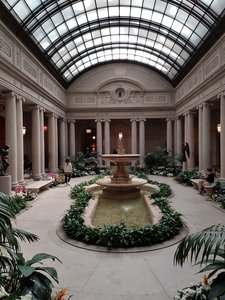
Portrett av Vecchietta

De 10 mest kjente maleriene av Vecchietta, et gallerivalg

Oppdatert October 2026 · rangert etter vår popularitetsscore (søk, besøk og bestillinger for hvert verk) · 10 verk av Vecchietta i vår katalog

Kort fortalt

Av alle originalverkene Vecchietta etterlot seg, er det mest kjente The religious vow of obedience (1460), som er en del av samlingen til Bavarian State Painting Collections i München. Like bak følger Risen Christ (1476) og Arliquiera (outer shutters) (1445). Vår katalog inneholder 10 verk av Vecchietta; galleriet har bevart de 10 verkene som verden beundrer mest, hver vist med sin dato, sitt museum og sin historie.

1412 – 1480, Siena Flest verk: Pinacoteca Nazionale

Vecchiettas topp 10 malerier: galleriets utvalg

1
The religious vow of obedience (1460) av Vecchietta

The religious vow of obedience

1460 · Tempera On Panel · Bavarian State Painting Collections, München

In "The religious vow of obedience" by Vecchietta, the scene is anchored by two figures captured in profile. On the right, an older, bald man with a halo leans forward. He is draped in a heavy, greyish-brown monastic habit, his presence marked by the weight of the fabric. He holds a wooden staff or rod, extending it toward a second, smaller figure. This smaller figure bows deeply in a gesture…

2
Risen Christ (1476) av Vecchietta

Risen Christ

1476 · Bronze · Chiesa dell'Ospedale della Scala, Siena

Located at the high altar of the Church of the Santissima Annunziata within the Hospital of Santa Maria della Scala in Siena, Italy, this 1476 bronze sculpture represents a departure from traditional liturgical placement. It is a monumental, full-length figure of the Savior, notable for being the first instance where bronze was selected for such a significant altar image. The work captures Christ in a state of transition, bearing the…

3
Arliquiera (outer shutters) (1445) av Vecchietta

Arliquiera (outer shutters)

1445 · Oil On Canvas · Pinacoteca Nazionale, Siena

To stand before this magnificent Arliquiera, or outer shutters, is to step directly into the deeply spiritual heart of Quattrocento Siena. This piece transcends mere decorative woodwork; it is a profound devotional narrative rendered in paint and wood, a veritable encyclopedia of Christian iconography crafted for a sacred space. The sheer density of painted figures—at least thirteen distinct representations of Christ, Mary, and various saints—suggests not just an artist's skill,…

4
Resurrection (1472) av Vecchietta

Resurrection

1472 · Painting · The Frick Collection, New York City

To gaze upon Vecchietta’s "Resurrection" is to confront one of humanity's most enduring spiritual yearnings: the promise of eternal life beyond earthly decay. Painted in 1472, this work transcends a mere depiction of an event; it captures a moment of sublime, breathtaking transition. The composition immediately draws the eye to the central figure, standing victoriously atop the bier—the very symbol of death itself. His raised arms are not merely gestures,…

Motivene som fanget Vecchiettas blikk

De fire motivene som går igjen hyppigst i disse originalverkene, hver med sitt fremste eksempel.

Museene som har Vecchiettas originalverk

De 8 museene som innehar flest av maleriene på denne siden.

Museum By Verker av Vecchietta Malerier fra denne listen
Pinacoteca Nazionale, SienaPinacoteca Nazionale Siena 2 Arliquiera (outer shutters), The Blessed Agostino Novello Assigning the Habit of the Hospital to the Rector
Bavarian State Painting Collections, MünchenBavarian State Painting Collections München 1 The religious vow of obedience
Chiesa dell'Ospedale della Scala, SienaChiesa dell'Ospedale della Scala Siena 1 Risen Christ
The Frick Collection, New York CityThe Frick Collection New York City 1 Resurrection
Cathedral, PienzaCathedral Pienza 1 The Virgin of the Assumption with Saints
Santa Maria del Popolo, RomaSanta Maria del Popolo Roma 1 Sepulchral Monument of Pietro Foscari
Collezione Vittorio Cini, VeniceCollezione Vittorio Cini Venice 1 St Peter the Martyr
Aberdeen Art GalleryAberdeen Art Gallery 1 Madonna of Humility Crowned by Two Angels, Saints Francis and Dominic, Annunciation and Crucifixion - Vecchietta (Lorenzo di Pietro)

Vecchietta tiår for tiår: originalverket som definerer hvert av dem

Verk per tiår

Velg et tiår for å se originalverket som definerer det.

Samlere spør om maleriene til Vecchietta

Hvilket verk er Vecchietta mest kjent for?Avslør svaret

The religious vow of obedience (1460), Bavarian State Painting Collections, München. Deretter følger Risen Christ (1476) og Arliquiera (outer shutters) (1445).

Hvor gammel var Vecchietta da The religious vow of obedience ble laget?Avslør svaret

48 år gammel: The religious vow of obedience er fra 1460, og Vecchietta ble født i 1412.

Hva er de ti mest kjente maleriene til Vecchietta?Avslør svaret

The religious vow of obedience, Risen Christ, Arliquiera (outer shutters), Resurrection, The Blessed Agostino Novello Assigning the Habit of the Hospital to the Rector, The Virgin of the Assumption with Saints, Sepulchral Monument of Pietro Foscari, St Peter the Martyr, Madonna of Humility Crowned by Two Angels, Saints Francis and Dominic, Annunciation and Crucifixion - Vecchietta (Lorenzo di Pietro) og The Founding of the Spedale di Santa Maria della Scala. Rangeringen ovenfor viser årstall og museum for hvert verk.

Hvor mange malerier etterlot Vecchietta?Avslør svaret

Vår katalog inneholder 10 verk av Vecchietta, datert fra 1445 til 1480.

I hvilke museer henger mesterverkene til Vecchietta?Avslør svaret

Hovedsakelig i Pinacoteca Nazionale (Siena), Bavarian State Painting Collections (München) og Chiesa dell'Ospedale della Scala (Siena). Museumslisten ovenfor viser alle.

I hvilke år malte Vecchietta sine mest kjente verk?Avslør svaret

I 1470s: 3 av de 10 verkene på denne siden ble laget da, Risen Christ av dem.

Hva er de første og de siste kjente originalverkene til Vecchietta?Avslør svaret

På denne siden er det eldste Arliquiera (outer shutters) (1445) og det nyeste Sepulchral Monument of Pietro Foscari (1480).

Hvilke verk av Vecchietta stilles ut på Pinacoteca Nazionale?Avslør svaret

Arliquiera (outer shutters) og The Blessed Agostino Novello Assigning the Habit of the Hospital to the Rector: Pinacoteca Nazionale, Siena har 2 av verkene på denne siden.

Vecchietta: liv og virke

Lorenzo di Pietro, Known as Vecchietta: The Painter of Siena’s Soul

Lorenzo di Pietro, more commonly known as Vecchietta – a name that translates roughly to “little old one” – remains a captivating enigma within the landscape of early Renaissance art. Born in Asciano, near Siena, around 1410 and passing away in 1480, he wasn’t a flamboyant figure who dominated courtly circles or received lavish commissions like some of his contemporaries. Instead, Vecchietta carved out a unique legacy through his deeply rooted connection to the city of Siena and its institutions – particularly the Hospital of Santa Maria della Scala. His work isn't defined by grand narratives or heroic figures; rather, it’s imbued with a quiet spirituality and an intimate understanding of everyday life, making him one of the most compelling and subtly powerful artists of his time.

Vecchietta’s artistic lineage is complex and fascinatingly intertwined. While often associated with Sassetta, Taddeo di Bartolo, and Jacopo della Quercia – masters who shaped the Sienese School – he seems to have absorbed elements from a broader range of influences. Vasari, in his *Lives*, notes Vecchietta’s apprenticeship under Sassetta, but also highlights the impact of Florentine innovation, particularly the burgeoning realism championed by Masaccio. This synthesis is evident in his work: a delicate balance between Sienese tradition and the emerging dynamism of the Renaissance.

The Painter of the Hospital

Vecchietta’s most enduring fame stems from his extensive work within the walls of the Hospital of Santa Maria della Scala, a sprawling complex that served as both a hospital and a civic center. This wasn't merely a commission; it was a vocation. He became known as *pittor dello spedale* – “painter of the hospital” – reflecting his role in documenting the institution’s history, celebrating its charitable works, and providing solace to its patients. The frescoes he created within the Pellegrinaio (Pilgrim Hall) are particularly significant, depicting scenes like "The Founding of the Spedale" and "The Vision of Santa Sorore," a dream vision that established the hospital's foundation. These aren’t merely decorative paintings; they’re imbued with a profound sense of piety and community.

Beyond the Pellegrinaio, Vecchietta continued to contribute to the Hospital complex, including the Cappella del Sacro Chiodo – “The Old Sacristy.” This small chapel showcases his versatility, featuring a stunning bronze Risen Christ sculpture (1476), demonstrating an influence from Donatello’s dynamic approach to depicting the human form. The Arliquiera, a painted wardrobe designed to house sacred relics, further exemplifies his skill in combining painting and craftsmanship.

Sculptural Contributions and Artistic Style

Vecchietta's artistic output extended beyond fresco into sculpture. He crafted a monumental bronze ciborium for the Hospital of Santa Maria della Scala around 1467-72, a testament to his technical mastery and a work that garnered considerable acclaim. His sculptural contributions also included a tomb statue of Marianus Soccinus the Elder for San Domenico in Siena and life-size figures of St. Peter and St. Paul for the Loggia della Mercanzia in Siena – works praised by Vasari for their grace and execution.

Vecchietta’s style is characterized by a remarkable restraint and a subtle emotional depth. His figures are often rendered with a delicate realism, avoiding the overly stylized approach of some of his contemporaries. He employed muted colors and a restrained palette, prioritizing clarity of form and composition over elaborate ornamentation. His work possesses a quiet dignity and an intimate connection to the spiritual life – qualities that resonate deeply within the context of his role as “painter of the hospital.”

Legacy and Historical Significance

Despite not achieving widespread fame during his lifetime, Vecchietta’s legacy has been steadily recognized in recent decades. His work offers a unique window into the social and religious life of Siena during the early Renaissance. He wasn't interested in creating grand historical narratives or celebrating heroic figures; instead, he focused on capturing the everyday experiences of ordinary people – patients, caregivers, and members of the community – within the context of their faith.

Vecchietta’s enduring appeal lies in his ability to convey a profound sense of humanity and spirituality through his art. He remains a vital figure in understanding the artistic landscape of Siena during the early Renaissance, a testament to the power of quiet observation, skillful craftsmanship, and an unwavering commitment to serving his community.