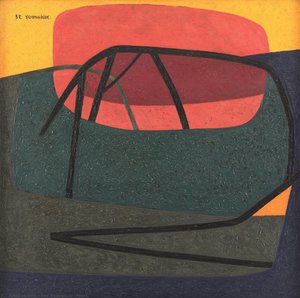
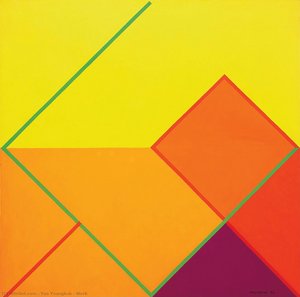
Portrett av Yoo Youngkuk

De 30 mest kjente Yoo Youngkuk-maleriene, hvert og ett unikt

Oppdatert November 2026 · rangert etter vår popularitetsscore (søk, besøk og bestillinger for hvert verk) · 30 verk av Yoo Youngkuk i vår katalog

Kort fortalt

Mountain (1968) er maleriet av Yoo Youngkuk som vekker mest oppmerksomhet. Deretter går blikket til Work og Mountain (1960). Blant de 30 verkene til Yoo Youngkuk i vår katalog, er disse 30 de mest kjente – hver og en et unikt originalverk presentert med sitt årstall, sitt museum og årsaken til at det består.

1916 – 2002, Uljin Abstract expressionism Flest verk: Statens Museum for Kunst

Topp 10 malerier av Yoo Youngkuk, sett gjennom galleriets øyne

1
Mountain (1968) av Yoo Youngkuk

Mountain

1968 · Oil On Canvas

Mountain is an artwork created by Yoo Youngkuk. This piece emerged in 1968, a time when the artist was refining a visual language of pure form. Yoo Youngkuk was born in 1916 in Uljin, South Korea, and remained a dedicated presence in the art world until his death in 2002. His practice sought to distill the essence of the landscape into something elemental.

2
Work av Yoo Youngkuk

Work

Oil On Canvas

In the quietude of this canvas, we find a profound dialogue between the tangible earth and the purity of geometric thought. This particular piece presents a sweeping landscape where the ruggedness of a mountain range is distilled into a rhythmic arrangement of light and shadow. The eye is immediately drawn to the striking, pyramidal silhouette of the peaks, a shape that feels both ancient and avant-garde. Through a masterful command…

5
CIRCLE_A (1968) av Yoo Youngkuk

CIRCLE_A

1968 · Oil On Canvas

In this 1968 oil on canvas, the canvas is divided by a warm, red field that provides a sense of depth and heat. Two distinct circles occupy the space, positioned in a way that creates a subtle tension between the upper left and the center-right. The first circle is a pale orange, while the second is a deeper, more saturated hue. These forms do not represent physical objects but instead…

6
Work (1968) av Yoo Youngkuk

Work

1968 · Painting

The painting Work is an abstract composition featuring a prominent red triangle. This central triangular structure has a pointy top and a rounded bottom, with its edges transitioning into warm orange hues. At the heart of the triangle lies a luminous yellow circle, which serves as a focal point. The artwork is executed on canvas and utilizes a palette of red, yellow, and orange.

7
Work (1967) av Yoo Youngkuk

Work

1967 · Oil On Canvas

The painting titled Work was created by the artist Yoo Youngkuk in 1967. It is a product of a vision shaped by the coastal landscape of Ulchin, South Korea, where the artist was born in 1916. This specific piece emerged from a period of intense formal exploration, long before the artist's death in 2002.

8
Work (1957) av Yoo Youngkuk

Work

1957 · Oil On Canvas

In this masterful 1957 composition, Yoo Youngkuk invites the viewer into a realm where the boundaries between form and emotion dissolve into a striking abstract landscape. The artwork presents a captivating dance of geometric shapes, dominated by a powerful interplay of black, red, and green. At first glance, the eye is met with a sense of profound mystery; the canvas feels like a fragmented window into a structured yet enigmatic…

9
Work (1968) av Yoo Youngkuk

Work

1968

In the realm of mid-century abstraction, few voices resonate with as much structural purity and rhythmic vitality as that of Yoo Youngkuk. His 1968 masterpiece, Work, serves as a profound testament to his lifelong pursuit of distilling the natural world into its most fundamental geometric essences. At first glance, the viewer is met with a striking, crimson-hued triangle, a central void that commands the eye and anchors the composition. Yet,…

10
Work (1967) av Yoo Youngkuk

Work

1967 · Oil On Canvas

In this mesmerizing 1967 masterpiece, the legendary Korean pioneer Yoo Youngkuk invites us into a realm where the boundaries between landscape and pure abstraction dissolve. At first glance, the eye is immediately captured by a commanding, luminous yellow triangle that anchors the composition with an almost celestial intensity. This central form, bathed in a glow that suggests a light source from below, acts as a beacon of stability amidst a…

Yoo Youngkuks berømte malerier, nummer 11 til 30

Motivene som fanget Yoo Youngkuks blikk

De fire motivene som går igjen hyppigst i disse originalverkene, hver med sitt fremste eksempel.

Museene som har Yoo Youngkuks originalverk

Museet som innehar flest av maleriene på denne siden.

Museum By Verker av Yoo Youngkuk Malerier fra denne listen
Statens Museum for Kunst, KøbenhavnStatens Museum for Kunst København 2 Work, Work

Yoo Youngkuk gjennom tiårene: ett unikt originalverk for hvert tiår

Verk per tiår

Velg et tiår for å se originalverket som definerer det.

Yoo Youngkuks malerier: spørsmål til galleriet

Hva er det mest kjente verket til Yoo Youngkuk?Avslør svaret

Mountain (1968). Deretter følger Work og Mountain (1960).

Hvor gammel var Yoo Youngkuk da Mountain ble skapt?Avslør svaret

52 år gammel: Mountain er fra 1968, og Yoo Youngkuk ble født i 1916.

Hvilke ti malerier av Yoo Youngkuk er de mest kjente?Avslør svaret

Mountain, Work, Mountain, Work, CIRCLE_A, Work, Work, Work, Work og Work. Rangeringen ovenfor viser årstall og museum for hvert verk.

Hvor mange verk av Yoo Youngkuk er kjent?Avslør svaret

Vår katalog inneholder 30 verk av Yoo Youngkuk, datert fra 1940 til 1994.

Hvor kan de mest kjente originalverkene til Yoo Youngkuk ses?Avslør svaret

Hovedsakelig i Statens Museum for Kunst (København). Museumslisten ovenfor viser alle.

I hvilken periode malte Yoo Youngkuk sine mest kjente malerier?Avslør svaret

I 1960s: 12 av de 30 verkene på denne siden ble laget da, Mountain av dem.

Hvilket kjent maleri av Yoo Youngkuk er det eldste, og hvilket er det nyeste?Avslør svaret

På denne siden er det eldste Work (1940) og det nyeste Mountain-Blue (1994).

Hvilke motiver foretrakk Yoo Youngkuk?Avslør svaret

Geometric (7), Korean abstraction (4) og Geometric abstraction (3), fordelt på 30 verk på denne siden.

Hvilke materialer brukte Yoo Youngkuk mest av?Avslør svaret

Oil On Canvas, for 8 av de 30 verkene på denne siden.

Hvilken kunstretning tilhører verkene til Yoo Youngkuk?Avslør svaret

Abstract expressionism og Abstract art, basert på originalene på denne siden.

Hvilke originalverk av Yoo Youngkuk kan jeg se på Statens Museum for Kunst?Avslør svaret

Work og Work: Statens Museum for Kunst, København har 2 av verkene på denne siden.

Yoo Youngkuk: et portrett av kunstneren

A Pioneer of Korean Abstraction: The Life and Art of Yoo Youngkuk

Yoo Youngkuk, a name now inextricably linked to the birth of abstract art in Korea, stands as a pivotal figure during a period defined by profound social and political upheaval. Born in 1916 in the serene coastal town of Uljin, nestled within the majestic Taebaek Mountains, his artistic journey was one of relentless exploration—a quest to forge a new visual language for a nation grappling with its identity and embracing modernity. From his earliest years, immersed in the breathtaking beauty of the Korean landscape – particularly those towering mountains that would become a recurring motif throughout his career – Yoo developed an intimate connection to nature, a sentiment subtly woven into even his most rigorously geometric compositions. This formative experience instilled within him a deep-seated desire not merely to represent the external world but to distill its very essence into pure form and color. Yoo’s path toward abstraction began with formal training at Bunka Gakuin University in Tokyo, where he graduated from the oil painting department in 1938. It was here that he encountered the burgeoning currents of Western abstract movements and engaged in stimulating dialogues with pioneering Japanese artists like Murai Masanari and Hasegawa Saburo—figures who profoundly shaped his early experimentation and solidified his commitment to non-representational art.

Forging a New Path: Sinsasil-pa and Early Experimentation

Returning to Korea in 1943 amidst the turmoil of World War II, Yoo faced formidable challenges in pursuing his artistic vision. The war years were marked by hardship and disruption, forcing him to sustain himself through various means while maintaining an unwavering dedication to his art. Despite these difficulties, with the liberation of Korea and the subsequent establishment of the Republic of Korea, a new era dawned for the nation’s artistic community. In 1948, Yoo Youngkuk joined forces with Kim Whanki and Lee Kyusang to form *Sinsasil-pa* (New Realism Group)—a watershed moment in Korean art history. This collective represented the first organized attempt to break free from traditional representational styles and embrace the possibilities of modern abstraction—a bold move that challenged conventional artistic norms and ignited debate within the Korean art world. The group’s manifesto called for an art that reflected the realities of post-war Korea, interpreted through a lens of abstraction—a truly innovative approach. Yoo's early works during this period are characterized by a dynamic interplay between color fields and emerging geometric forms, hinting at the direction his style would take in later years. He also briefly shared his expertise as a professor at Seoul National University for two years, nurturing the next generation of artists and shaping the future of Korean art.

The Mountain Within: Evolution of Style and Symbolic Resonance

Throughout the 1950s and early 60s, Yoo Youngkuk’s artistic style underwent a significant transformation. While his earlier works explored color field painting, he gradually began to incorporate more defined geometric shapes, influenced by his ongoing engagement with nature and his personal experiences. This period witnessed the emergence of what would become his signature motif: the mountain. Often referred to as “the painter of mountains,” Yoo didn’t depict these majestic peaks in a literal sense; rather, he abstracted their essence—their solidity, their grandeur, their spiritual resonance—into powerful compositions of color and form. The mountain became a potent symbol of Korea itself, representing resilience, endurance, and the enduring spirit of the nation. He sought to capture not just the visual appearance of the mountains but also the feeling they evoked – a sense of stability amidst chaos, a connection to something larger than oneself. This symbolic depth is what elevates his work beyond mere landscape painting. Following his participation in the São Paulo Biennial in 1963, Yoo experienced a period of artistic consolidation, withdrawing from group activities to focus on solo exhibitions held every other year for two decades. This allowed him to refine his unique style, pushing the boundaries of geometric abstraction and exploring increasingly complex relationships between color, line, and space.

A Legacy of Innovation: Recognition and Enduring Influence

Yoo Youngkuk’s contributions to Korean modern art were widely recognized during his lifetime, culminating in a survey by *Monthly Art* magazine that hailed him as the most outstanding artist among over a hundred of his contemporaries. His work has been exhibited extensively both domestically and internationally, solidifying his position as a leading figure in the global abstract art scene. His legacy extends beyond his paintings; he paved the way for subsequent generations of Korean artists to explore abstraction and experiment with new forms of expression. Yoo’s unwavering commitment to artistic innovation, coupled with his deep connection to Korean culture and landscape, continues to inspire artists today. His ability to translate the emotional and spiritual qualities of nature into a purely abstract visual language remains a testament to his profound artistry and enduring influence. Exploring Yoo Youngkuk's masterpieces – such as “Mountain” or “Work”– at platforms like OriginalUniqueArt.com offers a glimpse into the mind of a true pioneer, an artist who dared to break with tradition and forge a new path for Korean art. His work stands as a powerful reminder of the transformative power of abstraction and its ability to capture the essence of both the external world and the inner self.

Key Facts

* **Artistic Movement/Style:** Abstract Painting * **Influenced by:** Kim Whanki * **Influenced by:** Murai Masanari, Hasegawa Saburo * **Date of Birth:** 1916 * **Date of Death:** 2002 * **Full Name:** Yoo Youngkuk * **Nationality:** Korean * **Notable Works:** Mountain, Work