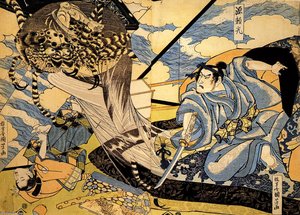
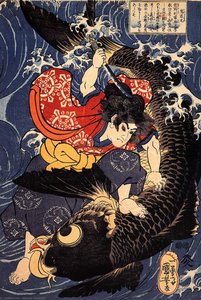
Portrett av Utagawa Kuniyoshi

Utagawa Kuniyoshis malerier: De 100 mest kjente, sett gjennom et galleris øyne

Oppdatert November 2026 · rangert etter vår popularitetsscore (søk, besøk og bestillinger for hvert verk) · 329 verk av Utagawa Kuniyoshi i vår katalog

Kort fortalt

I galleriets øyne er Utagawa Kuniyoshis mest kjente maleri Musashi on the back of a whale. Shikamatsu Kanroku Yukishige (1847) og Hatakeyama sitting next to a Go board (1845) fullfører trioen som alle kjenner igjen. Av de 329 verkene til Utagawa Kuniyoshi i vår katalog, presenterer galleriet de 100 mest kjente nedenfor; hvert originalverk med årstall, museum og hva som gjør det unikt.

1798 – 1861, Tokyo Japanese ukiyo-e tradition Flest verk: Keio University Library

Galleriets 10 beste malerier av Utagawa Kuniyoshi

1
Musashi on the back of a whale av Utagawa Kuniyoshi

Musashi on the back of a whale

Woodblock Print

This arresting image, a masterful execution of Ukiyo-e by the legendary artist Utagawa Kuniyoshi, transports us to 19th century Japan. Kuniyoshi, born Yoshisaburō in 1798 and tragically passing in 1861, was a pivotal figure at the close of the *ukiyo-e* movement – a vibrant artistic tradition that captured the essence of everyday life during the Edo period. This particular scene, depicting Musashi, the famed swordsman, astride a colossal whale, is…

2
Shikamatsu Kanroku Yukishige (1847) av Utagawa Kuniyoshi

Shikamatsu Kanroku Yukishige

1847 · Woodblock Print

Utagawa Kuniyoshi’s “Shikamatsu Kanroku Yukishige” (circa 1847) is more than a depiction of a samurai; it’s a potent distillation of Japanese heroism, loyalty, and the fleeting beauty of a moment captured in woodblock form. This iconic image, part of Kuniyoshi's celebrated series “Stories of the True Loyalty of the Faithful Samurai,” transports us to a pivotal scene from the classic tale of Suikoden – a story of betrayal, redemption, and…

3
Hatakeyama sitting next to a Go board (1845) av Utagawa Kuniyoshi

Hatakeyama sitting next to a Go board

1845 · Acrylic On Canvas

Utagawa Kuniyoshi’s “Hatakeyama Sitting Next to a Go Board” is more than just a depiction of a solitary figure; it's a window into the heart of 19th-century Japan. Painted in 1845, during a period of immense social and artistic change, this ukiyo-e masterpiece captures a quiet moment of contemplation – a scene imbued with layers of meaning reflecting the values and aesthetics of the Edo period. Kuniyoshi, one of the…

4
Yukukawa Sanpei Munenori (1848) av Utagawa Kuniyoshi

Yukukawa Sanpei Munenori

1848 · Acrylic

This exceptional ukiyo-e print, created in 1848 by the master artist Utagawa Kuniyoshi, offers a captivating glimpse into the world of Edo-period Japan. Depicting Yukukawa Sanpei Munenori, a figure likely rooted in historical or legendary lore, the artwork is far more than a simple portrait; it’s a dynamic tableau brimming with action, symbolism, and the raw energy of a warrior's spirit. Kuniyoshi’s skill lies not just in his technical prowess…

5
De tjuefire förebilder för pietetsförhållande till föräldrar i Kina (1852) av Utagawa Kuniyoshi

De tjuefire förebilder för pietetsförhållande till föräldrar i Kina

1852 · Tresnitt · Keio University Library, Tokyo

Utagawa Kuniyoshi og "De tjuefire dydige børn af ærbødighed mod forældre" Denne artikel beskriver Utagawa Kuniyoshi’s ikoniske ukiyo-e trætryk “De tjuefire dydige børn af ærbødighed mod forældre” (Morokoshi nijushiko), en kunstværk der repræsenterer højdepunktet i japansk trætrykkunst og dybtgående buddhistiske og konfucianistiske værdier. Kuniyoshi, født Yoshisaburō i Tokyo år 1798, var ikke selvfølgelig en kunstner fra starten af sin rejse; hans tidlige erfaringer med silkevævning gav ham et fundament for…

6
Ôtaka Gengo Tadao (1848) av Utagawa Kuniyoshi

Ôtaka Gengo Tadao

1848 · Woodblock Print

Within the vibrant tapestry of Ukiyo-e prints, few images capture the raw power and stoic determination of a warrior quite like Utagawa Kuniyoshi's "Otaka Gengo Tadao," created in 1848. This remarkable woodblock print isn’t merely a depiction of a samurai; it’s a window into the heart of Edo-period Japan, brimming with tales of loyalty, honor, and the enduring spirit of martial prowess. Kuniyoshi, one of the last masters of this…

7
Oki no Jiro Hiroari killing a monstrous tengu av Utagawa Kuniyoshi

Oki no Jiro Hiroari killing a monstrous tengu

Woodblock Print

In the vibrant world of Ukiyo-e, few scenes command the eye with as much visceral intensity as Utagawa Kuniyoshi’s masterpiece, Oki no Jiro Hiroari killing a monstrous tengu. This dynamic mythological painting serves as a window into a moment of profound struggle, where the boundaries between the human and the supernatural blur amidst a backdrop of dark, foreboding shadows. The composition is anchored by the figure of Oki no Jiro…

8
Battle of Uji River. Uji kawa kassen no zu av Utagawa Kuniyoshi

Battle of Uji River. Uji kawa kassen no zu

Acrylic On Canvas · Hammer Museum, Los Angeles

Utagawa Kuniyoshi’s “Battle of Uji River,” painted between 1848 and 1850, stands as a quintessential example of *nishiki-e*, or polychrome woodblock printing, capturing the fervor and grandeur of samurai warfare against a backdrop of breathtaking natural beauty. This monumental print transcends mere depiction; it’s an immersive experience designed to evoke emotion and convey profound themes of courage, resilience, and the ephemeral nature of glory.

Utagawa Kuniyoshi sine malerier, rangert fra 11 til 100

11The Twenty-four Paragons of Filial Piety in China , Script by Tanekazu : Ding Lan (Tei Ran) (1852) av Utagawa KuniyoshiThe Twenty-four Paragons of Filial Piety in China , Script by Tanekazu : Ding Lan (Tei Ran)1852 · Keio University Library 12Thirty-six Famous Battles (1848) av Utagawa KuniyoshiThirty-six Famous Battles1848 13Kiura Okaemon Sadayuki (1848) av Utagawa KuniyoshiKiura Okaemon Sadayuki1848 14The Heavenly Weaver and the Heardsman (1842) av Utagawa KuniyoshiThe Heavenly Weaver and the Heardsman1842 · Bristol Museum - Art Gallery 15Yata Gorôemon Suketake (1848) av Utagawa KuniyoshiYata Gorôemon Suketake1848 16Oniwakamaru and the Giant Carp Fighting Underwater (1835) av Utagawa KuniyoshiOniwakamaru and the Giant Carp Fighting Underwater1835 17A Votive Tablet with Masks of Kabuki Actors at Face Value av Utagawa KuniyoshiA Votive Tablet with Masks of Kabuki Actors at Face ValueFukuoka City Museum 18The actor (12) av Utagawa KuniyoshiThe actor (12) 19The Sixth Month (Right) (1849) av Utagawa KuniyoshiThe Sixth Month (Right)1849 · British Museum 20Bon-bon Uta,Children av Utagawa KuniyoshiBon-bon Uta,ChildrenFukuoka City Museum 21Scene from the play “The Life of Onoe Kikugorō III”\n\nScene from the play “The Life of Onoe Kikugorō III” (1847) av Utagawa KuniyoshiScene from the play “The Life of Onoe Kikugorō III”\n\nScene from the play “The Life of Onoe Kikugorō III”1847 · The Art Museum RIGA BOURSE 22Minamoto Yorimitsu also known as Raiko av Utagawa KuniyoshiMinamoto Yorimitsu also known as Raiko 23Mount Fuji from the Sumida River embankment (1842) av Utagawa KuniyoshiMount Fuji from the Sumida River embankment1842 24A record of origins of the great country of Japan av Utagawa KuniyoshiA record of origins of the great country of Japan 25The actor (16) av Utagawa KuniyoshiThe actor (16) 26Seaweed Gatherers at Omari (1833) av Utagawa KuniyoshiSeaweed Gatherers at Omari1833 27The ghost of Taira Tomomori av Utagawa KuniyoshiThe ghost of Taira Tomomori 28Thaishun with elephants av Utagawa KuniyoshiThaishun with elephants 29Raiko tormented by the earth spider av Utagawa KuniyoshiRaiko tormented by the earth spider 30Benkei holdin a halberd av Utagawa KuniyoshiBenkei holdin a halberd 31A samurai overwhelming a giant serpent av Utagawa KuniyoshiA samurai overwhelming a giant serpent 32The Famous Unrivalled Hidari Jingoro av Utagawa KuniyoshiThe Famous Unrivalled Hidari Jingoro 33Samurai and the conquered av Utagawa KuniyoshiSamurai and the conquered 34Kamigashihime stabbing a giant spider av Utagawa KuniyoshiKamigashihime stabbing a giant spider 35Vesper bell at Todaiji av Utagawa KuniyoshiVesper bell at Todaiji 36Oniwakamaru about to kill the giant carp av Utagawa KuniyoshiOniwakamaru about to kill the giant carp 37Uneme is exorcising the monstrous serpent from the lake av Utagawa KuniyoshiUneme is exorcising the monstrous serpent from the lake 38Shoki and Demon, Edo period (1850) av Utagawa KuniyoshiShoki and Demon, Edo period1850 · Arthur M. Sackler Gallery 39Nichiren going into exile on the island of Sado av Utagawa KuniyoshiNichiren going into exile on the island of Sado 40Uchiwakamaru fighting Benkei on Gojo bridge av Utagawa KuniyoshiUchiwakamaru fighting Benkei on Gojo bridge 41The young Benkei holding a pole av Utagawa KuniyoshiThe young Benkei holding a pole 42New edition of the life of a hundred generals av Utagawa KuniyoshiNew edition of the life of a hundred generals 43Sharks av Utagawa KuniyoshiSharks 44Koga Saburo, suspendeding a basket, watching a dragon av Utagawa KuniyoshiKoga Saburo, suspendeding a basket, watching a dragon 45Kamei Rokuro and the Black Bear in the Snow (1849) av Utagawa KuniyoshiKamei Rokuro and the Black Bear in the Snow1849 46Hattara Sonja with his white tiger av Utagawa KuniyoshiHattara Sonja with his white tiger 47Ishi-jo, wife of Oboshi Yoshio, one of the loyal ronin (1848) av Utagawa KuniyoshiIshi-jo, wife of Oboshi Yoshio, one of the loyal ronin1848 48Untitled (D2X8SB) (801) av Utagawa KuniyoshiUntitled (D2X8SB)801 · Metropolitan Museum of Art 49Yoshida Sadaemon Kanesada (1848) av Utagawa KuniyoshiYoshida Sadaemon Kanesada1848 50Hara Gôemon Mototoki (1848) av Utagawa KuniyoshiHara Gôemon Mototoki1848 51Woodcut (1852) av Utagawa KuniyoshiWoodcut1852 · Museum of Far Eastern Antiquities 52Woodcut (1852) av Utagawa KuniyoshiWoodcut1852 · Museum of Far Eastern Antiquities 53Island Enoshima. The Fuji can be seen far away av Utagawa KuniyoshiIsland Enoshima. The Fuji can be seen far away 54Hayano Kanpei Tsuneyo (1848) av Utagawa KuniyoshiHayano Kanpei Tsuneyo1848 · Cleveland Museum of Art 55In the Waves at Kakuda enroute to Sado Island, Edo period (1835) av Utagawa KuniyoshiIn the Waves at Kakuda enroute to Sado Island, Edo period1835 · Arthur M. Sackler Gallery 56Woman selling decorative bowls av Utagawa KuniyoshiWoman selling decorative bowls 57A fierce depiction of Uesugi Kenshin seated (1844) av Utagawa KuniyoshiA fierce depiction of Uesugi Kenshin seated1844 58The Twenty-four Paragons of Filial Piety in China, Script by Tanekazu : Emperor Wen of Han (Kan no Buntei) (1852) av Utagawa KuniyoshiThe Twenty-four Paragons of Filial Piety in China, Script by Tanekazu : Emperor Wen of Han (Kan no Buntei)1852 · Keio University Library 59The Twenty-four Paragons of Filial Piety in China , Script by Tanekazu : Cai Shun (Sai Jun) (1852) av Utagawa KuniyoshiThe Twenty-four Paragons of Filial Piety in China , Script by Tanekazu : Cai Shun (Sai Jun)1852 · Keio University Library 60Isoai Jûroemon Masahisa (1848) av Utagawa KuniyoshiIsoai Jûroemon Masahisa1848 61Tokuda Sadaemon Yukitaka (1848) av Utagawa KuniyoshiTokuda Sadaemon Yukitaka1848 62Tamakatzura Tamatori attacked by the octopus av Utagawa KuniyoshiTamakatzura Tamatori attacked by the octopus 63Bijin with a dog in the snow (1845) av Utagawa KuniyoshiBijin with a dog in the snow1845 64From Suikoden of Japanese Heroes av Utagawa KuniyoshiFrom Suikoden of Japanese Heroes 65Hatakeyama Shigetada av Utagawa KuniyoshiHatakeyama Shigetada 66The sailor Tokuso and the sea monster av Utagawa KuniyoshiThe sailor Tokuso and the sea monster 67Tokiwa Gozen in the snow av Utagawa KuniyoshiTokiwa Gozen in the snow 68Mongaku doing penace at the Nachi waterfall av Utagawa KuniyoshiMongaku doing penace at the Nachi waterfall 69Eight Hundred Heroes of Our Country av Utagawa KuniyoshiEight Hundred Heroes of Our Country 70The suicide of morozumi Masakiyo av Utagawa KuniyoshiThe suicide of morozumi Masakiyo 71Tametomo rescued from the sea monster by tengu av Utagawa KuniyoshiTametomo rescued from the sea monster by tengu 72Miyamoto Musashi killing a giant av Utagawa KuniyoshiMiyamoto Musashi killing a giant 73The Twenty-four Paragons of Filial Piety in China , Script by Tanekazu : Tanzi (Enshi) (1852) av Utagawa KuniyoshiThe Twenty-four Paragons of Filial Piety in China , Script by Tanekazu : Tanzi (Enshi)1852 · Keio University Library 74The Twenty-four Paragons of Filial Piety in China , Script by Tanekazu : Jiang Shi (Kyo Shi) (1852) av Utagawa KuniyoshiThe Twenty-four Paragons of Filial Piety in China , Script by Tanekazu : Jiang Shi (Kyo Shi)1852 · Keio University Library 75Hawk av Utagawa KuniyoshiHawk 76Tengu av Utagawa KuniyoshiTengu 77Otsu-e Paintings Coming Alive Triptych (1847) av Utagawa KuniyoshiOtsu-e Paintings Coming Alive Triptych1847 78Lady-in-Waiting at Edo Castle (1854) av Utagawa KuniyoshiLady-in-Waiting at Edo Castle1854 79Bando Shuka I as the courtesan Shiraito of Hashimoto-ya (1852) av Utagawa KuniyoshiBando Shuka I as the courtesan Shiraito of Hashimoto-ya1852 · Art Gallery of New South Wales 80Self-portrait of the Shunga album av Utagawa KuniyoshiSelf-portrait of the Shunga album 81Saitogo Kunitake, Japanese actor (1816) av Utagawa KuniyoshiSaitogo Kunitake, Japanese actor1816 82Kuroda Ukinaga, Japanese actor (1816) av Utagawa KuniyoshiKuroda Ukinaga, Japanese actor1816 83Sosan returning to his mother (1840) av Utagawa KuniyoshiSosan returning to his mother1840 84Strings for night firing av Utagawa KuniyoshiStrings for night firing 85Woman catching firefly by a stream av Utagawa KuniyoshiWoman catching firefly by a stream 86Nakamura Kansuke Tadatoki (1848) av Utagawa KuniyoshiNakamura Kansuke Tadatoki1848 87Yazama Shinroku Mitsukaze (1848) av Utagawa KuniyoshiYazama Shinroku Mitsukaze1848 88Oribe Yasubei Taketsune (1848) av Utagawa KuniyoshiOribe Yasubei Taketsune1848 89Katsuta Shin'emon Taketaka (1848) av Utagawa KuniyoshiKatsuta Shin'emon Taketaka1848 90Senzaki Yagorô Noriyasu (1848) av Utagawa KuniyoshiSenzaki Yagorô Noriyasu1848 91Ôboshi Rikiya Yoshikane (1848) av Utagawa KuniyoshiÔboshi Rikiya Yoshikane1848 92Hayano Wasuke Tsunenari (1848) av Utagawa KuniyoshiHayano Wasuke Tsunenari1848 93Writing a Label for Chrysanthemums (1844) av Utagawa KuniyoshiWriting a Label for Chrysanthemums1844 94Shikamatsu Kanroku’s Manservant, Jinzaburô (1848) av Utagawa KuniyoshiShikamatsu Kanroku’s Manservant, Jinzaburô1848 95Tokiwa-Gozen with her three children in the snow (1840) av Utagawa KuniyoshiTokiwa-Gozen with her three children in the snow1840 96Neve, the moon is chilling (1845) av Utagawa KuniyoshiNeve, the moon is chilling1845 97Shoriko kaei shooting a wild goose av Utagawa KuniyoshiShoriko kaei shooting a wild goose 98One Hundred and Eight Heroes from the Chinese Tale, The Water Margin- Zhang Shun, alias White Stripe... av Utagawa KuniyoshiOne Hundred and Eight Heroes from the Chinese Tale, The Water Margin- Zhang Shun, alias White Stripe...Tokyo National Museum 99Head of a Courtesan av Utagawa KuniyoshiHead of a CourtesanHarvard Art Museums 100Ishiyakushi av Utagawa KuniyoshiIshiyakushi

Utagawa Kuniyoshis berømte malerier, periode for periode

Motivene som fanget Utagawa Kuniyoshis blikk

De fire motivene som går igjen hyppigst i disse originalverkene, hver med sitt fremste eksempel.

Museene som har Utagawa Kuniyoshis originalverk

De 8 museene som innehar flest av maleriene på denne siden.

Museum By Verker av Utagawa Kuniyoshi Malerier fra denne listen
Keio University Library, TokyoKeio University Library Tokyo 8 De tjuefire förebilder för pietetsförhållande till föräldrar i Kina, The Twenty-four Paragons of Filial Piety in China , Script by Tanekazu : Guo Ju (Kaku Kyo), The Twenty-four Paragons of Filial Piety in China , Script by Tanekazu : Lu Ji (Riku Seki)
Fukuoka City Museum, FukuokaFukuoka City Museum Fukuoka 4 A Votive Tablet with Masks of Kabuki Actors at Face Value, Bon-bon Uta,Children
Arthur M. Sackler Gallery, Washington, D.C.Arthur M. Sackler Gallery Washington, D.C. 2 Shoki and Demon, Edo period, In the Waves at Kakuda enroute to Sado Island, Edo period
Museum of Far Eastern Antiquities, StockholmMuseum of Far Eastern Antiquities Stockholm 2 Woodcut, Woodcut
Hammer Museum, Los AngelesHammer Museum Los Angeles 2 Battle of Uji River. Uji kawa kassen no zu
Tokyo National Museum, TokyoTokyo National Museum Tokyo 2 One Hundred and Eight Heroes from the Chinese Tale, The Water Margin- Zhang Shun, alias White Stripe...
Bristol Museum - Art Gallery, BristolBristol Museum - Art Gallery Bristol 1 The Heavenly Weaver and the Heardsman
British Museum, LondonBritish Museum London 1 The Sixth Month (Right)

Utagawa Kuniyoshi, ett signaturmaleri per tiår

Verk per tiår

Velg et tiår for å se originalverket som definerer det.

Utagawa Kuniyoshis malerier: galleriets svar

Hvilket maleri av Utagawa Kuniyoshi er det mest kjente av alle?Avslør svaret

Musashi on the back of a whale. Deretter følger Shikamatsu Kanroku Yukishige (1847) og Hatakeyama sitting next to a Go board (1845).

Hvilke er de 10 beste maleriene til Utagawa Kuniyoshi?Avslør svaret

Musashi on the back of a whale, Shikamatsu Kanroku Yukishige, Hatakeyama sitting next to a Go board, Yukukawa Sanpei Munenori, De tjuefire förebilder för pietetsförhållande till föräldrar i Kina, Ôtaka Gengo Tadao, Oki no Jiro Hiroari killing a monstrous tengu, Battle of Uji River. Uji kawa kassen no zu, The Twenty-four Paragons of Filial Piety in China , Script by Tanekazu : Guo Ju (Kaku Kyo) og The Twenty-four Paragons of Filial Piety in China , Script by Tanekazu : Lu Ji (Riku Seki). Rangeringen ovenfor viser årstall og museum for hvert verk.

Hvor mange verk skapte Utagawa Kuniyoshi?Avslør svaret

Vår katalog inneholder 329 verk av Utagawa Kuniyoshi, datert fra 1816 til 1854.

Hvor henger de mest kjente originalverkene til Utagawa Kuniyoshi?Avslør svaret

Hovedsakelig i Keio University Library (Tokyo), Fukuoka City Museum (Fukuoka) og Arthur M. Sackler Gallery (Washington, D.C.). Museumslisten ovenfor viser alle.

Når malte Utagawa Kuniyoshi sine mest kjente malerier?Avslør svaret

I 1840s: 33 av de 100 verkene på denne siden ble laget da, Shikamatsu Kanroku Yukishige av dem.

Hvilke er Utagawa Kuniyoshis tidligste og nyeste berømte verk?Avslør svaret

På denne siden er det eldste Saitogo Kunitake, Japanese actor (1816) og det nyeste Lady-in-Waiting at Edo Castle (1854).

Hvilke motiver vendte Utagawa Kuniyoshi oftest tilbake til?Avslør svaret

Warrior (14), Samurai (14) og Edo period (14), fordelt på 100 verk på denne siden.

Hvilket medium arbeidet Utagawa Kuniyoshi mest med?Avslør svaret

Woodblock Print, for 59 av de 100 verkene på denne siden.

Hvilken kunstretning er Utagawa Kuniyoshi tilknyttet?Avslør svaret

Japanese ukiyo-e tradition, basert på originalene på denne siden.

Hvilke originalverk av Utagawa Kuniyoshi har Keio University Library i sin samling?Avslør svaret

De tjuefire förebilder för pietetsförhållande till föräldrar i Kina, The Twenty-four Paragons of Filial Piety in China , Script by Tanekazu : Guo Ju (Kaku Kyo) og The Twenty-four Paragons of Filial Piety in China , Script by Tanekazu : Lu Ji (Riku Seki): Keio University Library, Tokyo har 8 av verkene på denne siden.

Utagawa Kuniyoshi: kunstneren

A Life Immersed in the Floating World

Utagawa Kuniyoshi, født Yoshisaburō den 1. januar 1798 i Edo (moderne Tokyo), står som en monumental figur på slutten av *ukiyo-e*-tradisjonen – de livlige bildene som fanget japansk liv under Edo-perioden. Hans reise begynte ikke midt i kunstneriske kretser, men i det praktiske domenet av sin fars silkefargingsverksted. Denne tidlige eksponeringen for farge og mønster ville subtilt påvirke hans senere arbeid, og gi det en distinkt vibrans. Selv som ung gutt var Kuniyoshi fascinert av *ukiyo-e*-verdenen, spesielt den heroiske imagery av krigere og håndverkere som preget populære trykk. Disse formative inntrykkene tenkte han i gang en lidenskap som skulle definere hans livs innsats. Han gikk inn i studiet av Utagawa Toyokuni I i 1811, tok navnet Kuniyoshi og satte ut på en streng læretid som skarpet ferdighetene sine og introduserte ham for konvensjonene til Utagawa-skolen.

Fra Humble Begynnelse til Mestersk Visjon

Kuniyoshi’s tidlige karriere var preget av en periode med relativt anonymitet. Selv om han var dyktig i de etablerte stiler, slet han med å finne sin unike stemme midt i det travle landskapet av Edo-trykkemaking. Hans innledende verk speilet i stor grad lærers arbeid, og tilbød lite som skilte ham fra samtidige. Likevel viste denne utforskningsperioden seg avgjørende. Han eksperimenterte med ulike sjangre og teknikker, og utviklet gradvis en distinkt tilnærming preget av dynamiske komposisjoner, dristige farger og en stadig mer sofistikert forståelse av narrativ fortelling. Gjennombruddet kom i 1827 med utgivelsen av *The One Hundred and Eight Heroes of the Popular Suikoden*, en monumental serie basert på den kinesiske romanen *Shui Hu Zhuan*. Dette arbeidet katapulterte Kuniyoshi til berømmelse, etablerte ham som mester i *musha-e* – krigerkunsttrykk. Serien var ikke bare en illustrasjon av heroiske fortellinger; det var en visning av Kuniyoshi’s voksende talent for dramatisk komposisjon og karakterisering. Han portretterte ikke bare krigere, men ga dem liv med overbevisende følelser og intrikate detaljer.

En Syntese av Tradisjon og Vestlig Innflytelse

Det som virkelig skiller Kuniyoshi ut er hans villighet til å omfavne innovasjon samtidig som han forblir dypt forankret i japanske kunsttradisjoner. Da Edo-perioden nærmet seg slutten, opplevde Japan økende kontakt med Vesten, og Kuniyoshi var blant de første *ukiyo-e*-kunstnerne til å integrere elementer fra vestlig perspektiv og skyggelegging i sitt arbeid. Dette var ikke bare etterligning; han integrerte disse teknikkene dyktig for å forbedre dybde, realisme og dramatisk effekt. Hans landskapsmalerier demonstrerer spesielt en mesterfull kontroll over atmosfæriske effekter og romlige forhold, ofte også skaper en følelse av storhet og undring. Ut over teknikk utvidet Kuniyoshi grensene for *ukiyo-e*-kunst ved å utforske nye temaer og narrativer. Mens tradisjonelle temaer som vakre kvinner og Kabuki-skuespillere fortsatt var populære, kastet han seg inn i nytt territorium, og portretterte historiske scener, mytologiske skapninger og til og med satiriske kommentarer på samtidens samfunn. Hans trippeltrykk *In Minamoto’s Residence the Earth Spider Appears as a Monster* (1843) er et godt eksempel på denne dristige tilnærmingen, klokt skjuler politisk kritikk i en fantasifull fortelling.

Hovedverk og Innflytelse

Kuniyoshi’s kunst er mer enn bare vakre bilder; det er et vindu inn i en fascinerende æra, et vitnesbyrd om kunstnerisk innovasjon og en feiring av Japans vedvarende ånd. Han etterlot seg et enormt og mangfoldig utvalg av verk – anslått til å være over 5 000 design – som fortsatt inspirerer beundring i dag. Hans dyktige blanding av tradisjonelle japanske estetikk med vestlige teknikker banet vei for nye kunstneriske muligheter, mens hans villighet til å utfordre konvensjoner utvidet omfanget av *ukiyo-e*. Han trente mange studenter, inkludert Yoshitoshi, som ville videreføre hans arv inn i Meiji-perioden.
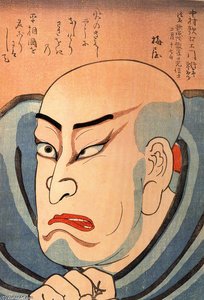
  • Bemerkelsesverdige serier: *The One Hundred and Eight Heroes of the Popular Suikoden*, en milepæl i krigerkunsttrykk.
  • Dynamiske komposisjoner: Hans evne til å skape dynamiske, visuelt slående scener er uten sidestykke.
  • Innovative teknikker: Integreringen av vestlig perspektiv og skyggelegging revolusjonerte *ukiyo-e*-landskapsmaleri.
  • Utvidet tematisering: Han utvidet grensene for *ukiyo-e*, utforsket nye temaer og narrativer.
Kuniyoshi’s kunst er mer enn bare vakre bilder; det er et vindu inn i en fascinerende æra, et vitnesbyrd om kunstnerisk innovasjon og en feiring av Japans vedvarende ånd. Han står som en sentral figur i japansk kunsthistorie, hvis verk fortsetter å resonere med publikum over hele verden. Han døde den 14. april 1861, og etterlot seg en arv som solidt etablerte ham som en av de siste store mesterne i *ukiyo-e*.