The Architect of Abstraction: The Life and Legacy of Sophie Taeuber-Arp
In the turbulent landscape of early 20th-century modernism, few figures possessed the multidisciplinary vision of Sophie Henriette Gertrud Taeuber-Arp. Born in 1889 in the serene Swiss town of Davos, her journey would eventually lead her to the very heart of the avant-garde revolution. She was not merely a painter or a sculptor; she was a weaver of worlds, an artist who dissolved the boundaries between fine art and functional design. Her life’s work stands as a testament to the power of geometric precision married to the spontaneous energy of the human spirit, creating a visual language that remains strikingly contemporary.
Taeuber-Arp’s artistic foundation was built upon a rigorous dedication to craft. Her early education at the Gewerbeschule in St. Gallen provided her with a profound understanding of textiles and design, a skill set that would later become a cornerstone of her abstract vocabulary. This technical mastery was further refined through her studies at influential German art schools, most notably the Bauhaus. It was here that she absorbed the revolutionary principles of modernism—the idea that art should be integrated into the fabric of daily life. Her marriage to the renowned artist Jean Arp in 1922 did more than unite two souls; it forged a creative partnership that would propel her into the epicenter of the Dada movement.
A Rebellion in Form: Dada and the Geometric Spirit
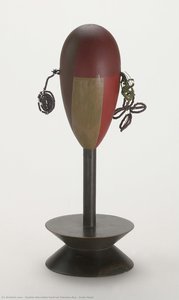
When the shadows of World War I descended upon Europe, Taeuber-Arp found herself part of the radical Dadaist circle in Cologne. While many associated Dada with chaos and nihilism, Sophie brought a unique structural discipline to its rebellion. She embraced the movement's anti-rationalist ethos, yet she infused it with a meticulous sense of composition. Her iconic “Dada Head” serves as a breathtaking example of this duality; by utilizing assemblage techniques involving geometric shapes and textile fragments, she rejected traditional sculptural norms in favor of a new, fragmented reality that mirrored the fractured world around her.
As her career progressed, her work transitioned from the provocative spontaneity of Dada toward the structured elegance of Constructivism and Concrete Art. This evolution is beautifully captured in her various masterpieces:
- Schematic Composition (1933): A vibrant oil on board that demonstrates her ability to use color and geometry to create a sense of playful, rhythmic movement.
- Composition of Circles and Overlapping Angles (1930): An iconic exploration of how geometric precision can evoke organic, fluid energy within a Constructivist framework.
- Shells and Flowers (1938): A delicate paper cut that showcases her mastery of minimalism, using radial design and stark contrast to find beauty in the simplest of forms.
The Enduring Resonance of a Visionary
The historical significance of Sophie Taeuber-Arp lies in her refusal to be confined by medium or label. She moved seamlessly between the tactile world of textile design, the structural demands of furniture creation, and the ethereal realms of dance and painting. Her ability to blend organic forms with mathematical precision allowed her to bridge the gap between the natural world and the industrial age. She did not just observe the changing tides of modernism; she helped direct them.
Though her life was tragically cut short in 1943, her influence continues to ripple through the history of abstract art. Today, we recognize her as a pioneer who saw the potential for profound beauty in the grid, the circle, and the line. Her legacy is found in every modern design that seeks harmony between function and aesthetic, reminding us that true innovation often requires the courage to break old forms to build entirely new ones.