Kort fortalt
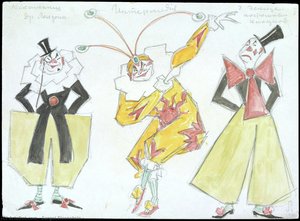
I galleriets øyne er Sergej Eisensteins mest kjente maleri Hermes (1914). A Petition (1914) og Harlequin (1921) fullfører trioen som alle kjenner igjen. Av de 41 verkene til Sergej Eisenstein i vår katalog, presenterer galleriet de 41 mest kjente nedenfor; hvert originalverk med årstall, museum og hva som gjør det unikt.
Galleriets 10 beste malerier av Sergej Eisenstein
Duncan
This striking black and white line drawing, titled "Duncan," presents a powerful depiction of the crucifixion scene. Eisenstein, renowned for his pioneering work in film montage and cinematic theory, brings a unique visual language to this traditional Christian iconography. The artwork centers on the figure of Christ on the cross, rendered with simplified forms and dramatic lines that emphasize suffering and despair. A large rectangular structure sits beneath him, while…
Sergej Eisenstein sine malerier, rangert fra 11 til 41
Sergej Eisensteins berømte malerier, periode for periode
Early Period
1914 · 4 verk i denne listenMature Period
6 verk i denne listenMotivene som fanget Sergej Eisensteins blikk
De fire motivene som går igjen hyppigst i disse originalverkene, hver med sitt fremste eksempel.
Black and white art 2 verk
Sergej Eisenstein, ett signaturmaleri per tiår
Sergej Eisensteins malerier: galleriets svar
Hvilket maleri av Sergej Eisenstein er det mest kjente av alle?Avslør svaret
Hermes (1914). Deretter følger A Petition (1914) og Harlequin (1921).
Hvor gammel var Sergej Eisenstein da Hermes ble ferdigstilt?Avslør svaret
16 år gammel: Hermes er fra 1914, og Sergej Eisenstein ble født i 1898.
Hvilke er de 10 beste maleriene til Sergej Eisenstein?Avslør svaret
Hermes, A Petition, Harlequin, Sam Mangan (Mikhail Visarov),Sketch Nr 6 for, ¡Que viva Mexico, Crucifiction, Alexander Nevsky, Self Portrait, Those Nameless Friends og Duncan. Rangeringen ovenfor viser årstall og museum for hvert verk.
Hvor mange verk skapte Sergej Eisenstein?Avslør svaret
Vår katalog inneholder 41 verk av Sergej Eisenstein, datert fra 1914 til 1942.
Når malte Sergej Eisenstein sine mest kjente malerier?Avslør svaret
I 1920s: 8 av de 41 verkene på denne siden ble laget da, Harlequin av dem.
Hvilke er Sergej Eisensteins tidligste og nyeste berømte verk?Avslør svaret
På denne siden er det eldste Hermes (1914) og det nyeste Self Portrait (1942).
Hvilken kunstretning er Sergej Eisenstein tilknyttet?Avslør svaret
Expressionism, basert på originalene på denne siden.
Sergej Eisenstein: kunstneren
Sergei Eisenstein: Pioneer of Montage and Revolutionary Filmmaker
Sergei Mikhailovich Eisenstein (1898-1948) stands as one of the most influential figures in cinematic history, a visionary director whose groundbreaking theories revolutionized filmmaking and cemented his place among the titans of artistic expression. Born in Riga, Latvia—then part of the Russian Empire—Eisenstein’s early life was marked by familial upheaval and intellectual curiosity, shaping him into the revolutionary artist he would become. His father, Mikhail Osipovich Eisenstein, an architect with German Jewish heritage, instilled a love for precision and design, while his mother, Julia Ivanovna Konetskaya, brought forth a tradition of cultural refinement. From a young age, Sergei demonstrated a passion for theatre and visual arts, sketching caricatures and immersing himself in the vibrant world of performance—interests that would profoundly inform his artistic endeavors throughout his life.- Early Education & Influences: Eisenstein pursued architectural studies at Petrograd Institute of Civil Engineering before decisively shifting his focus to art and theatre. His fascination with Japanese culture, cultivated during service in Minsk, particularly Kabuki theatre, instilled a deep appreciation for dramatic pacing and visual storytelling—elements he would later translate into his cinematic masterpieces.
- Revolutionary Involvement: Following the Russian Revolution of 1905, Eisenstein joined the Red Army, actively participating in propaganda efforts that ignited his interest in filmmaking. He recognized the potential of cinema to convey powerful messages and shape public opinion, a conviction that would drive him to embrace the revolutionary spirit of his time.
The Birth of Montage Theory
Eisenstein’s most enduring contribution to film theory resides in his concept of “montage,” articulated in his seminal manifesto, “Montage of Attractions.” Rejecting the prevailing narrative conventions of theatre—where dialogue dominates—he proposed a radically new approach: juxtaposing images not sequentially but strategically to maximize psychological impact. This technique, dubbed "chop, chop, chop" editing by critics, prioritized visual dynamism and emotional resonance over chronological order. Eisenstein argued that meaning emerges from the relationship between shots, rather than solely from individual images themselves—a revolutionary assertion that fundamentally altered filmmaking practice. He famously stated that “the film should be constructed not in narrative fashion but from brief segments that serve to reinforce and counterpoint one another.”- Dynamic Montage: Eisenstein championed dynamic montage, emphasizing the collision and interaction of shots to generate conflict, tension, and intellectual understanding.
- Sound & Music Integration: Recognizing the crucial role of sound in conveying emotion and enhancing narrative impact, Eisenstein skillfully integrated music into his films—most notably his collaboration with Sergei Prokofiev on *Alexander Nevsky*, establishing a precedent for cinematic musical scoring as a powerful tool for storytelling.