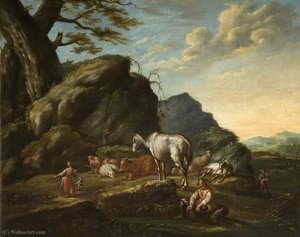
Goats and Flock of Sheep
Goats and Flock of Sheep is an oil painting by Philipp Peter Roos. The artist, who was also known by the moniker Rosa di Tivoli, produced this work about 1681. He was a German Baroque painter born in Sankt Goar, Germany.
Kort fortalt
Av alle originalverkene Philipp Peter Roos etterlot seg, er det mest kjente Goats and Flock of Sheep (1681), som er en del av samlingen til Bavarian State Painting Collections i München. Like bak følger Piece of Livestock (1681) og Landscape with Cattle and Shepherd (1681). Vår katalog inneholder 93 verk av Philipp Peter Roos; galleriet har bevart de 92 verkene som verden beundrer mest, hver vist med sin dato, sitt museum og sin historie.
Goats and Flock of Sheep is an oil painting by Philipp Peter Roos. The artist, who was also known by the moniker Rosa di Tivoli, produced this work about 1681. He was a German Baroque painter born in Sankt Goar, Germany.
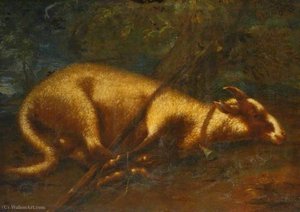
Piece of Livestock is an oil painting by Philipp Peter Roos, executed in 1681. The work originates from the Baroque period, a time when the artist was establishing his presence within the Italianate landscape tradition.
Landscape with Cattle and Shepherd is a work by the German Baroque painter Philipp Peter Roos. Created about 1681, the painting reflects the artist's specialized focus on pastoral scenes and animal subjects. Roos was a significant figure in the development of Italianate landscapes, often characterized by his intimate study of livestock and the natural environment.
In Piece of Livestock, Philipp Peter Roos organizes a pastoral scene through a close-up, ground-level perspective that establishes an immediate intimacy with the subjects. The composition is dominated by a large, seated cow positioned slightly to the right of the center. To the left, a smaller lamb or calf provides a sense of scale, while a woman interacts with a dog in the space behind the primary subject. This arrangement…
Resting Flock with Shepherds is an oil painting by the German Baroque artist Philipp Peter Roos. Created about 1681, this work captures a quiet moment within a rugged landscape. The composition focuses on a group of livestock and a shepherd, rendered with a sense of immediate presence that draws the viewer into the scene.
Resting Flock with Shepherds is an oil painting by Philipp Peter Roos. The canvas captures a heavy stillness among livestock and their guardian. This work was created about 1681. It presents a scene of animals and men gathered in a quiet, layered space under a turbulent sky.
In this Baroque-style oil painting, the mythological drama of the Liberation of Io unfolds with a sudden, heavy intensity. Created by Philipp Peter Roos about 1681, the scene captures a moment of profound tension between the divine and the mortal. A massive, powerful bull dominates the foreground, its muscular form rendered with a weight that feels almost tangible. This central figure looms over the landscape, its presence commanding the space…
This oil on canvas painting, dated 1681, presents a monochromatic scene rendered in various shades of gray. In the foreground, a young woman is positioned amidst a group of livestock, including sheep or goats. The composition is a medium shot, placing the human subject and the animals in the immediate front and middle ground. The terrain is undulating, forming rolling hills that recede into a background of hazy mountains and…
Returning Flock with Shepherds is an oil painting by Philipp Peter Roos. Created about 1681, the work captures a quiet moment of pastoral movement. The artist, a German Baroque painter, was born in Sankt Goar. He would later become known by the moniker Rosa di Tivoli.
The scene unfolds in Shepherd with Cow, Sheep and Goats in Italian Mountain Landscape, a work that captures a quiet moment of pastoral life. This painting, created about 1680, brings together a shepherd and his diverse herd amidst a rugged, mountainous setting. The figures and animals exist within a landscape that feels both immediate and deeply rooted in the natural world.
De fire motivene som går igjen hyppigst i disse originalverkene, hver med sitt fremste eksempel.
De 8 museene som innehar flest av maleriene på denne siden.
| Museum | By | Verker av Philipp Peter Roos | Malerier fra denne listen |
|---|---|---|---|
| München | 15 | Goats and Flock of Sheep, Piece of Livestock, Landscape with Cattle and Shepherd | |
| København | 5 | Cattle Piece, Landscape with a Bull, Sheep and Goats, A Shepherd with his Herd | |
| Buenos Aires | 4 | Landscape with shepherd and animals, Landscape with figures and animals, Shepherd and animals in a landscape | |
| Bratislava | 3 | Goat Herd with a Goatherd, Shepherd's Idyl in a Romantic Landscape with Ruins, Herd by an Ancient Well | |
| Praha | 3 | Ravine with a Stream, a Shepherd and His Herd, Horse and Goats Grazing, Shepherd with a Herd of Sheep and Goats | |
| Wien | 3 | Herd with Sleeping Shepherds, Rider Meeting, Landscape with Flock of Sheep | |
| St. Petersburg | 3 | Landscape with a Grotto, Landscape with a Waterfall, Landscape with a Herd | |
| Stockholm | 3 | Dead Hare, Landskap med hjord, A Goat Resting |
Velg et tiår for å se originalverket som definerer det.
This large-scale oil painting, dated 1669, presents a crowded, maximalist composition of diverse animal species. The arrangement is packed, with various animals overlapping to create a sense of density and movement. The color palette relies on deep, earthy tones, including rich browns, blacks, and dark ochres. These dark shades are interrupted by specific highlights of white and cream, alongside splashes of red from a rooster and parrots. The lighting follows…
Goats and Flock of Sheep is an oil painting by Philipp Peter Roos. The artist, who was also known by the moniker Rosa di Tivoli, produced this work about 1681. He was a German Baroque painter born in Sankt Goar, Germany.
A heavy, dark-colored cow anchors the center of this scene, its presence felt in the weight of its silhouette. To the left, two goats rest upon the ground, one a pale contrast of white and light tan against the shadows. A man sits nearby, leaning back in a moment of stillness, his gaze directed toward the animals or perhaps the viewer. The air in the enclosure feels thick and dim,…
In this work, titled Shepherd's Idyl in a Romantic Landscape with Ruins, the artist Philipp Peter Roos presents a quiet moment of rural existence. Created about 1700, the painting captures a shepherd tending to his flock amidst a landscape of rolling hills and weathered stone structures. There is a sense of stillness in the way the figures and animals occupy the space, suggesting a life governed by the rhythms of…
Goats and Flock of Sheep (1681), Bavarian State Painting Collections, München. Deretter følger Piece of Livestock (1681) og Landscape with Cattle and Shepherd (1681).
24 år gammel: Goats and Flock of Sheep er fra 1681, og Philipp Peter Roos ble født i 1657.
Goats and Flock of Sheep, Piece of Livestock, Landscape with Cattle and Shepherd, Piece of Livestock, Resting Flock with Shepherds, Resting Flock with Shepherds, Liberation of Io, Piece of Cattle, Returning Flock with Shepherds og Shepherd with Cow, Sheep and Goats in Italian Mountain Landscape. Rangeringen ovenfor viser årstall og museum for hvert verk.
Vår katalog inneholder 93 verk av Philipp Peter Roos, datert fra 1669 til 1700.
Hovedsakelig i Bavarian State Painting Collections (München), Statens Museum for Kunst (København) og National Museum of Fine Arts (Buenos Aires). Museumslisten ovenfor viser alle.
I 1680s: 21 av de 92 verkene på denne siden ble laget da, Goats and Flock of Sheep av dem.
På denne siden er det eldste Various animals gathered before Noah's Ark (1669) og det nyeste Shepherd's Idyl in a Romantic Landscape with Ruins (1700).
Landscape (33), Animals (29) og Goats (19), fordelt på 92 verk på denne siden.
Oil On Canvas, for 18 av de 92 verkene på denne siden.
Baroque, basert på originalene på denne siden.
Goats and Flock of Sheep, Piece of Livestock og Landscape with Cattle and Shepherd: Bavarian State Painting Collections, München har 15 av verkene på denne siden.
I det gylne lyset fra den italienske barokken er det få navn som fremkaller landskapets pastorale ro like sterkt som Philipp Peter Roos. Historien kjenner ham under det stemningsfulle økenavnet Rosa di Tivoli, en tyskfødt mester som transformerte landskapsmaleriet gjennom en dyp, nesten instinktiv forbindelse til naturen. Han ble født i 1655 i Rhinland-regionen – nærmere bestemt nær Sankt Goar – og var skjebnebestemt til penselen fra sine tidligste år. Som sønn av Johann Heinrich Roos, en respektert landskapsmaler, fikk han de grunnleggende leksjonene i tonal harmoni og komposisjonell balanse som senere skulle definere kunstnerens modne stil. Denne tidlige læretiden handlet om mer enn bare teknikk; det var en fordypning i en måte å se verden på, gjennom et filter av lys, skygge og jordens stille verdighet.
Roos' livsbane endret seg dramatisk i 1677, et vendepunkt drevet frem av gavmildheten til Karl I, landgreve av Hessen-Kassel. Ved å anerkjenne det spirende talentet til den unge maleren, sørget landgreven for de økonomiske midlene som gjorde at Roos kunne legge ut på en transformativ reise til Roma. Denne vandringen fra de germanske tradisjonene til hjertet av den italienske barokken lot Roos absorbere den levende energien i romersk kunst. Det var her han søkte veiledning under den berømte Giacinto Brandi, hvis innflytelse bidro til å foredle Roos' evne til å smelte sammen klassisk struktur med en mer spontan og atmosfærisk realisme. Denne perioden i Roma var også dypt personlig; det var i disse årene han forelsket seg i Isabella Brandi, hans mentors datter. Deres forening ville til slutt føre ham til å bosette seg i Tivoli, et trekk som for alltid ville knytte hans identitet til landskapet han elsket så høyt.
Det som virkelig utmerker verket til Rosa di Tivoli, er den uovertrufne autentisiteten i hans dyremotiver. I motsetning til mange av hans samtidige, som brukte dyr som rent dekorative ettertanker i et landskap, behandlet Roos hver eneste skapning – fra den kraftige oksen til den smidige geita – med en portrettmalers ærbødighet. Hans residens i Tivoli var berømt for å være utformet som et slags levende atelier; han holdt en omfattende samling av eksotiske og tamme dyr, og forvandlet dermed sine omgivelser til en kontinuerlig studie av bevegelse, anatomi og temperament. Denne intime nærheten gjorde det mulig for ham å fange det subtile rykk i et øre eller den muskuløse spenningen hos et dyr under press, noe som ga lerretene hans en pustende vitalitet.
Hans tekniske mesterskap kommer tydelig til uttrykk i måten han navigerte i barokkens estetiske kompleksitet på. Selv om komposisjonene hans ofte henter inspirasjon fra de serene og atmosfæriske kvalitetene i den nederlandske gullalderen, er de gjennomsyret av den dramatiske intensiteten som kjennetegner den italienske skolen. Hans verk preges ofte av:
Den historiske betydningen til Philipp Peter Roos ligger i hans evne til å bygge bro mellom de strukturerte landskapstradisjonene i Nord-Europa og det emosjonelle, lysfylte dramaet i Italia. Han trådte frem i en tid da vitenskapelige undersøkelser begynte å kreve mer presise observasjoner av den naturlige verden, samtidig som religiøse og mytologiske temaer fremdeles dominerte den kunstneriske bevisstheten. I hans malerier finner man både naturforskerens nitidige detaljrikdom og den romantiske sjelens poesi. Ved å dokumentere floraen og faunaen på den romerske landsbygda med en slik hengivenhet, skapte han et visuelt arkiv som handler like mye om tidens ånd som om motivene i seg selv.
Selv om han gikk bort i 1706 og etterlot seg en arv risset inn i selve jordsmonnet i Tivoli, har hans innflytelse vedvart. Han forblir en sentral skikkelse for alle som studerer utviklingen av dyremaleri og det italienske landskapets fremvekst. Gjennom hans øyne ser vi ikke bare en samling husdyr; vi er vitne til en dyp feiring av livet i dets mest fundamentale og uforfalskede former. Hans arbeid fortsetter å resonnere som et vitnesbyrd om observasjonens kraft og den vedvarende skjønnheten i det pastorale idealet.