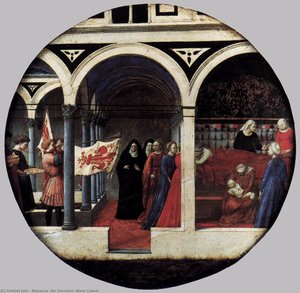
Portrett av Masaccio

De 96 mest kjente Masaccio-maleriene, hvert og ett unikt

Oppdatert October 2026 · rangert etter vår popularitetsscore (søk, besøk og bestillinger for hvert verk) · 97 verk av Masaccio i vår katalog

Kort fortalt

Treenigheten (1428) er maleriet av Masaccio som vekker mest oppmerksomhet. Deretter går blikket til Betalingspengene (1425) og Utvisningen fra Edens hage (1426). Blant de 97 verkene til Masaccio i vår katalog, er disse 96 de mest kjente – hver og en et unikt originalverk presentert med sitt årstall, sitt museum og årsaken til at det består.

1401 – 1428, San Giovanni Valdarno Tidlig renessanse Flest verk: Santa Maria del Carmine

Topp 10 malerier av Masaccio, sett gjennom galleriets øyne

1
Treenigheten (1428) av Masaccio

Treenigheten

1428 · Fresko

Treenigheten av Masaccio Freskomaleriet Treenigheten av Masaccio markerte begynnelsen på renessansen i Italia. Verket ble skapt i 1425 og regnes som et av de viktigste kunstverkene fra den tidlige renessansen. Dette mesterverket er i dag bevart i Santa Maria Novella-kirken i Firenze, Italia. Kunstneriske innovasjoner Treenigheten av Masaccio var et banebrytende verk som introduserte flere kunstneriske nyvinninger. Det er et av de første monumentale renessansemaleriene som tar i bruk lineærperspektiv,…

2
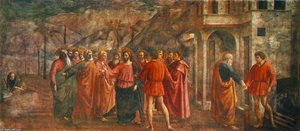
Betalingspengene (1425) av Masaccio

Betalingspengene

1425 · Fresko

Scenen utspiller seg i Brancacci-kapellet i basilikaen Santa Maria del Carmine i Firenze. Her vekker fresken med tittelen Betalingspengene av Masaccio en bibelsk fortelling til live på kapellets vegger. Verket ble bestilt av Felice Brancacci og utgjør en betydelig del av en større syklus dedikert til livet til Sankt Peter. Luften i kapellet virker å bære tyngden av denne hellige historien, idet figurene beveger seg gjennom et øyeblikk av dyp…

3
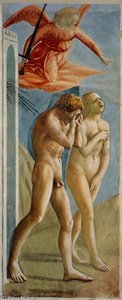
Utvisningen fra Edens hage (1426) av Masaccio

Utvisningen fra Edens hage

1426 · Fresko

Den tunge stillheten i Brancacci-kapellet i kirken Santa Maria del Carmine i Firenze, Italia, bærer vekten av en dyp tragedie. Her ånder veggene av historien om Utvisningen fra Edens hage, en fresco malt av Masaccio rundt 1425. Luften virker å tykne rundt figurene idet de står overfor sin plutselige, irreversible utvisning fra paradiset. Denne scenen markerer begynnelsen på et større narrativ, og fungerer som den første frescoen i en serie…

4
Rendering av Tribute Money (Detalj) av Masaccio

Rendering av Tribute Money (Detalj)

Fresko

Denne fengslende detaljen stammer fra Masaccios banebrytende fresko, «Tribute Money», et avgjørende verk i Brancacci-kapellet i Firenze. Utført rundt 1426, representerer det et vendepunkt i vestlig kunst, der man beveget seg bort fra den stiliserte konvensjonen i gotikken mot en ny æra av naturalisme og humanistisk uttrykk.

5
Predella panel from the Pisa Altar (1426) av Masaccio

Predella panel from the Pisa Altar

1426 · Oil On Panel · Staatliche Museen zu Berlin, Berlin

To stand before this Predella panel from the Pisa Altar is to encounter a moment frozen in time, yet vibrating with raw, undeniable human drama. Dating to 1426, this work captures Masaccio at the zenith of his revolutionary power. It is not merely a depiction of the Crucifixion; it is a profound meditation on sacrifice, community, and the weight of divine narrative rendered with startling immediacy. The composition draws the…

6
The Madonna of Humility (1424) av Masaccio

The Madonna of Humility

1424 · Tempera On Panel

In the quiet, profound stillness of Masaccio’s The Madonna of Humility, we encounter one of the most moving snapshots of the Early Italian Renaissance. Created around 1424, this masterpiece transcends mere religious iconography to offer a window into a moment of raw, maternal intimacy. The scene is set not upon a celestial throne, but on the earth itself, where the Virgin Mary sits upon a blue patterned cushion. This choice…

7
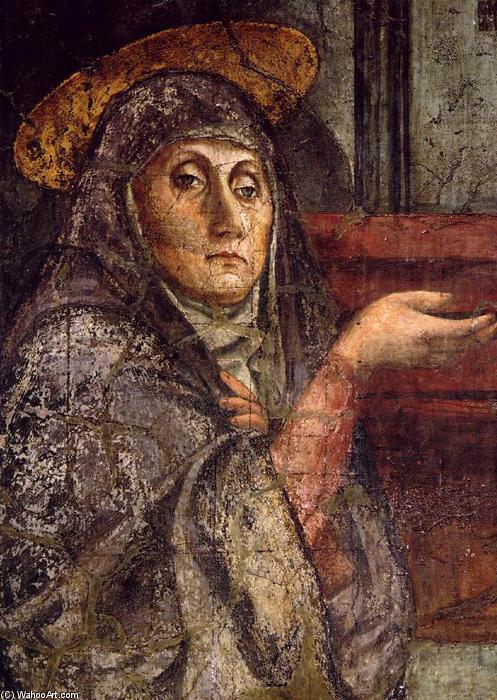
Trinity (detail) (1425) av Masaccio

Trinity (detail)

1425 · Fresco · Santa Maria Novella, Firenze

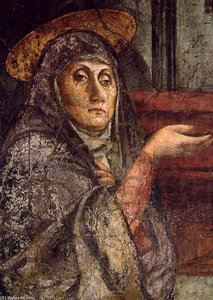
The image presents a detail from a fresco painting created in 1425 by Masaccio. Within this specific view, a figure is depicted that appears to be Mary Magdalene, identified by the traditional iconography of her long hair and a head covering. She possesses a contemplative expression, directing her gaze slightly downwards toward an object held in her right hand, which may be interpreted as a symbol of faith or devotion.

8
Two panels from the Pisa Altarpiece (1426) av Masaccio

Two panels from the Pisa Altarpiece

1426 · Tempera On Panel · Staatliche Museen zu Berlin, Berlin

In the quiet, hallowed halls of art history, few works capture the dawn of a new era as poignantly as Masaccio’s Two Panels from the Pisa Altarpiece. Completed in 1426, these panels are far more than mere fragments of a lost polyptych; they are windows into a transformative moment when the rigid conventions of the Gothic period began to dissolve, giving way to the profound humanism of the Early Italian…

9
Trinity (1425) av Masaccio

Trinity

1425 · Fresco · Santa Maria Novella, Firenze

To step before Masaccio’s Holy Trinity is to witness the exact moment when the flattened, symbolic world of the Middle Ages dissolved into the profound, breathing reality of the Renaissance. Painted between 1425 and 1427 within the hallowed walls of Santa Maria Novella in Florence, this fresco does not merely depict a religious scene; it carves a hole in the very wall of the chapel, inviting the viewer to step…

10
Trinity (detail) (1425) av Masaccio

Trinity (detail)

1425 · Acrylic On Canvas · Santa Maria Novella, Firenze

Masaccio’s “Trinity (detail),” housed within the magnificent Santa Maria Novella in Florence, isn't merely a fresco; it’s a pivotal moment in art history – a visual manifesto declaring the arrival of the High Renaissance. Painted between 1425 and 1427, this intimate section captures the essence of Masaccio’s revolutionary approach to depicting reality, a departure from the stylized elegance of the preceding Gothic era and a profound influence on generations of…

Masaccios berømte malerier, nummer 11 til 96

11Visning av Cappella Brancacci (før restaurering) (1426) av MasaccioVisning av Cappella Brancacci (før restaurering)1426 · Santa Maria del Carmine 12Trinity (scheme of the perspective) (1425) av MasaccioTrinity (scheme of the perspective)1425 · Santa Maria Novella 13Raising of the Son of Theophilus and St Peter Enthroned (detail) (1426) av MasaccioRaising of the Son of Theophilus and St Peter Enthroned (detail)1426 14St Peter Healing the Sick with his Shadow (detail) (1426) av MasaccioSt Peter Healing the Sick with his Shadow (detail)1426 15Freskoer i Cappella Brancacci (høyre syn (1426) av MasaccioFreskoer i Cappella Brancacci (høyre syn1426 · Santa Maria del Carmine 16Madonna Casini (1426) av MasaccioMadonna Casini1426 17Adam and Eve banished from Paradise (1427) av MasaccioAdam and Eve banished from Paradise1427 18The Distribution of Alms and the Death of Ananias (detail) (1426) av MasaccioThe Distribution of Alms and the Death of Ananias (detail)1426 19Freskoer i Cappella Brancacci (venstre syn) (1426) av MasaccioFreskoer i Cappella Brancacci (venstre syn)1426 · Santa Maria del Carmine 20Baptism of the Neophytes (1427) av MasaccioBaptism of the Neophytes1427 21Christ in the Garden of Gethsemane (detail) (1424) av MasaccioChrist in the Garden of Gethsemane (detail)1424 · Lindenau-Museum 22Crucifixion (1426) av MasaccioCrucifixion1426 · Museo di Capodimonte 23Tribute Money (detail) (1426) av MasaccioTribute Money (detail)1426 24The Agony in the Garden (1426) av MasaccioThe Agony in the Garden1426 25St Peter Healing the Sick with his Shadow (detail) (1426) av MasaccioSt Peter Healing the Sick with his Shadow (detail)1426 26St. Juvenal Triptych (1422) av MasaccioSt. Juvenal Triptych1422 27Maria and Child (1426) av MasaccioMaria and Child1426 28Tribute Money (detail) (1426) av MasaccioTribute Money (detail)1426 29The Expulsion from the Garden of Eden (detail) (1426) av MasaccioThe Expulsion from the Garden of Eden (detail)1426 30Birth tray (1428) av MasaccioBirth tray1428 31The Baptism of the Neophytes (1426) av MasaccioThe Baptism of the Neophytes1426 32Raising of the Son of Theophilus and St Peter Enthroned (1426) av MasaccioRaising of the Son of Theophilus and St Peter Enthroned1426 33The Distribution of Alms and the Death of Ananias (detail) (1426) av MasaccioThe Distribution of Alms and the Death of Ananias (detail)1426 34Adoration of the Knigs (1428) av MasaccioAdoration of the Knigs1428 35Tribute Money (detail) (1426) av MasaccioTribute Money (detail)1426 36Tribute Money (1426) av MasaccioTribute Money1426 37The Expulsion from the Garden of Eden (1426) av MasaccioThe Expulsion from the Garden of Eden1426 38Tribute Money (detail) (1426) av MasaccioTribute Money (detail)1426 39Raising of the Son of Theophilus and St Peter Enthroned (detail) (9) (1426) av MasaccioRaising of the Son of Theophilus and St Peter Enthroned (detail) (9)1426 40San Giovenale Triptych. Right panel. (1422) av MasaccioSan Giovenale Triptych. Right panel.1422 41Raising of the Son of Theophilus and St Peter Enthroned (detail) (1426) av MasaccioRaising of the Son of Theophilus and St Peter Enthroned (detail)1426 42Raising of the Son of Theophilus and St Peter Enthroned (detail) (1426) av MasaccioRaising of the Son of Theophilus and St Peter Enthroned (detail)1426 43The Raising of the Son of Theophilus and St Peter Enthroned (detail) (1426) av MasaccioThe Raising of the Son of Theophilus and St Peter Enthroned (detail)1426 44Raising of the Son of Theophilus and St Peter Enthroned (detail) (1426) av MasaccioRaising of the Son of Theophilus and St Peter Enthroned (detail)1426 45Christ in the Garden of Gethsemane (detail) (1424) av MasaccioChrist in the Garden of Gethsemane (detail)1424 · Lindenau-Museum 46San Giovenale Triptych. Central panel (1423) av MasaccioSan Giovenale Triptych. Central panel1423 47Distribution of Alms and Death of Ananias (1425) av MasaccioDistribution of Alms and Death of Ananias1425 48Profile Portrait of a Young Man av MasaccioProfile Portrait of a Young Man 49Profile Portrait of a Young Man (1425) av MasaccioProfile Portrait of a Young Man1425 · National Gallery of Art 50Rendering of the Tribute Money av MasaccioRendering of the Tribute Money 51Distribution of the Goods of the Community and the Death of Ananias (detail) av MasaccioDistribution of the Goods of the Community and the Death of Ananias (detail) 52St. Giovenale Triptych av MasaccioSt. Giovenale Triptych 53The Expulsion from Paradise av MasaccioThe Expulsion from Paradise 54The Adoration of the Magi av MasaccioThe Adoration of the Magi 55St. Peter Baptizing the Neophytes av MasaccioSt. Peter Baptizing the Neophytes 56Birth Salver av MasaccioBirth Salver 57Medallion av MasaccioMedallion 58Madonna and Child av MasaccioMadonna and Child 59Madonna Enthroned av MasaccioMadonna Enthroned 60St Jerome and St John the Baptist av MasaccioSt Jerome and St John the Baptist 61Christ in the Garden of Gethsemane (1424) av MasaccioChrist in the Garden of Gethsemane1424 · Lindenau-Museum 62San Giovenale Triptych. Left panel (1422) av MasaccioSan Giovenale Triptych. Left panel1422 63Portrait of a Young Woman (1425) av MasaccioPortrait of a Young Woman1425 64Distribution of the Goods of the Community and the Death of Ananias av MasaccioDistribution of the Goods of the Community and the Death of Ananias 65The Holy Trinity with the Virgin, St. John and Two Donors av MasaccioThe Holy Trinity with the Virgin, St. John and Two Donors 66The Cricifixion of St. Peter. The Beheading of St. John the Baptist av MasaccioThe Cricifixion of St. Peter. The Beheading of St. John the Baptist 67La Consagración av MasaccioLa Consagración 68Crucifixion av MasaccioCrucifixion 69St Jerome and St John the Baptist 1 av MasaccioSt Jerome and St John the Baptist 1 70The Madonna and Child with Saint Anne av MasaccioThe Madonna and Child with Saint Anne 71Two panels from the Pisa Altarpiece av MasaccioTwo panels from the Pisa Altarpiece 72Portrait of a young man av MasaccioPortrait of a young manIsabella Stewart Gardner Museum 73View of the Cappella Brancacci (after restoration) av MasaccioView of the Cappella Brancacci (after restoration) 74Putto and a Small Dog (back side of the Berlin Tondo) av MasaccioPutto and a Small Dog (back side of the Berlin Tondo) 75The Madonna and Child with st.Anna. (1424) av MasaccioThe Madonna and Child with st.Anna.1424 76Plate of Nativity (Berlin Tondo) (1427) av MasaccioPlate of Nativity (Berlin Tondo)1427 · Staatliche Museen zu Berlin 77Madonna with Child and Angels (1426) av MasaccioMadonna with Child and Angels1426 · National Gallery 78The Distribution of Alms and the Death of Ananias (1426) av MasaccioThe Distribution of Alms and the Death of Ananias1426 · Santa Maria del Carmine 79St Peter Healing the Sick with his Shadow (1426) av MasaccioSt Peter Healing the Sick with his Shadow1426 · Santa Maria del Carmine 80San Giovenale Triptych (1422) av MasaccioSan Giovenale Triptych1422 81Raising of the Son of Teophilus and St.Peter Enthroned (1427) av MasaccioRaising of the Son of Teophilus and St.Peter Enthroned1427 · Santa Maria del Carmine 82St Paul (1426) av MasaccioSt Paul1426 · Museo Nazionale di San Matteo 83Carnesecchi Triptych (1423) av MasaccioCarnesecchi Triptych1423 84Adoration of the Magi (1426) av MasaccioAdoration of the Magi1426 · Staatliche Museen zu Berlin 85Martyrdom of San Giovanni Battista (1426) av MasaccioMartyrdom of San Giovanni Battista1426 · Gemäldegalerie 86Predella panel from the Pisa Altar (1426) av MasaccioPredella panel from the Pisa Altar1426 · Staatliche Museen zu Berlin 87A Bearded Carmelite Saint (1426) av MasaccioA Bearded Carmelite Saint1426 · Gemäldegalerie 88Madonna Casini (1426) av MasaccioMadonna Casini1426 89Madonna of Humility (1420) av MasaccioMadonna of Humility1420 · National Gallery of Art 90Repentance of Saint Peter (1425) av MasaccioRepentance of Saint Peter1425 · Santa Maria del Carmine 91San Agustín av MasaccioSan AgustínGemäldegalerie 92St. Andrew (1426) av MasaccioSt. Andrew1426 · J. Paul Getty Museum 93Carmelita av MasaccioCarmelitaGemäldegalerie 94St. Jerome av MasaccioSt. JeromeGemäldegalerie 95St.Girolamo end Giovanni Battista (1428) av MasaccioSt.Girolamo end Giovanni Battista1428 · National Gallery 96Crucifixion of St Peter (1426) av MasaccioCrucifixion of St Peter1426 · Staatliche Museen zu Berlin

Masaccios berømte malerier, periode for periode

Motivene som fanget Masaccios blikk

De fire motivene som går igjen hyppigst i disse originalverkene, hver med sitt fremste eksempel.

Museene som har Masaccios originalverk

De 8 museene som innehar flest av maleriene på denne siden.

Museum By Verker av Masaccio Malerier fra denne listen
Santa Maria del Carmine, FirenzeSanta Maria del Carmine Firenze 7 Visning av Cappella Brancacci (før restaurering), Freskoer i Cappella Brancacci (høyre syn, Freskoer i Cappella Brancacci (venstre syn)
Staatliche Museen zu Berlin, BerlinStaatliche Museen zu Berlin Berlin 6 Predella panel from the Pisa Altar, Two panels from the Pisa Altarpiece, Plate of Nativity (Berlin Tondo)
Gemäldegalerie, BerlinGemäldegalerie Berlin 5 Martyrdom of San Giovanni Battista, A Bearded Carmelite Saint, San Agustín
Santa Maria Novella, FirenzeSanta Maria Novella Firenze 4 Trinity (detail), Trinity, Trinity (detail)
Lindenau-Museum, AltengauLindenau-Museum Altengau 3 Christ in the Garden of Gethsemane (detail), Christ in the Garden of Gethsemane (detail), Christ in the Garden of Gethsemane
National Gallery of Art, WashingtonNational Gallery of Art Washington 2 Profile Portrait of a Young Man, Madonna of Humility
National Gallery, LondonNational Gallery London 2 Madonna with Child and Angels, St.Girolamo end Giovanni Battista
Museo di Capodimonte, NapoliMuseo di Capodimonte Napoli 1 Crucifixion

Masaccio gjennom årene: de unike originalene fra hvert verk

Masaccios daterte originaler som vises her, strekker seg over omtrent ti år, fra 1420 til 1428: øyet følger dem år for år.

Verk per år

Velg et år for å se originalverkene.

Masaccios malerier: spørsmål til galleriet

Hva er det mest kjente verket til Masaccio?Avslør svaret

Treenigheten (1428). Deretter følger Betalingspengene (1425) og Utvisningen fra Edens hage (1426).

Hvor gammel var Masaccio da Treenigheten ble skapt?Avslør svaret

27 år gammel: Treenigheten er fra 1428, og Masaccio ble født i 1401.

Hvilke ti malerier av Masaccio er de mest kjente?Avslør svaret

Treenigheten, Betalingspengene, Utvisningen fra Edens hage, Rendering av Tribute Money (Detalj), Predella panel from the Pisa Altar, The Madonna of Humility, Trinity (detail), Two panels from the Pisa Altarpiece, Trinity og Trinity (detail). Rangeringen ovenfor viser årstall og museum for hvert verk.

Hvor mange verk av Masaccio er kjent?Avslør svaret

Vår katalog inneholder 97 verk av Masaccio, datert fra 1420 til 1428.

Hvor kan de mest kjente originalverkene til Masaccio ses?Avslør svaret

Hovedsakelig i Santa Maria del Carmine (Firenze), Staatliche Museen zu Berlin (Berlin) og Gemäldegalerie (Berlin). Museumslisten ovenfor viser alle.

I hvilken periode malte Masaccio sine mest kjente malerier?Avslør svaret

I 1426: 40 av de 96 verkene på denne siden ble laget da, Utvisningen fra Edens hage av dem.

Hvilket kjent maleri av Masaccio er det eldste, og hvilket er det nyeste?Avslør svaret

På denne siden er det eldste Madonna of Humility (1420) og det nyeste Treenigheten (1428).

Hvilke motiver foretrakk Masaccio?Avslør svaret

Saints (28), Religious (22) og Renaissance (16), fordelt på 96 verk på denne siden.

Hvilke materialer brukte Masaccio mest av?Avslør svaret

Fresco, for 8 av de 96 verkene på denne siden.

Hvilken kunstretning tilhører verkene til Masaccio?Avslør svaret

Tidlig renessanse, basert på originalene på denne siden.

Hvilke originalverk av Masaccio kan jeg se på Santa Maria del Carmine?Avslør svaret

Visning av Cappella Brancacci (før restaurering), Freskoer i Cappella Brancacci (høyre syn og Freskoer i Cappella Brancacci (venstre syn): Santa Maria del Carmine, Firenze har 7 av verkene på denne siden.

Masaccio: et portrett av kunstneren

Masaccio (1401-1428): The Dawn of Renaissance Realism

Tommaso di Ser Giovanni di Simone Guidi Cassai, better known as Masaccio (meaning "clumsy Tom"), was a pivotal figure in the Early Italian Renaissance. Born on December 21, 1401, in San Giovanni Valdarno, Italy, and dying tragically young in 1428, his brief career revolutionized painting with groundbreaking realism, perspective, and chiaroscuro (the use of strong contrasts between light and dark). Despite his short life, Masaccio’s impact on subsequent generations of artists was profound, establishing a new standard for naturalism and influencing the course of Western art.

Early Life and Training

Masaccio's origins were humble; he descended from a family involved in cabinet making – Ser Giovanni di Simone Cassai, his father, was a notary, and Monna Iacopa di Martinozzo di Dino, his mother. Tragedy struck early when Masaccio’s father perished in 1406, leaving him orphaned at the age of five alongside his brother, Giovanni (Lo Scheggia), who also pursued artistic endeavors. Giovanni Scheggia was equally adept at painting and signed only one piece, but scholars now believe that many works previously attributed to the Master of Fucecchio and Masolino were actually his creations. The details surrounding Masaccio’s artistic training remain elusive – a rarity for Renaissance artists – adding to the mystique surrounding his rapid development and innovative techniques. It is believed he apprenticed around 1415, though definitive documentation is lacking. This absence of verifiable mentorship underscores the extraordinary nature of his talent and its genesis. He joined the Florentine painters’ guild on January 7, 1422, marking his emergence as an independent master artist and signifying a crucial step in establishing his reputation within the artistic community.

Artistic Development and Major Works

Masaccio's artistic journey began under the influence of Giotto di Bondone, a predecessor who championed naturalism and departed from the stylized conventions of Medieval art. However, Masaccio swiftly surpassed Giotto’s achievements in mastering perspective and anatomical accuracy. He was particularly captivated by Filippo Brunelleschi’s rediscovery of linear perspective – Brunelleschi's groundbreaking experiments fundamentally reshaped how artists represented space on canvas. Masaccio pioneered several transformative techniques that irrevocably altered the trajectory of Renaissance painting:
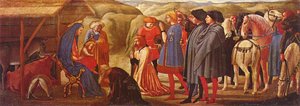
  • Linear Perspective: Employed vanishing points with meticulous mathematical precision to create a convincing illusion of depth, mirroring the architectural innovations championed by Brunelleschi.
  • Chiaroscuro: Masterfully utilized light and shadow to sculpt forms, generating volume and realism previously unattainable in painting—a technique that would become synonymous with Renaissance artistry.
His most celebrated works reside within the Brancacci Chapel of Santa Maria del Carmine in Florence – a testament to his unparalleled skill and vision. The frescoes commissioned by Giovanni Tornabuoni depict scenes from Saint Peter’s life, showcasing Masaccio's mastery of narrative storytelling alongside his groundbreaking use of perspective and emotional depth. Notable pieces include “The Tribute Money,” “Expulsion from Paradise,” and “St. Peter Baptizing the Neophytes,” each embodying the essence of Renaissance realism and humanist ideals. Furthermore, Masaccio collaborated with Masolino on the Madonna and Child with St. Anne, demonstrating a harmonious blend of stylistic approaches while cementing his position as one of Florence’s foremost artists.

Historical Significance and Legacy

Masaccio's influence extended far beyond his lifetime, shaping the artistic sensibilities of subsequent generations—Leonardo da Vinci, Michelangelo, Raphael—who sought to emulate his mastery of human anatomy and his ability to convey emotion through visual representation. Giorgio Vasari famously lauded Masaccio as “the best painter of his generation,” recognizing him as the catalyst for a revolution in painting that ushered in the High Renaissance. Despite dying prematurely at the age of 26, Masaccio’s legacy persists as an enduring symbol of artistic innovation and genius—a figure whose brief but brilliant career fundamentally redefined Western art history. His pioneering use of perspective and chiaroscuro continues to inspire artists today, securing his place among the titans of Renaissance creativity.