Portrett av Joseph Beuys

Joseph Beuyss malerier: De 29 mest kjente, sett gjennom et galleris øyne

Oppdatert November 2026 · rangert etter vår popularitetsscore (søk, besøk og bestillinger for hvert verk) · 33 verk av Joseph Beuys i vår katalog

Kort fortalt

Etter galleriets vurdering er Joseph Beuyss mest kjente maleri Lightning with Stag in Its Glare (1985), hvis original henger i Guggenheim Museum Bilbao, Bilbao. Bathtub (1977) og Halved Felt Cross with Dust Image "Magda" (1965) fullfører trioen som alle kjenner igjen. Av de 33 verkene til Joseph Beuys i vår katalog, presenterer galleriet de 29 mest kjente nedenfor; hvert originalverk med årstall, museum og hva som gjør det unikt.

1921 – 1986, Krefeld Conceptual art Flest verk: Tate Modern

Galleriets 10 beste malerier av Joseph Beuys

1
Lightning with Stag in Its Glare (1985) av Joseph Beuys

Lightning with Stag in Its Glare

1985 · Assemblage · Guggenheim Museum Bilbao, Bilbao

The Genesis of a Mythic Landscape Joseph Beuys's *Lightning with Stag in Its Glare* isn’t merely a sculpture; it’s an invocation, a primal scream rendered in bronze and imbued with the weight of history. Completed between 1958 and 1985, this monumental work emerged from a confluence of influences – Beuys's own turbulent past, his deep engagement with shamanic traditions, and a profound yearning to bridge the gap between individual experience…

2
Bathtub (1977) av Joseph Beuys

Bathtub

1977 · Other-None · Lenbachhaus, München

Joseph Beuys's "Bathtub," created in 1977, isn't merely a photograph of an antique claw-foot tub; it’s a carefully orchestrated meditation on the cyclical nature of existence, the potential for renewal, and the inherent dignity within the commonplace. This seemingly simple image—a white bathtub resting on its metal frame against a muted grey backdrop—holds a profound depth that speaks to Beuys's core artistic philosophy: the belief that art could be a…

3
Halved Felt Cross with Dust Image "Magda" (1965) av Joseph Beuys

Halved Felt Cross with Dust Image "Magda"

1965 · Assemblage · Museum Ludwig, Köln

In the evocative landscape of mid-century avant-garde art, few works command such a quiet, somber presence as Joseph Beuys’s Halved Felt Cross with Dust Image “Magda”. Created in 1965, this striking assemblage serves as a profound testament to the artist’s deep engagement with themes of loss, remembrance, and the ephemeral nature of existence. At its heart, the piece is a masterclass in the Neo-Dada movement, where the boundaries between traditional…

4
The silence of Marcel Duchamp is overrated (1964) av Joseph Beuys

The silence of Marcel Duchamp is overrated

1964 · Black and White Photography · Nasjonalgalleriet i Armenia, Jerevan

In this 1964 work, titled The silence of Marcel Duchamp is overrated, the artist Joseph Beuys engages directly with the medium of broadcast. The piece originated from a transmission via the Second German Television Studio. It captures a specific moment of intellectual and artistic confrontation, moving beyond the traditional confines of a static object to inhabit the space of a televised performance.

5
I Like America and America Likes Me av Joseph Beuys

I Like America and America Likes Me

Black and White Photography

The performance piece titled I Like America and America Likes Me was staged by the German avant-garde artist Joseph Beuys. This action, which is also known as Coyote, took place in May 1974. The event was held at the René Block Gallery located in SoHo, New York City.

8
How to Explain Pictures to a Dead Hare av Joseph Beuys

How to Explain Pictures to a Dead Hare

"One of the artist’s most famous performances, Beuys covered his head first with honey, and then with fifty dollars worth of gold leaf. He cradles a dead hare in his arms, and strapped an iron plate to the bottom of his right shoe. Viewed from behind glass in the gallery, the audience could see Beuys walking from drawing to drawing, quietly whispering in the dead rabbit’s ear. As he walked…

10
Seminar with Joseph Beuys av Joseph Beuys

Seminar with Joseph Beuys

Black and White Photography · Modern Art Oxford, Oxford

This evocative black and white photograph transports us directly into the charged atmosphere of an intellectual exchange—a seminar presided over by the visionary Joseph Beuys. It is not merely a record of people gathered; it is a captured breath of thought, a moment where ideas, like smoke from chalk dust, hang suspended in the air. The composition itself speaks volumes about the nature of discourse: informal, immediate, and deeply human.…

Joseph Beuys sine malerier, rangert fra 11 til 29

Motivene som fanget Joseph Beuyss blikk

De fire motivene som går igjen hyppigst i disse originalverkene, hver med sitt fremste eksempel.

Museene som har Joseph Beuyss originalverk

De 8 museene som innehar flest av maleriene på denne siden.

Museum By Verker av Joseph Beuys Malerier fra denne listen
Tate Modern, LondonTate Modern London 3 Hearts of the Revolutionaries: Passage of the Planets of the Future, Actresses, Brightly-Lit Stag Chair
Guggenheim Museum Bilbao, BilbaoGuggenheim Museum Bilbao Bilbao 1 Lightning with Stag in Its Glare
Lenbachhaus, MünchenLenbachhaus München 1 Bathtub
Museum Ludwig, KölnMuseum Ludwig Köln 1 Halved Felt Cross with Dust Image "Magda"
Nasjonalgalleriet i Armenia, JerevanNasjonalgalleriet i Armenia Jerevan 1 The silence of Marcel Duchamp is overrated
Modern Art Oxford, OxfordModern Art Oxford Oxford 1 Seminar with Joseph Beuys
Nasjonalgalleriet i Skottland, EdinburghNasjonalgalleriet i Skottland Edinburgh 1 Capri Battery
Statens Museum for Kunst, KøbenhavnStatens Museum for Kunst København 1 Painting Version 15

Joseph Beuys, ett signaturmaleri per tiår

Verk per tiår

Velg et tiår for å se originalverket som definerer det.

Joseph Beuyss malerier: galleriets svar

Hvilket maleri av Joseph Beuys er det mest kjente av alle?Avslør svaret

Lightning with Stag in Its Glare (1985), Guggenheim Museum Bilbao, Bilbao. Deretter følger Bathtub (1977) og Halved Felt Cross with Dust Image "Magda" (1965).

Hvor gammel var Joseph Beuys da Lightning with Stag in Its Glare ble ferdigstilt?Avslør svaret

64 år gammel: Lightning with Stag in Its Glare er fra 1985, og Joseph Beuys ble født i 1921.

Hvilke er de 10 beste maleriene til Joseph Beuys?Avslør svaret

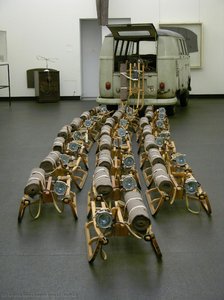
Lightning with Stag in Its Glare, Bathtub, Halved Felt Cross with Dust Image "Magda", The silence of Marcel Duchamp is overrated, I Like America and America Likes Me, Fat chair, Fat chair, How to Explain Pictures to a Dead Hare, Fettecke og Seminar with Joseph Beuys. Rangeringen ovenfor viser årstall og museum for hvert verk.

Hvor mange verk skapte Joseph Beuys?Avslør svaret

Vår katalog inneholder 33 verk av Joseph Beuys, datert fra 1952 til 1985.

Hvor henger de mest kjente originalverkene til Joseph Beuys?Avslør svaret

Hovedsakelig i Tate Modern (London), Guggenheim Museum Bilbao (Bilbao) og Lenbachhaus (München). Museumslisten ovenfor viser alle.

Når malte Joseph Beuys sine mest kjente malerier?Avslør svaret

I 1960s: 9 av de 29 verkene på denne siden ble laget da, Halved Felt Cross with Dust Image "Magda" av dem.

Hvilke er Joseph Beuyss tidligste og nyeste berømte verk?Avslør svaret

På denne siden er det eldste Bug der Argo (1952) og det nyeste Lightning with Stag in Its Glare (1985).

Hvilke motiver vendte Joseph Beuys oftest tilbake til?Avslør svaret

Social commentary (3), Man (2) og Black and white (2), fordelt på 29 verk på denne siden.

Hvilket medium arbeidet Joseph Beuys mest med?Avslør svaret

Black and White Photography, for 3 av de 29 verkene på denne siden.

Hvilken kunstretning er Joseph Beuys tilknyttet?Avslør svaret

Conceptual art og Neo-dada, basert på originalene på denne siden.

Hvilke originalverk av Joseph Beuys har Tate Modern i sin samling?Avslør svaret

Hearts of the Revolutionaries: Passage of the Planets of the Future, Actresses og Brightly-Lit Stag Chair: Tate Modern, London har 3 av verkene på denne siden.

Joseph Beuys: kunstneren

A Life Sculpted in Society

Joseph Beuys, a name synonymous with the expansion of artistic boundaries, was more than just an artist; he was a visionary who believed creativity held the key to societal transformation. Born in Krefeld, Germany, in 1921, his life unfolded against a backdrop of immense political and social upheaval, profoundly shaping his artistic philosophy. From a childhood marked by relocation and early exposure to both natural sciences and the burgeoning darkness of Nazism—an event crystallized by rescuing Carl Linnaeus’s *Systema Naturae* from a book burning—Beuys developed a sensitivity to the fragility of existence and the power of symbolic action. His formative years were steeped in an intellectual curiosity that spanned music, mythology, and history, laying the groundwork for his later multidisciplinary approach. Though briefly involved with the Hitler Youth as a teenager – a common experience for German youth at the time – Beuys’s trajectory would ultimately lead him to challenge established norms and advocate for radical social change through art.

The Crucible of War and the Birth of an Iconography

World War II proved a pivotal, almost mythic, turning point in Beuys's life. Volunteering for the Luftwaffe in 1941, he experienced a near-fatal plane crash in Crimea in 1944. The story that emerged from this event—his rescue by Tatar tribesmen who wrapped his broken body in felt and fat to preserve warmth and aid healing—became central to his artistic identity. While historical accounts dispute the details of this narrative, Beuys embraced it as a foundational myth, imbuing these materials with profound symbolic weight. Felt, representing protection, insulation, and connection to nature; and fat, symbolizing energy, healing, and transformation—these became recurring motifs in his work, acting as potent metaphors for the human condition and the potential for renewal. Following the war, Beuys formally studied sculpture at the Düsseldorf Academy of Fine Arts, but it was his engagement with anthroposophy, the spiritual philosophy developed by Rudolf Steiner, that truly ignited his artistic vision. This encounter profoundly influenced his belief in the interconnectedness of all things and the role of art as a means of fostering social harmony.

Social Sculpture: Art as a Revolutionary Force

Beuys’s most significant contribution to art history is arguably his concept of “Social Sculpture” (*Soziale Plastik*). This wasn't merely about creating physical objects; it was a holistic vision where creativity played a vital role in shaping society and politics. He believed that every individual possessed creative potential, and that this potential could be unlocked through participation—blurring the lines between artist, artwork, and audience. Social Sculpture wasn’t confined to galleries or museums; it extended into everyday life, encompassing political activism, educational initiatives, and public performances. He envisioned a “Gesamtkunstwerk”—a total work of art—where all aspects of human existence could be creatively engaged to foster positive social change. This philosophy underpinned his numerous actions, installations, and pedagogical endeavors, challenging the traditional role of the artist as a solitary creator and positioning them instead as a catalyst for collective transformation.

Performance, Materials, and Political Engagement

Beuys’s artistic practice was remarkably diverse, encompassing performance art, installations, drawings, sculptures, and political activism. His performances were often ritualistic, involving direct engagement with the public and unconventional materials. Iconic works like his felt suits, which he wore during numerous actions, symbolized warmth, protection, and a primal connection to nature. Fat Installations explored themes of energy, healing, and transformation, while performances such as “I Like to Learn” (1965), where he sat in a gallery window with stones and honey inviting dialogue, emphasized the importance of knowledge sharing and open communication. Sculptures like “Lightning with Stag in Its Glare” represented primal forces and human consciousness. Beyond his artistic creations, Beuys actively participated in political debates, founding the Free International Zone (FIZ) at documenta 7—a space for artistic experimentation and social dialogue—and becoming a vocal supporter of the German Green Party.

A Lasting Legacy

Joseph Beuys died in 1986, leaving behind a legacy that continues to inspire artists, activists, and thinkers today. He radically challenged conventional notions of creativity and authorship, emphasizing participation and social engagement. His work expanded the definition of art beyond aesthetic concerns to encompass political, environmental, and spiritual dimensions. His concept of Social Sculpture remains profoundly relevant, urging us to recognize the creative potential within ourselves and to actively participate in shaping a more just and sustainable future. Beuys wasn’t simply an artist; he was a prophet of possibility, reminding us that art has the power not only to reflect society but also to transform it.