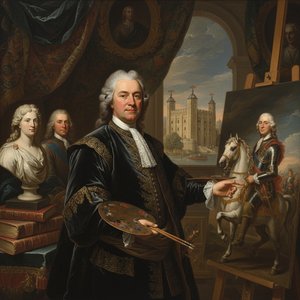
1859 - 1954

Essensielt

  • Copyright status: Public domain
  • Museums on this site: The Beacon Museum
  • Works on this site: 16
  • Art period: 19th Century
  • Topics explored: portrait
  • Lifespan: 95 years
  • Top 3 works:
    • Self Portrait
    • Dr James Irving Lace
    • Mr Robert Fisher

A Life Immersed in Landscape and Portraiture: John Dalzell Kenworthy

John Dalzell Kenworthy, born in 1858 at Whitehaven, Cumbria, was an artist whose life unfolded across the pivotal turn of the twentieth century, a period marked by both societal upheaval and artistic innovation. He wasn’t merely a painter; he was a chronicler of his time, capturing the dignity of individuals and the serene beauty of the landscapes that surrounded him—particularly those of Whitehaven, Scotland, and France. Kenworthy's story is one of quiet dedication to his craft, earning him recognition through consistent exhibition at prestigious venues like the Royal Academy in London, alongside galleries in Manchester, Leeds, and Liverpool. His association with the Royal Cambrian Academy further solidified his position within the British art scene. He was a man deeply rooted in his local community, yet possessed an international sensibility that allowed his work to resonate beyond geographical boundaries.

Early Life and Artistic Development

Born into a prominent West Cumbrian family, Kenworthy’s early life instilled in him a profound appreciation for the natural world. The rugged coastline of Whitehaven and the surrounding countryside provided a constant source of inspiration. He developed a keen eye for detail and a sensitivity to light that would become hallmarks of his style. While formal artistic training details remain somewhat elusive, it is clear he possessed both innate talent and a commitment to honing his skills through diligent practice. Kenworthy worked in both oils and watercolors, mastering the nuances of each medium. His early works likely focused on local scenes and portraits of family and acquaintances, establishing a foundation for his later explorations. He settled at Seacroft House, St Bees, a picturesque coastal village south of Whitehaven, which became his base for artistic endeavors and community involvement.

A Broad Canvas: Subjects and Style

Kenworthy’s oeuvre is remarkably diverse, encompassing both portraiture and landscape painting. His portraits are characterized by their realism and dignified representation of the sitter. He wasn't interested in flamboyant displays of wealth or status; instead, he sought to capture the inner character and personality of his subjects. Works like ‘Portrait of a Mayor of Whitehaven’ exemplify this approach—a meticulous rendering of detail combined with a sense of quiet authority. His landscapes, meanwhile, reveal a deep connection to nature. He travelled extensively in Scotland, drawn by its dramatic mountains, lochs, and glens, producing evocative watercolors and oil paintings that capture the atmospheric beauty of the region. France also held a special appeal, where he became particularly well known, likely painting scenes of the Mediterranean coast and rural life. His style can be described as traditional yet subtly modern, reflecting the influence of late Victorian realism while embracing a more impressionistic approach to light and color in his landscapes.

Beyond the Brush: Kenworthy’s Wider Contributions

Kenworthy was not solely defined by his artistic pursuits. He was an active member of his community, serving as a Justice of the Peace from 1919 and holding positions as President of both the West Cumberland Club and Whitehaven Art Club in 1948. This demonstrates a commitment to civic engagement and a desire to foster artistic appreciation within his locality. Perhaps less known is his literary side; he authored ‘Fisherman’s Philosophy’ in 1933, a thoughtful exploration of Scottish salmon and loch trout fishing, interwoven with reflections on the natural world and the contemplative aspects of angling. This work reveals a depth of intellectual curiosity beyond the realm of visual art. His involvement in designing war memorials for St Bees further illustrates his dedication to commemorating significant events and contributing to the collective memory of his community. He designed a second memorial after believing that the first one lacked impact, showcasing his strong sense of artistic vision and civic responsibility.

Legacy and Historical Significance

John Dalzell Kenworthy’s work offers a valuable glimpse into British life during a period of transition. His paintings are not grand statements or revolutionary departures; rather, they are subtle yet powerful representations of individuals, landscapes, and the values of his time. He captured the essence of Whitehaven and its surrounding regions, preserving scenes and faces that might otherwise have been lost to history. His association with prominent art institutions like the Royal Academy and the Royal Cambrian Academy confirms his standing within the British art establishment. Today, his works are held in public collections such as the Beacon Museum and Helena Thompson Museum, ensuring their continued accessibility for future generations. Kenworthy’s legacy lies not in radical innovation but in a quiet mastery of technique, a deep connection to his subjects, and a commitment to capturing the beauty and dignity of the world around him. He stands as a testament to the enduring power of observation, dedication, and artistic skill—a painter who truly immersed himself in the landscapes and lives he so eloquently portrayed. His paintings continue to resonate with viewers today, offering a poignant reminder of a bygone era and the timeless appeal of skillful artistry.

Quiz

Det er kun ett riktig svar på hvert spørsmål.

Spørsmål 1:
John Dalzell Kenworthy was particularly well-known for his art in which two countries?
Spørsmål 2:
Kenworthy was an associate of which Royal Academy?
Spørsmål 3:
Besides painting, what other artistic pursuit was Kenworthy known for?
Spørsmål 4:
What subject matter did Kenworthy frequently paint in addition to portraits?
Spørsmål 5:
In what year did Kenworthy publish 'Fisherman's Philosophy'?

Spørsmål og svar

I hvilken historisk periode arbeidet John Dalzell Kenworthy?

John Dalzell Kenworthy var virksom i perioden 19th Century. Denne perioden plasserer kunstnerens virke i en historisk kontekst.

Hvordan finner jeg verk av John Dalzell Kenworthy innenfor et spesifikt tema?

Siden Søk etter nøkkelord for John Dalzell Kenworthy grupperer kunstnerens verk etter nøkkelord.

Hvor populære er kunstverkene til John Dalzell Kenworthy?

Det finnes en Besøksstatistikk-side for John Dalzell Kenworthy, som viser statistikk over kunstnerens verk på denne nettsiden.

Finnes det en tidslinje over verkene til John Dalzell Kenworthy?

Se en tidslinje over John Dalzell Kenworthy sine verk på siden for Kronologisk oversikt over kunstverk, hvor kunstverkene er sortert etter produksjonsdato.

Hvilke stemninger uttrykker kunstverkene til John Dalzell Kenworthy?

Kunstnerens Kunst etter stemning-side viser John Dalzell Kenworthy sine kunstverk sortert etter stemning.

Kan jeg sortere John Dalzell Kenworthy sine kunstverk etter farge?

Sorter etter farge for John Dalzell Kenworthy er en side som organiserer kunstnerens verk etter farge.

Finnes det en oversikt over alle motivene John Dalzell Kenworthy malte?

Utforsk John Dalzell Kenworthy sine verk etter motiv på kunstnerens Motivatlas-side.

Finnes det en virtuell 3D-omvisning av John Dalzell Kenworthy sine verk?

Virtuelt 3D-galleri til John Dalzell Kenworthy er en side som viser kunstnerens verk i et virtuelt tredimensjonalt galleri.

What subject matter did Kenworthy frequently paint in addition to portraits?

Landscapes