Portrett av John Crome

De 54 mest kjente John Crome-maleriene, hvert og ett unikt

Oppdatert October 2026 · rangert etter vår popularitetsscore (søk, besøk og bestillinger for hvert verk) · 54 verk av John Crome i vår katalog

Kort fortalt

Boys Bathing on the River Wensum, Norwich (1817) er maleriet av John Crome som vekker mest oppmerksomhet; originalen befinner seg i Yale Center for British Art, New Haven. Deretter går blikket til Grove Scene (1820) og Slate Quarries (1803). Blant de 54 verkene til John Crome i vår katalog, er disse 54 de mest kjente – hver og en et unikt originalverk presentert med sitt årstall, sitt museum og årsaken til at det består.

1768 – 1821, Norwich Romanticism Flest verk: Yale Center for British Art

Topp 10 malerier av John Crome, sett gjennom galleriets øyne

1
Boys Bathing on the River Wensum, Norwich (1817) av John Crome

Boys Bathing on the River Wensum, Norwich

1817 · Oil On Canvas · Yale Center for British Art, New Haven

Boys Bathing on the River Wensum, Norwich – A Reflection of Norfolk’s Soul John Crome's “Boys Bathing on the River Wensum, Norwich” isn’t merely a depiction of a picturesque riverside scene; it’s a distillation of the very spirit of Norfolk—a region steeped in tradition and celebrated for its understated beauty. Painted in 1817 during the height of the Romantic era, this landscape masterpiece encapsulates the fascination with nature that characterized…

2
Grove Scene (1820) av John Crome

Grove Scene

1820 · Oil On Canvas · Norwich Castle Museum And Art Gallery, Norwich

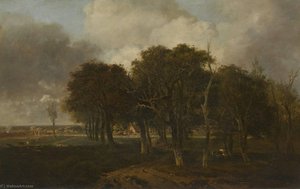
A small clearing within a Norfolk forest provides the setting for this 1820 oil on canvas. Two figures stand amidst the trees, appearing as quiet observers of the landscape. Nearby, a horse grazes in the grass, contributing to the pastoral stillness of the scene. The composition uses these figures to anchor the expansive vista, establishing a connection between the human presence and the natural environment.

6
A Mountain Scene (1806) av John Crome

A Mountain Scene

1806 · Oil · Scottish National Gallery, Edinburgh

In his 1806 masterpiece, A Mountain Scene, John Crome captures a panoramic vista of East Anglian hills, a scene that serves as a profound embodiment of Romantic ideals. The composition is dominated by a substantial rock outcrop in the foreground, its rugged presence acting as a symbol of resilience and permanence against the relentless forces of time and weather. Through a skillful application of perspective, Crome draws the viewer’s gaze…

John Cromes berømte malerier, nummer 11 til 54

11The Beaters (1810) av John CromeThe Beaters1810 · Scottish National Gallery 12Yarmouth Jetty (1810) av John CromeYarmouth Jetty1810 · Yale Center for British Art 13Woodland Landscape near Norwich (1810) av John CromeWoodland Landscape near Norwich1810 · Yale Center for British Art 14View near Thorpe; Moonlight scene (1807) av John CromeView near Thorpe; Moonlight scene1807 · Vanderbilt Museum of Art 15Hautbois Common, Norfolk (1810) av John CromeHautbois Common, Norfolk1810 · Metropolitan Museum of Art 16High Tor, Matlock (1811) av John CromeHigh Tor, Matlock1811 · Fitzwilliam Museum 17Hautbois Common, Norfolk (1810) av John CromeHautbois Common, Norfolk1810 18Dock Leaves (1813) av John CromeDock Leaves1813 · Norwich Castle Museum And Art Gallery 19A Heath Scene: Sun after Storm (1818) av John CromeA Heath Scene: Sun after Storm1818 · National Gallery of Ireland 20A Windmill near Norwich (1816) av John CromeA Windmill near Norwich1816 21Yarmouth Harbour - Evening (1817) av John CromeYarmouth Harbour - Evening1817 22The Poringland Oak (1819) av John CromeThe Poringland Oak1819 23A Sandy Bank (1820) av John CromeA Sandy Bank1820 · Scottish National Gallery 24The Harling Gate (1817) av John CromeThe Harling Gate1817 · Vanderbilt Museum of Art 25The Edge of the Forest (1821) av John CromeThe Edge of the Forest1821 · Vanderbilt Museum of Art 26Landscape with Trees and Cattle (1820) av John CromeLandscape with Trees and Cattle1820 27Marlingford Grove (1815) av John CromeMarlingford Grove1815 28Mousehold Heath, Norwich (1820) av John CromeMousehold Heath, Norwich1820 29The Fish Market, Boulogne, France (1820) av John CromeThe Fish Market, Boulogne, France1820 · Norwich Castle Museum And Art Gallery 30Moonlight on the Yare (1817) av John CromeMoonlight on the Yare1817 · National Gallery of Art 31Moonrise on the Yare ( ) (1816) av John CromeMoonrise on the Yare ( )1816 32Ruined Buildings av John CromeRuined BuildingsNational Gallery of Canada 33Windmill near Norwich av John CromeWindmill near NorwichMuseum of Fine Arts 34Landscape Edge of a Wood (1820) av John CromeLandscape Edge of a Wood1820 · Courtauld Gallery 35The Lime Kiln (1806) av John CromeThe Lime Kiln1806 36An Egyptian Poppy and a Water Mole (1812) av John CromeAn Egyptian Poppy and a Water Mole1812 · Yale Center for British Art 37View near Weymouth av John CromeView near WeymouthDetroit Institute of Arts 38A sandy hollow av John CromeA sandy hollowFitzwilliam Museum 39Yarmouth Beach av John CromeYarmouth BeachYale University Art Gallery 40A Barge with a Wounded Soldier av John CromeA Barge with a Wounded SoldierYale Center for British Art 41Moonlight Norwich, Norfolk av John CromeMoonlight Norwich, NorfolkRussell 42The Edge of the Forest av John CromeThe Edge of the Forest 43Landscape with a Waterfall near Norwich, Norfolk, 1819 av John CromeLandscape with a Waterfall near Norwich, Norfolk, 1819The Wilson: Cheltenham Art Gallery And Museum 44Wooded Landscape with an Oak av John CromeWooded Landscape with an Oak 45The Mill av John CromeThe MillNorfolk Museums 46Moonlight av John CromeMoonlight 47Mousehold Heath av John CromeMousehold Heath 48The Mill (after Rembrandt van Rijn) av John CromeThe Mill (after Rembrandt van Rijn)Norfolk Museums 49Lane near Norwich av John CromeLane near NorwichWolverhampton Art Gallery 50Landscape with a Cottage and Trees av John CromeLandscape with a Cottage and TreesNorfolk Museums 51Pløyeren av John CromePløyerenSheffield City Art Galleries 52Landscape with a River av John CromeLandscape with a RiverSheffield City Art Galleries 53Mousehold Heath, Norwich (1819) av John CromeMousehold Heath, Norwich1819 54The River Wensum, Norwich (1814) av John CromeThe River Wensum, Norwich1814 · Yale Center for British Art

Motivene som fanget John Cromes blikk

De fire motivene som går igjen hyppigst i disse originalverkene, hver med sitt fremste eksempel.

Museene som har John Cromes originalverk

De 8 museene som innehar flest av maleriene på denne siden.

Museum By Verker av John Crome Malerier fra denne listen
Yale Center for British Art, New HavenYale Center for British Art New Haven 6 Boys Bathing on the River Wensum, Norwich, Yarmouth Jetty, Woodland Landscape near Norwich
Scottish National Gallery, EdinburghScottish National Gallery Edinburgh 4 A Mountain Scene, The Bell Inn, The Beaters
Norwich Castle Museum And Art Gallery, NorwichNorwich Castle Museum And Art Gallery Norwich 3 Grove Scene, Dock Leaves, The Fish Market, Boulogne, France
Vanderbilt Museum of Art Nashville 3 View near Thorpe; Moonlight scene, The Harling Gate, The Edge of the Forest
Norfolk Museums, NorwichNorfolk Museums Norwich 3 The Mill, The Mill (after Rembrandt van Rijn), Landscape with a Cottage and Trees
Birmingham Museum and Art Gallery, BirminghamBirmingham Museum and Art Gallery Birmingham 2 The Way Through the Wood, View At Blofield, Near Norwich
National Gallery of Canada, OttawaNational Gallery of Canada Ottawa 2 The Old Oak, Ruined Buildings
Fitzwilliam MuseumFitzwilliam Museum 2 High Tor, Matlock, A sandy hollow

John Crome gjennom tiårene: ett unikt originalverk for hvert tiår

Verk per tiår

Velg et tiår for å se originalverket som definerer det.

John Cromes malerier: spørsmål til galleriet

Hva er det mest kjente verket til John Crome?Avslør svaret

Boys Bathing on the River Wensum, Norwich (1817), Yale Center for British Art, New Haven. Deretter følger Grove Scene (1820) og Slate Quarries (1803).

Hvor gammel var John Crome da Boys Bathing on the River Wensum, Norwich ble skapt?Avslør svaret

49 år gammel: Boys Bathing on the River Wensum, Norwich er fra 1817, og John Crome ble født i 1768.

Hvilke ti malerier av John Crome er de mest kjente?Avslør svaret

Boys Bathing on the River Wensum, Norwich, Grove Scene, Slate Quarries, The Willow, Sheds and Old Houses on the Yare, A Mountain Scene, The Way Through the Wood, View At Blofield, Near Norwich, The Old Oak og The Bell Inn. Rangeringen ovenfor viser årstall og museum for hvert verk.

Hvor mange verk av John Crome er kjent?Avslør svaret

Vår katalog inneholder 54 verk av John Crome, datert fra 1800 til 1821.

Hvor kan de mest kjente originalverkene til John Crome ses?Avslør svaret

Hovedsakelig i Yale Center for British Art (New Haven), Scottish National Gallery (Edinburgh) og Norwich Castle Museum And Art Gallery (Norwich). Museumslisten ovenfor viser alle.

I hvilken periode malte John Crome sine mest kjente malerier?Avslør svaret

I 1810s: 22 av de 54 verkene på denne siden ble laget da, Boys Bathing on the River Wensum, Norwich av dem.

Hvilket kjent maleri av John Crome er det eldste, og hvilket er det nyeste?Avslør svaret

På denne siden er det eldste The Willow (1800) og det nyeste The Edge of the Forest (1821).

Hvilke motiver foretrakk John Crome?Avslør svaret

Landscape (11), Norfolk (6) og Rural scene (4), fordelt på 54 verk på denne siden.

Hvilke materialer brukte John Crome mest av?Avslør svaret

Oil On Canvas, for 5 av de 54 verkene på denne siden.

Hvilken kunstretning tilhører verkene til John Crome?Avslør svaret

Romanticism, basert på originalene på denne siden.

Hvilke originalverk av John Crome kan jeg se på Yale Center for British Art?Avslør svaret

Boys Bathing on the River Wensum, Norwich, Yarmouth Jetty og Woodland Landscape near Norwich: Yale Center for British Art, New Haven har 6 av verkene på denne siden.

John Crome: et portrett av kunstneren

John Crome (1768–1821) – Norfolk Museums Collections

John Crome, affectionately known as “Old Crome” to distinguish him from his artist son, stands as a pivotal figure in British art history—a founder and leading light of the celebrated Norwich School. Born in 1768 in the bustling market town of Norwich, Norfolk, Crome’s journey was one of remarkable self-education and dedication, rising from humble beginnings to become a respected landscape painter who captured the very essence of his beloved East Anglian countryside. His father, a weaver, instilled a strong work ethic, but it was an apprenticeship with house, coach, and sign painter Francis Whisler that first nurtured Crome’s artistic inclinations, providing him with foundational skills in design and color. This practical training proved invaluable as he began to explore his passion for depicting the natural world around him. A formative friendship with Robert Ladbrooke, a fellow aspiring artist, further fueled his development; together they sketched en plein air, honing their observational abilities and sharing a burgeoning enthusiasm for art.

Early Influences and Artistic Training

Crome’s artistic trajectory was profoundly shaped by exposure to the artistic treasures housed in Thomas Harvey of Old Catton’s collection—a formative experience that introduced him to masterpieces by artists like Gainsborough and Hobbema. These works served as crucial models for composition, light, and atmosphere, demonstrating the importance of careful observation and stylistic emulation. Furthermore, guidance from established figures such as Sir William Beechey and John Opie cemented his connection to the wider artistic community, fostering a supportive environment conducive to artistic growth. Notably, Crome’s early training encompassed not only drawing but also printmaking—a skill honed during his apprenticeship with Whisler that would prove instrumental in developing his distinctive etching technique. This grounding in craftsmanship instilled a meticulous attention to detail and informed his approach to capturing the subtleties of Norfolk landscapes.

The Norwich School: A Regional Vision

In 1803, Crome decisively propelled himself onto the national art stage by co-founding the Norwich Society of Artists with Robert Ladbrooke—a bold initiative that marked the formal genesis of the Norwich School. This groundbreaking movement championed direct engagement with nature and sought to portray the Norfolk landscape in a manner distinct from prevailing artistic conventions emanating from London, prioritizing authenticity and capturing the spirit of the region. Recognizing the need for a collective effort to elevate Norfolk’s artistic representation, Crome spearheaded this endeavor, uniting fellow artists who shared his unwavering commitment to portraying their surroundings truthfully. The Society quickly gained prominence, attracting talented painters eager to explore the beauty of Norfolk's countryside—a testament to Crome’s vision and leadership.

Style and Technique: Light, Atmosphere, and Observation

Crome’s artistic style is characterized by a remarkable sensitivity to light and atmosphere—qualities he meticulously rendered in his paintings using a technique rooted in observation and meticulous detail. Unlike many of his contemporaries who favored idealized depictions, Crome prioritized capturing the nuances of natural illumination, conveying the mood and character of Norfolk landscapes with profound accuracy. His brushwork was loose yet controlled, allowing for expressive marks that nevertheless maintained compositional integrity. He skillfully employed watercolor and oil pigments to achieve a luminous effect—a hallmark of his distinctive style—demonstrating an exceptional understanding of color theory and artistic execution. Furthermore, Crome’s meticulous botanical studies informed his depictions of trees and plants, elevating his work beyond mere landscape representation into a celebration of the natural world.

Legacy and Recognition

John Crome's contribution extended far beyond his artistic output. The Norwich School he helped establish fostered a distinctive regional artistic identity, nurturing generations of painters who followed in his footsteps—a legacy that continues to inspire artists today. His unwavering dedication to capturing Norfolk’s beauty solidified his place as one of Britain’s most important Romantic landscape painters. Despite initial skepticism from the London art establishment, Crome achieved national acclaim through thirteen exhibitions at the Royal Academy between 1806 and 1818—a testament to his artistic merit and enduring appeal. His etchings, though unpublished during his lifetime, revealed another facet of his talent—demonstrating a mastery of printmaking alongside his painting prowess. As historian Dr Giorgia Bottinelli eloquently stated, “Our three greatest masters - Crome, Constable and Turner - demonstrate that landscape painting ... is peculiarly the business of the English genius.” His life serves as an inspiring example of how artistic vision, combined with a deep connection to one’s surroundings, can create a body of work that resonates across generations. His paintings remain treasured for their quiet beauty, evocative atmosphere, and enduring reflection of Norfolk's timeless charm.