Kort fortalt
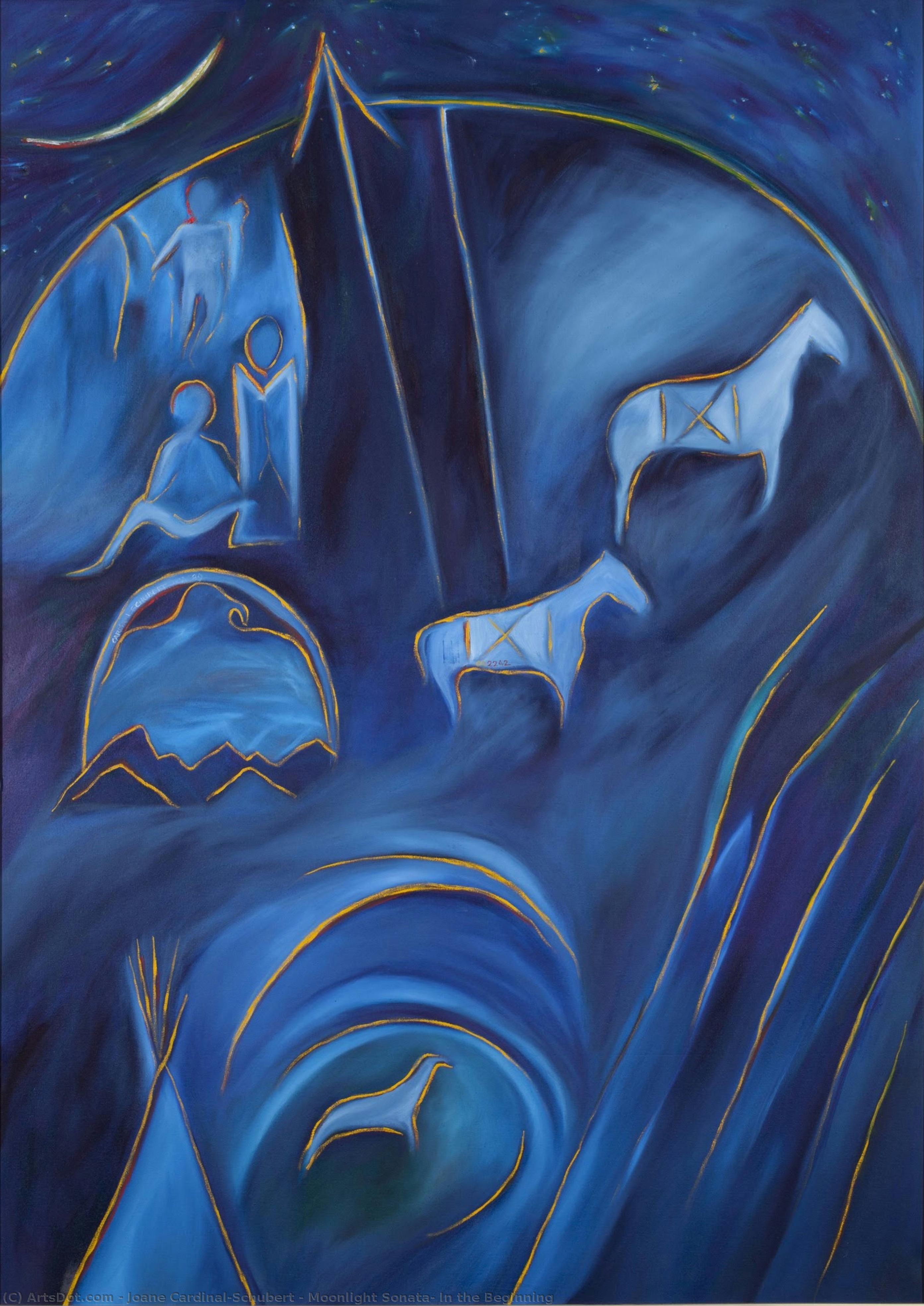
Moonlight Sonata: In the Beginning (1989) er maleriet av Joane Cardinal-Schubert som vekker mest oppmerksomhet; originalen befinner seg i Alberta Foundation for the Arts, Edmonton. Deretter går blikket til I Dream of Horse / Counterpane (2002) og Looking For the Silver Bullet (1995). Blant de 5 verkene til Joane Cardinal-Schubert i vår katalog, er disse 4 de mest kjente – hver og en et unikt originalverk presentert med sitt årstall, sitt museum og årsaken til at det består.
Topp 10 malerier av Joane Cardinal-Schubert, sett gjennom galleriets øyne
I Dream of Horse / Counterpane
In the breathtaking canvas of I Dream of Horse / Counterpane, the viewer is transported into a world where movement and memory intertwine. Created in 2002 by the esteemed Kainai Nation artist Joane Cardinal-Schubert, this masterpiece serves as a vibrant window into a landscape teeming with life and ancestral echoes. The composition is a rhythmic dance of equine forms; a central, large horse bows its head in a moment of…
Looking For the Silver Bullet
In the profound and evocative masterpiece Looking For the Silver Bullet, created in 1995, the viewer is transported into a realm where the boundaries between humanity and the natural world dissolve. This vibrant work by the esteemed Kainai Nation artist Joane Cardinal-Shrubert serves as more than just a painting; it is a powerful testament to Indigenous identity and cultural endurance. The composition centers on a striking female figure, adorned with…
Motivene som fanget Joane Cardinal-Schuberts blikk
De fire motivene som går igjen hyppigst i disse originalverkene, hver med sitt fremste eksempel.
Museene som har Joane Cardinal-Schuberts originalverk
Museet som innehar flest av maleriene på denne siden.
| Museum | By | Verker av Joane Cardinal-Schubert | Malerier fra denne listen |
|---|---|---|---|
| Edmonton | 4 | Moonlight Sonata: In the Beginning, I Dream of Horse / Counterpane, Looking For the Silver Bullet |
Joane Cardinal-Schubert gjennom tiårene: ett unikt originalverk for hvert tiår
Verk per tiår
Velg et tiår for å se originalverket som definerer det.
Looking For the Silver Bullet
In the profound and evocative masterpiece Looking For the Silver Bullet, created in 1995, the viewer is transported into a realm where the boundaries between humanity and the natural world dissolve. This vibrant work by the esteemed Kainai Nation artist Joane Cardinal-Shrubert serves as more than just a painting; it is a powerful testament to Indigenous identity and cultural endurance. The composition centers on a striking female figure, adorned with…
I Dream of Horse / Counterpane
In the breathtaking canvas of I Dream of Horse / Counterpane, the viewer is transported into a world where movement and memory intertwine. Created in 2002 by the esteemed Kainai Nation artist Joane Cardinal-Schubert, this masterpiece serves as a vibrant window into a landscape teeming with life and ancestral echoes. The composition is a rhythmic dance of equine forms; a central, large horse bows its head in a moment of…
Joane Cardinal-Schuberts malerier: spørsmål til galleriet
Hva er det mest kjente verket til Joane Cardinal-Schubert?Avslør svaret
Moonlight Sonata: In the Beginning (1989), Alberta Foundation for the Arts, Edmonton. Deretter følger I Dream of Horse / Counterpane (2002) og Looking For the Silver Bullet (1995).
Hvor gammel var Joane Cardinal-Schubert da Moonlight Sonata: In the Beginning ble skapt?Avslør svaret
47 år gammel: Moonlight Sonata: In the Beginning er fra 1989, og Joane Cardinal-Schubert ble født i 1942.
Hvor mange verk av Joane Cardinal-Schubert er kjent?Avslør svaret
Vår katalog inneholder 5 verk av Joane Cardinal-Schubert, datert fra 1989 til 2002.
Hvor kan de mest kjente originalverkene til Joane Cardinal-Schubert ses?Avslør svaret
Hovedsakelig i Alberta Foundation for the Arts (Edmonton). Museumslisten ovenfor viser alle.
I hvilken periode malte Joane Cardinal-Schubert sine mest kjente malerier?Avslør svaret
I 1990s: 2 av de 4 verkene på denne siden ble laget da, Looking For the Silver Bullet av dem.
Hvilket kjent maleri av Joane Cardinal-Schubert er det eldste, og hvilket er det nyeste?Avslør svaret
På denne siden er det eldste Moonlight Sonata: In the Beginning (1989) og det nyeste I Dream of Horse / Counterpane (2002).
Hvilken kunstretning tilhører verkene til Joane Cardinal-Schubert?Avslør svaret
Contemporary art, basert på originalene på denne siden.
Hvilke originalverk av Joane Cardinal-Schubert kan jeg se på Alberta Foundation for the Arts?Avslør svaret
Moonlight Sonata: In the Beginning, I Dream of Horse / Counterpane og Looking For the Silver Bullet: Alberta Foundation for the Arts, Edmonton har 4 av verkene på denne siden.
Joane Cardinal-Schubert: et portrett av kunstneren
A Legacy of Resilience: The Art of Joane Cardinal-Schubert
Joane Cardinal-Schubert (1942–2009) was far more than a painter; she was a profound visual storyteller and a fierce advocate for the Kainai Nation. Born in Canoe Lake, Alberta, her life’s work emerged as a powerful response to the systemic erasures of Indigenous history within the Canadian landscape. Growing up amidst the quiet strength of her heritage, she recognized early on how colonial education systems sought to omit the vibrant traditions, languages, and histories of her people. This void became the catalyst for her artistic mission. Rather than accepting the silence imposed by mainstream narratives, Cardinal-Schubert utilized her canvas as a site of reclamation, transforming personal and collective memory into a monumental act of cultural preservation. Her formal training at the Alberta College of Art + Design provided her with a sophisticated technical foundation in painting, printmaking, and multimedia, yet her true education was rooted in the oral histories and spiritual landscapes of the Kainaiwa people. As her career progressed, her work evolved from traditional representations into complex, multi-layered installations that challenged the viewer to confront the uncomfortable realities of colonialism. She mastered the ability to weave together disparate elements—textiles, sculptural components, and photographic prints—to create immersive environments that breathed life into ancestral spirits and historical truths.Symbolism, Narrative, and the Spirit of the Land
The aesthetic language of Cardinal-Schultbert is deeply evocative, characterized by a rich tapestry of symbolism that bridges the gap between the physical and spiritual realms. Her compositions often feature figures that serve as vessels for resilience, embodying the enduring spirit of her ancestors. These figures do not exist in isolation; they are inextricably linked to landscapes that are imbued with profound spiritual significance. In her work, the land is never merely a backdrop but a living participant in the narrative, reflecting the deep-seated connection between Indigenous identity and the natural world. Through her use of mixed media, she achieved a tactile depth that invited viewers into a sensory experience of history. Her paintings often possess a rhythmic quality, where color and form dance to the cadence of mythic storytelling. By integrating sculptural elements and textiles, she broke the boundaries of the two-dimensional plane, mirroring the way Indigenous culture is lived through movement, craft, and ceremony. This approach allowed her to address themes of sovereignty and identity with a complexity that transcended simple protest, offering instead a nuanced celebration of survival and continuity.Historical Significance and Artistic Achievement
The impact of Joane Cardinal-Schubert extends well beyond the borders of the gallery space. As an artist-activist, she utilized her platform to spark essential dialogues regarding Indigenous sovereignty and the lasting scars of colonial policy. Her work served as a vital bridge, bringing the struggles and triumphs of the Kainai Nation to a global audience and demanding recognition for the truths often suppressed by history books. Her contributions were formally recognized through her induction into the Royal Canadian Academy of Arts, a testament to her standing within the highest echelons of the Canadian art community. Her enduring legacy can be summarized through several key pillars of her contribution to contemporary art:- Cultural Reclamation: She successfully re-centered Kainaiwa history and mythology within the contemporary art discourse, countering colonial erasure.
- Interdisciplinary Innovation: Her mastery of mixed media and installation art expanded the boundaries of Indigenous expression in Canada.
- Artistic Activism: She pioneered a way for fine art to function as a tool for political and social change, addressing themes of sovereignty and justice.
- Spiritual Connection: Her ability to translate the sacred relationship between people and the environment into visual form remains a cornerstone of her oeuvre.