Portrett av Henry Lark Pratt

Henry Lark Pratts malerier: De 26 mest kjente, sett gjennom et galleris øyne

Oppdatert November 2026 · rangert etter vår popularitetsscore (søk, besøk og bestillinger for hvert verk) · 26 verk av Henry Lark Pratt i vår katalog

Kort fortalt

Etter galleriets vurdering er Henry Lark Pratts mest kjente maleri Chatsworth House, Derbyshire (1852), hvis original henger i Buxton Museum - Art Gallery, Buxton. St Editha's Church and the Old Paregoric Shop, Tamworth (1856) og View of Wordsley, Stourbridge, from Dob Hill (1846) fullfører trioen som alle kjenner igjen. Av de 26 verkene til Henry Lark Pratt i vår katalog, presenterer galleriet de 26 mest kjente nedenfor; hvert originalverk med årstall, museum og hva som gjør det unikt.

1805 – 1873, Derby Flest verk: Brampton Museum

Galleriets 10 beste malerier av Henry Lark Pratt

1
Chatsworth House, Derbyshire (1852) av Henry Lark Pratt

Chatsworth House, Derbyshire

1852 · Oil · Buxton Museum - Art Gallery, Buxton

The sun hangs softly over the landscape, casting a gentle light across the sprawling grounds of Chatsworth House. In this quiet moment, the grand architecture of the house rests amidst a sea of lush greenery, framed by the rising silhouettes of distant mountains. The air feels still, as if the very earth is holding its breath. Near the foreground, the grass is alive with subtle movement; several deer graze peacefully,…

3
View of Wordsley, Stourbridge, from Dob Hill (1846) av Henry Lark Pratt

View of Wordsley, Stourbridge, from Dob Hill

1846 · Oil On Canvas

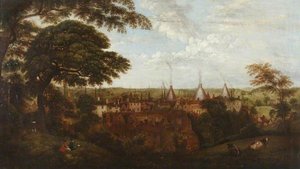
In this 1846 oil on canvas, we find ourselves positioned on the heights of Dob Hill, looking down upon the settlement of Wordsley and Stourbridge. The composition is anchored by a large, commanding tree in the foreground, which provides a sense of scale and depth against the sprawling town below. It is a scene of quiet industry and movement, where the architecture of the buildings spreads across the landscape, nestled…

4
View of Derby from Nottingham Road (1850) av Henry Lark Pratt

View of Derby from Nottingham Road

1850 · Oil On Canvas · Museum of Fine Arts, Boston

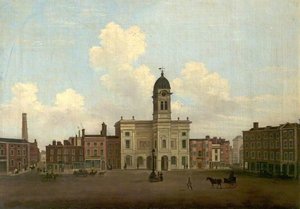
We are looking at View of Derby from Nottingham Road, a work by Henry Lark Pratt. This landscape captures a specific moment in the English countryside, rendered in oil on canvas. The scene depicts a tranquil road lined with trees, where horses and a horse-drawn carriage move through the landscape alongside scattered figures. It is a quiet study of rural life and topographical detail.

5
Haddon Hall, Derbyshire (1852) av Henry Lark Pratt

Haddon Hall, Derbyshire

1852 · Oil On Canvas · Buxton Museum - Art Gallery, Buxton

The oil painting depicts Haddon Hall in Derbyshire, a large stone structure situated within a landscape of green fields and dense clusters of trees. A moat surrounds the primary building, its surface reflecting the light and the surrounding vegetation. Near the water, a small boat rests, positioned close to the castle walls. The architecture of the hall features multiple levels and various smaller structures visible in the background. Scattered figures…

6
King Street, Newcastle under Lyme (1865) av Henry Lark Pratt

King Street, Newcastle under Lyme

1865 · Oil On Canvas · Brampton Museum, New South Wales

Henry Lark Pratt captured a bustling street scene in King Street, Newcastle under Lyme, in 1865. The composition emphasizes the length of the thoroughfare and the architecture of the buildings lining its edge. A church with a prominent steeple anchors the skyline, rising above various residences that define the urban landscape. This topographical view provides a detailed record of the town's layout and structural character.

7
View of Etruria from Basford Bank av Henry Lark Pratt

View of Etruria from Basford Bank

Oil On Canvas

The work before us is titled View of Etruria from Basford Bank, a landscape rendered by the artist Henry Lark Pratt. This specific piece captures a scene of the Trent Valley, focusing on the landscape surrounding the Wedgwood pottery works. It is a quiet observation of the intersection between the natural environment and the emerging industrial character of the Staffordshire region.

8
Trent Vale from Penkhull (1846) av Henry Lark Pratt

Trent Vale from Penkhull

1846 · Oil

The scene unfolds in Trent Vale from Penkhull, a landscape rendered by the artist Henry Lark Pratt. This work, dating to about 1846, captures a quiet moment within the valley. The composition presents a view of green fields and trees, where a dirt road winds through the terrain. A person sits upon the grass near the path, perhaps pausing to rest or simply to observe the surroundings. Nearby, a horse…

9
Red Lion Square (1854) av Henry Lark Pratt

Red Lion Square

1854 · Oil On Canvas · Brampton Museum, New South Wales

Red Lion Square is an oil on canvas work by Henry Lark Pratt. Executed in 1854, the piece measures 38 x 57 cm. The artist, born in Derby, United Kingdom, transitioned from a background in the porcelain industry to producing topographical landscapes and town scenes.

10
A View of Derby from Rowditch (1852) av Henry Lark Pratt

A View of Derby from Rowditch

1852 · Oil On Canvas

A View of Derby from Rowditch is a work by Henry Lark Pratt, dated 1852. The canvas captures a specific topographical moment, looking out over a town where a river winds through the landscape. It is a quiet record of a place defined by its water and its stone buildings.

Henry Lark Pratt sine malerier, rangert fra 11 til 26

Motivene som fanget Henry Lark Pratts blikk

De fire motivene som går igjen hyppigst i disse originalverkene, hver med sitt fremste eksempel.

Museene som har Henry Lark Pratts originalverk

De 5 museene som innehar flest av maleriene på denne siden.

Museum By Verker av Henry Lark Pratt Malerier fra denne listen
Brampton Museum, New South WalesBrampton Museum New South Wales 5 King Street, Newcastle under Lyme, Red Lion Square, Trentham Hall
Buxton Museum - Art Gallery, BuxtonBuxton Museum - Art Gallery Buxton 2 Chatsworth House, Derbyshire, Haddon Hall, Derbyshire
Derby Museum and Art GalleryDerby Museum and Art Gallery 2 View of Derby, Showing the Derwent, St Peter's Church, Derby, by Moonlight
Tamworth Castle, TamworthTamworth Castle Tamworth 1 St Editha's Church and the Old Paregoric Shop, Tamworth
Museum of Fine Arts, BostonMuseum of Fine Arts Boston 1 View of Derby from Nottingham Road

Henry Lark Pratt, ett signaturmaleri per tiår

Verk per tiår

Velg et tiår for å se originalverket som definerer det.

Henry Lark Pratts malerier: galleriets svar

Hvilket maleri av Henry Lark Pratt er det mest kjente av alle?Avslør svaret

Chatsworth House, Derbyshire (1852), Buxton Museum - Art Gallery, Buxton. Deretter følger St Editha's Church and the Old Paregoric Shop, Tamworth (1856) og View of Wordsley, Stourbridge, from Dob Hill (1846).

Hvor gammel var Henry Lark Pratt da Chatsworth House, Derbyshire ble ferdigstilt?Avslør svaret

47 år gammel: Chatsworth House, Derbyshire er fra 1852, og Henry Lark Pratt ble født i 1805.

Hvilke er de 10 beste maleriene til Henry Lark Pratt?Avslør svaret

Chatsworth House, Derbyshire, St Editha's Church and the Old Paregoric Shop, Tamworth, View of Wordsley, Stourbridge, from Dob Hill, View of Derby from Nottingham Road, Haddon Hall, Derbyshire, King Street, Newcastle under Lyme, View of Etruria from Basford Bank, Trent Vale from Penkhull, Red Lion Square og A View of Derby from Rowditch. Rangeringen ovenfor viser årstall og museum for hvert verk.

Hvor mange verk skapte Henry Lark Pratt?Avslør svaret

Vår katalog inneholder 26 verk av Henry Lark Pratt, datert fra 1846 til 1865.

Hvor henger de mest kjente originalverkene til Henry Lark Pratt?Avslør svaret

Hovedsakelig i Brampton Museum (New South Wales), Buxton Museum - Art Gallery (Buxton) og Derby Museum and Art Gallery. Museumslisten ovenfor viser alle.

Når malte Henry Lark Pratt sine mest kjente malerier?Avslør svaret

I 1850s: 9 av de 26 verkene på denne siden ble laget da, Chatsworth House, Derbyshire av dem.

Hvilke er Henry Lark Pratts tidligste og nyeste berømte verk?Avslør svaret

På denne siden er det eldste View of Wordsley, Stourbridge, from Dob Hill (1846) og det nyeste King Street, Newcastle under Lyme (1865).

Hvilke motiver vendte Henry Lark Pratt oftest tilbake til?Avslør svaret

People (8), Trees (6) og Landscape (6), fordelt på 26 verk på denne siden.

Hvilket medium arbeidet Henry Lark Pratt mest med?Avslør svaret

Oil On Canvas, for 10 av de 26 verkene på denne siden.

Hvilke originalverk av Henry Lark Pratt har Brampton Museum i sin samling?Avslør svaret

King Street, Newcastle under Lyme, Red Lion Square og Trentham Hall: Brampton Museum, New South Wales har 5 av verkene på denne siden.

Henry Lark Pratt: kunstneren

Henry Lark I Pratt: A Derbyshire Porcelain Painter

Henry Lark I Pratt (1805 – 1873) stands as a testament to the intersection of craft and artistic vision—a painter inextricably linked to the legacy of Derby’s porcelain industry. Born in St Peter's Parish, Derby, his early life was shaped by an apprenticeship at the prestigious Derby Manufactory, where he honed skills crucial not only for shaping clay but also for capturing its beauty on canvas. This formative experience instilled a meticulous attention to detail and a profound understanding of texture and form that would permeate his oeuvre.
  • Early Life & Training: Pratt’s dedication to mastering the craft began at a young age, providing him with invaluable insight into material properties and artistic representation. The Derby factory wasn't merely a workplace; it was an incubator for aesthetic sensibilities.
  • Career in Porcelain & Initial Artistic Pursuits: Following his apprenticeship, Pratt worked briefly at Mintons before embarking on a solo artistic journey. His marriage to Margaret Windsor solidified his life in Stoke-on-Trent and fostered a family rooted in the region’s artistic traditions.
Pratt's artistic style evolved significantly over time, transitioning from decorative porcelain painting to landscapes imbued with topographical accuracy. He found particular inspiration in Dovedale Valley, Derbyshire—a location that would become synonymous with his artistic output. The Duke of Devonshire and Queen Victoria recognized Pratt’s talent, commissioning him to depict Windsor Castle views, demonstrating the esteem in which he was held by Victorian society.
  • Notable Paintings & Patronage: His landscapes—characterized by meticulous observation and a commitment to realism—became celebrated for their evocative portrayal of the English countryside. Commissions from aristocratic patrons underscored his reputation as a respected artist.
  • Royal Recognition & Artistic Development: Pratt’s acceptance into the Royal Academy in 1867 and subsequent exhibitions with the Society of British Artists signaled a blossoming artistic career, fueled by an unwavering passion for capturing the essence of nature.

Technique & Influences

Pratt's paintings demonstrate a masterful command of oil paint—a medium favored for its ability to render subtle tonal variations and textural nuances. He meticulously blended pigments to achieve luminous effects, mirroring the delicate glaze surfaces of Derby porcelain. While biographical details remain somewhat sparse, Pratt’s artistic sensibilities clearly absorbed influences from Romantic landscape painting, prioritizing emotional resonance alongside precise topographical representation.
  • Derbyshire Landscape Tradition: Pratt's work aligns with Derbyshire’s burgeoning landscape tradition—a movement that sought to elevate rural vistas into subjects of artistic contemplation.

Legacy & Recognition

Today, Henry Lark I Pratt’s paintings reside in galleries across Newcastle-under-Lyme and Derby—testaments to his enduring contribution to British art history. His son, Hilton Pratt, continued the family artistic legacy, exhibiting his own work and cementing Pratt's place as a figure of considerable renown within his hometown.
  • Contemporary Exhibitions: Pratt’s paintings continue to inspire admiration for their beauty and technical skill—a lasting reminder of a Derbyshire artist who bridged the gap between craft and artistic expression.