Giovanni Paolo Panini – Master of Roman Visions: The Life and Art of Giovanni Paolo Pannini
Giovanni Paolo Panini, a name synonymous with the grandeur and romantic allure of 18th-century Rome, was more than just a painter; he was a visual architect of memory. Born in Piacenza in 1691, his artistic journey began under the tutelage of Giuseppe Natali and Andrea Galluzzi, but it was his exposure to the theatrical designs of Francesco Galli-Bibiena that truly ignited his imagination. This early immersion in stagecraft would profoundly influence his later work, imbuing it with a sense of dramatic composition and illusionistic space. In 1711, Panini relocated to Rome, a city already steeped in artistic history, where he honed his skills under the guidance of Benedetto Luti, mastering the art of drawing and laying the foundation for his future mastery of perspective.Early Training and Influences: Seeds of Genius
Panini’s formative years were marked by rigorous instruction in disegno—drawing—and quadratura—scenic perspective—skills considered essential for creating convincing illusionistic space. He studied under Giuseppe Natali, a celebrated Bolognese painter known for his frescoes depicting biblical scenes, and Andrea Galluzzi, who taught him the techniques of theatrical design. Crucially, Panini’s artistic sensibilities were shaped by Francesco Galli-Bibiena, whose innovative stage productions championed dramatic composition and illusionistic perspective—a style that would become central to Panini's own approach to painting. Galli Bibiena’s influence is palpable in Panini’s early works, particularly his frescoes at the Villa Patrizi (1719–25), where he skillfully employed quadratura to heighten the emotional impact of the scenes depicted. This fascination with theatrical illusion would continue to permeate Panini's oeuvre throughout his career.From Frescoes to Vedute: The Evolution of an Artistic Style
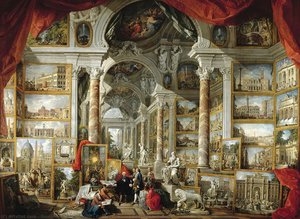
Panini’s initial success came not as a canvas painter but as a decorator of palaces. His frescoes adorned the walls of prominent Roman residences, including the Villa Patrizi (1719–25), Palazzo de Carolis (1720) and Seminario Romano (1721–22). These early commissions allowed him to develop his technical prowess and establish a reputation within Rome’s artistic circles. He skillfully blended classical ideals of beauty with Baroque exuberance, creating monumental paintings that celebrated Roman grandeur and religious piety. However, it was his embrace of the *veduta*, or view painting, that would ultimately define his legacy. Unlike earlier topographical artists who focused on precise documentation, Panini infused his depictions of Rome with a sense of imaginative reconstruction. He didn’t merely record what he saw; he re-imagined it, blending existing structures with fragments of ancient ruins and fanciful architectural elements. This approach, often referred to as *capriccio*, allowed him to create scenes that were both recognizable and dreamlike, capturing the spirit of Rome’s layered history. His 1719 admission into the Congregazione dei Virtuosi al Pantheon signaled his growing recognition within the Roman art world, and he soon became a sought-after artist among Grand Tourists – wealthy young Europeans traveling Italy to complete their education.The Captivating Vision of Ruins: Panini’s Capriccio Technique
Panini's distinctive style—characterized by meticulous detail combined with fantastical embellishments—became synonymous with the *capriccio* genre. This technique involved reconstructing imaginary landscapes populated by ruins, mythological figures, and architectural fantasies, creating scenes that transcended mere representation and tapped into a deeper emotional resonance. Panini’s mastery of perspective was unparalleled; he achieved astonishing accuracy in depicting vast spaces while simultaneously manipulating illusionistic depth to heighten the dramatic effect of his compositions. This innovative approach—the “Panini Projection”—became instrumental in rendering panoramic views, influencing subsequent generations of artists and establishing Panini as a pioneer of topographical painting. His depictions of Roman ruins weren’t simply reproductions; they were meditations on time, decay, and the enduring beauty of antiquity—a reflection of the broader intellectual currents of his era.Legacy and Influence: Shaping Artistic Expression
Giovanni Paolo Panini's influence extended far beyond his own lifetime. He was a respected teacher at both the Accademia di San Luca and the Académie de France in Rome, shaping the artistic sensibilities of a generation of artists. Among his pupils was Hubert Robert, who would become equally renowned for his depictions of ruins, though with a more overtly romantic sensibility. Panini’s style also resonated with other *vedutisti*, including Antonio Joli and Charles-Louis Clérisseau, inspiring them to explore the possibilities of architectural painting. His works are now held in prestigious collections worldwide, including the Prado Museum, the Louvre, and the Museo Nazionale di Capodimonte, testament to his enduring appeal. He remains a pivotal figure in art history—a master who fused observation with imagination, creating images that continue to captivate audiences centuries later.Spørsmål og svar
Hvor er Giovanni Paolo Panini sine kunstverk gruppert etter teknikk?
Siden Alle medier grupperer Giovanni Paolo Panini sine kunstverk etter teknikk.
Kan jeg besøke et virtuelt museum med verkene til Giovanni Paolo Panini?
3D-museum til Giovanni Paolo Panini er en side som viser kunstnerens verk i et virtuelt tredimensjonalt galleri.
Hvor og når ble Giovanni Paolo Panini født?
Giovanni Paolo Panini ble født i Piacenza i 1691.