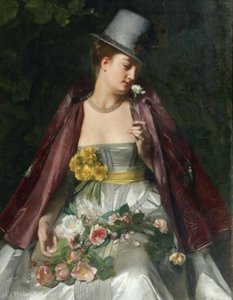
1


Oppdatert November 2026 · rangert etter vår popularitetsscore (søk, besøk og bestillinger for hvert verk) · 19 verk av Florent Willems i vår katalog
Kort fortalt
A Seated Page with a Dog (1848) er maleriet av Florent Willems som vekker mest oppmerksomhet; originalen befinner seg i Amsterdam Museum, Amsterdam. Deretter går blikket til The Woman with the Mirror / Coquetry (1854) og A Painter for His Easel Shows a Painting to a Girl (1852). Blant de 19 verkene til Florent Willems i vår katalog, er disse 19 de mest kjente – hver og en et unikt originalverk presentert med sitt årstall, sitt museum og årsaken til at det består.


De fire motivene som går igjen hyppigst i disse originalverkene, hver med sitt fremste eksempel.
De 6 museene som innehar flest av maleriene på denne siden.
| Museum | By | Verker av Florent Willems | Malerier fra denne listen |
|---|---|---|---|
 Amsterdam Museum |
Amsterdam | 2 | A Seated Page with a Dog, A Painter for His Easel Shows a Painting to a Girl |
 Koninklijk Museum voor Schone Kunsten Antwerpen |
Antwerpen | 2 | Market Scene in the 17th Century, Musician |
 Groeningemuseum |
Brugge | 1 | The Woman with the Mirror / Coquetry |
 Moravian Gallery in Brno |
Brno | 1 | House of Cards |
 New York Historical Society |
New York City | 1 | Revery |
 Walters Art Museum |
Baltimore | 1 | The Important Response |
Velg et tiår for å se originalverket som definerer det.
A Seated Page with a Dog (1848), Amsterdam Museum, Amsterdam. Deretter følger The Woman with the Mirror / Coquetry (1854) og A Painter for His Easel Shows a Painting to a Girl (1852).
25 år gammel: A Seated Page with a Dog er fra 1848, og Florent Willems ble født i 1823.
A Seated Page with a Dog, The Woman with the Mirror / Coquetry, A Painter for His Easel Shows a Painting to a Girl, The departure, Market Scene in the 17th Century, House of Cards, Musician, Revery, The mirror og Sympathetic friends. Rangeringen ovenfor viser årstall og museum for hvert verk.
Vår katalog inneholder 19 verk av Florent Willems, datert fra 1848 til 1886.
Hovedsakelig i Amsterdam Museum (Amsterdam), Koninklijk Museum voor Schone Kunsten Antwerpen (Antwerpen) og Groeningemuseum (Brugge). Museumslisten ovenfor viser alle.
I 1850s: 2 av de 19 verkene på denne siden ble laget da, The Woman with the Mirror / Coquetry av dem.
På denne siden er det eldste A Seated Page with a Dog (1848) og det nyeste Market Scene in the 17th Century (1886).
Mirrors (2) og Women (2), fordelt på 19 verk på denne siden.
A Seated Page with a Dog og A Painter for His Easel Shows a Painting to a Girl: Amsterdam Museum, Amsterdam har 2 av verkene på denne siden.
In the grand tapestry of nineteenth-century European art, where many painters sought to break from tradition through the advent of Impressionism and realism, Florent Joseph Marie Willems chose a different, more nostalgic path. Born in Liège in 1823, Willems did not merely observe history; he breathed life back into it. Often referred to by the evocative moniker “the modern Ter Borch,” this Belgian master possessed an uncanny ability to transcend his own era, transporting viewers to the golden age of the Dutch and Flemish Baroque. His work serves as a bridge across centuries, meticulously recreating the intimate, light-drenched atmospheres of masters like Gerard Ter Borch and Gabriel Metsu with a precision that feels both timeless and profoundly personal.
Willems’s artistic journey was deeply rooted in the discipline of restoration and the study of the Old Masters. While his formal training took place at the Academy of Mechelen, much of his true education came from the quiet, painstaking work of copying and restoring ancient canvases. This intimate contact with the textures of the past allowed him to master the subtle interplay of light and shadow—the chiaroscuro—that defines the Baroque aesthetic. His early years in Brussels, working as an art restorer for the dealer Héris, provided him with a unique laboratory of technique, where he learned to render the heavy sheen of satin, the delicate translucency of lace, and the rugged weight of velvet with such startling realism that his contemporaries could scarcely believe they were looking at contemporary works.
The ascent of Willems was marked by a series of prestigious encounters and triumphs that solidified his reputation across Europe. His talent was recognized remarkably early; at just eighteen years old, he caught the eye of Hamilton Seymour, the English ambassador to the Belgian king, who commissioned him to paint a grand family portrait. This early success paved the way for his debut at the Brussels Salon in 1842, where works such as “A Music Party” and “An Interior of a Seventeenth-Century Guard Room” immediately signaled the arrival of a master of genre painting. The Belgian King Leopold I himself became an admirer, acquiring his work and placing Willems within the highest circles of artistic patronage.
As his career progressed, Willems moved to Paris, a city that would become the stage for his greatest international acclaim. During the Second French Empire, his evocative scenes of domestic intimacy flourished. His ability to capture the quiet, dignified moments of life—a woman gazing into a mirror, a letter being read in soft light, or a tranquil domestic scene—resonated deeply with the Parisian elite. This period of his life was not only marked by artistic growth but also by significant honors, including the rank of Chevalier of the French Legion of Honour and the prestigious Chevalier cross in the Order of Leopold of Belgium. His studio in Paris even served as a creative hub, hosting fellow Belgian luminaries like Alfred Stevens, who was himself influenced by Willems’s masterful approach to depicting women in interior settings.
The historical significance of Florent Willems lies in his role as a guardian of classical excellence. While he did not seek to revolutionize the subject matter of his time, his technical virtuosity ensured that the aesthetic values of the seventeenth century remained vibrant and relevant in the nineteenth. His paintings are more than mere imitations; they are soulful reinterpretations that celebrate the enduring beauty of light, texture, and human connection. Through his brush, the vanished worlds of the Dutch and Flemish masters were resurrected, offering a sense of continuity and grace to an age of rapid change.
Today, the works of Willems continue to captivate collectors and historians alike, preserved in museums and galleries worldwide as testament to his skill. His legacy is defined by several key artistic pillars: