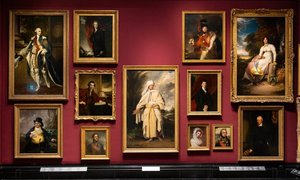
Portrett av Eden Upton Eddis

De 41 mest kjente Eden Upton Eddis-maleriene, hvert og ett unikt

Oppdatert November 2026 · rangert etter vår popularitetsscore (søk, besøk og bestillinger for hvert verk) · 47 verk av Eden Upton Eddis i vår katalog

Kort fortalt

Lady M. E. Hamlyn Williams and Sir H. Drummond (1865) er maleriet av Eden Upton Eddis som vekker mest oppmerksomhet; originalen befinner seg i Llyfrgell Genedlaethol Cymru, Aberystwyth. Deretter går blikket til Henry Sharp Taylor (1901) og Lieutenant Colonel Hankin (1901). Blant de 47 verkene til Eden Upton Eddis i vår katalog, er disse 41 de mest kjente – hver og en et unikt originalverk presentert med sitt årstall, sitt museum og årsaken til at det består.

1812 – 1901, Newington Green Flest verk: st Bartholomew’s Hospital Museum And Archive

Topp 10 malerier av Eden Upton Eddis, sett gjennom galleriets øyne

1
Lady M. E. Hamlyn Williams and Sir H. Drummond (1865) av Eden Upton Eddis

Lady M. E. Hamlyn Williams and Sir H. Drummond

1865 · Oil On Canvas · Llyfrgell Genedlaethol Cymru, Aberystwyth

The oil painting depicts an elderly woman and a young boy seated together upon a red velvet sofa. The woman is positioned on the left, wearing a dark velvet gown accented with lace and jewelry. Beside her, the boy is dressed in a tartan jacket. The composition is symmetrical, with the two figures occupying the central portion of the frame against a muted reddish-brown background. Lighting is applied with a…

2
Henry Sharp Taylor (1901) av Eden Upton Eddis

Henry Sharp Taylor

1901 · Oil On Canvas

There is a profound sense of dignity in the subject's posture. The book acts as a silent symbol of knowledge, grounding the man in a world of intellect and experience. Every detail, from the density of the beard to the subtle shadows in the folds of his clothing, speaks to a life of composed reflection. The composition is shallow, focusing entirely on the man and the weight of his thoughts.…

3
Lieutenant Colonel Hankin (1901) av Eden Upton Eddis

Lieutenant Colonel Hankin

1901 · Oil On Canvas

In this 1901 portrait, Eden Upton Eddis captures the likeness of Lieutenant Colonel Hankin. The British portrait artist, born in Newington Green, United Kingdom, brings a quiet precision to the sitter. The man sits within a space defined by shadow and the weight of his own history. Eddis, who passed away at age 88 in Shalford near Guildford, focuses his gaze upon the character of the subject.

4
Canon Sydney Smith (1831) av Eden Upton Eddis

Canon Sydney Smith

1831 · Oil

The room holds a heavy, thoughtful stillness. At the center of the scene, a man with white hair sits anchored at a table, his gaze cast downward in a moment of profound reflection. He wears a formal suit and tie, the attire of a man of intellect and standing. In his hands, he cradles an open book, its pages perhaps holding the weight of the thoughts currently clouding his expression.…

5
Sir Henry Ainslie Hoare (1824–1894), 5th Bt, and His Sister Georgiana Hoare (d.1905), as Children (1835) av Eden Upton Eddis

Sir Henry Ainslie Hoare (1824–1894), 5th Bt, and His Sister Georgiana Hoare (d.1905), as Children

1835 · Oil

In this 1835 portrait, two children, a boy and a girl, are positioned beneath the shade of a tree. The boy, later known as Sir Henry Ainslie Hoare, wears a dark suit paired with a tie. Beside him, his sister Georgiana is dressed in a white gown. Both children hold flowers in their hands. The background contains several smaller, less prominent figures, creating a sense of depth behind the primary…

6
Theodore Edward Hook (engraved 1839) (1839) av Eden Upton Eddis

Theodore Edward Hook (engraved 1839)

1839 · Engraving · National Portrait Gallery, London

In this portrait, Theodore Edward Hook (engraved 1839) by Eden Upton Eddis, we encounter a man of significant presence. Created about 1839, the work captures the subject in a moment of quiet, stern contemplation. Eddis, a British portrait artist, brings a particular sense of gravity to the sitter, focusing on the subtle nuances of the man's expression and the formal attire that defines his social standing. The composition is intimate,…

7
Francis Boott (1840) av Eden Upton Eddis

Francis Boott

Painted in 1840, this work reflects the portraiture traditions of the Victorian era, a period defined by an emphasis on moral seriousness and social structure. The sitter's composure is a study in the dignity expected of men in high-status positions during this time. Through the careful application of oil, the artist has preserved more than a likeness; he has captured the specific, somber atmosphere of a mid-century interior. The painting…

8
Francis Boott (1792–1863) (1840) av Eden Upton Eddis

Francis Boott (1792–1863)

1840 · Oil On Canvas

In this 1840 portrait, we encounter Francis Boott, a man whose steady gaze meets ours with a quiet, contemplative intensity. He is seated in a red chair, the high backrest framing him in a way that suggests a life of significant purpose. The composition is intimate, pulling the viewer into his immediate space. He wears a black coat over a white shirt, a formal arrangement that speaks to the social…

9
John Painter Vincent (1776–1852), Surgeon (1850) av Eden Upton Eddis

John Painter Vincent (1776–1852), Surgeon

1850 · Oil On Canvas · st Bartholomew’s Hospital Museum And Archive, London

The portrait presents a man seated in a formal posture, hands clasped in his lap. He is dressed in the heavy, structured attire of the mid-nineteenth century, a suit and tie that signal his social standing and professional gravity. The setting is an interior room, populated by the quiet markers of an intellectual life: books scattered across the space and a clock suspended upon the wall. The composition directs all…

10
Sir James Cosmo Melvill (1792–1861) (1853) av Eden Upton Eddis

Sir James Cosmo Melvill (1792–1861)

1853 · Oil · British Library, London

A man sits anchored in the shadows of a study. Sir James Cosmo Melvill faces the viewer with a gaze that does not flinch. He is draped in a dark suit, the fabric absorbing the light, contrasted sharply by the crisp white of his high collar and the deep black of his cravat. His hair, a soft gray, frames a face etched with the gravity of a life lived in…

Eden Upton Eddiss berømte malerier, nummer 11 til 41

11Thomas Kenyon (1780–1851) (1850) av Eden Upton EddisThomas Kenyon (1780–1851)1850 · Ludlow Museum Resource Centre 12Sir Charles Edward Trevelyan (1809–1886), 1st Bt (1850) av Eden Upton EddisSir Charles Edward Trevelyan (1809–1886), 1st Bt1850 · Wallington National Trust 13Frederick Charles Plumptre (1796–1870), DD, Fellow (1817), Master (1836) (1853) av Eden Upton EddisFrederick Charles Plumptre (1796–1870), DD, Fellow (1817), Master (1836)1853 · University College 14John Curtis Hayward (1870) av Eden Upton EddisJohn Curtis Hayward1870 · Gloucester Shire Hall 15Lady M. E. Hamlyn Williams (1825–1872) and Sir H. Drummond (1859–1924) (1865) av Eden Upton EddisLady M. E. Hamlyn Williams (1825–1872) and Sir H. Drummond (1859–1924)1865 · Llyfrgell Genedlaethol Cymru / The National Library of Wales 16George Smeed (1878) av Eden Upton EddisGeorge Smeed1878 · Swale House 17Thomas Hughes, Esq., of Ystrad (1799–1881), Chairman of Quarter Sessions (1855–1859) (1875) av Eden Upton EddisThomas Hughes, Esq., of Ystrad (1799–1881), Chairman of Quarter Sessions (1855–1859)1875 18R. J. Shepherd (1884) av Eden Upton EddisR. J. Shepherd1884 19Baron Cottesloe (1798–1890), PC (1881) av Eden Upton EddisBaron Cottesloe (1798–1890), PC1881 · County Hall 20George Chilton (1893) av Eden Upton EddisGeorge Chilton1893 21Reverend Robson (1895) av Eden Upton EddisReverend Robson1895 22George Chilton (1901) av Eden Upton EddisGeorge Chilton1901 23The Right Honourable Earl of Camperdown av Eden Upton EddisThe Right Honourable Earl of Camperdown 24Lewis Lloyd (1767–1858) av Eden Upton EddisLewis Lloyd (1767–1858)Harris Manchester College 25John Painter Vincent, Surgeon (1850) av Eden Upton EddisJohn Painter Vincent, Surgeon1850 · st Bartholomew’s Hospital Museum And Archive 26Henry Pownall av Eden Upton EddisHenry PownallMiddlesex Guildhall Art Collection 27Lewis Lloyd av Eden Upton EddisLewis Lloyd 28James Brownlow William Cecil, 2nd Marquess of Salisbury av Eden Upton EddisJames Brownlow William Cecil, 2nd Marquess of SalisburyMiddlesex Guildhall Art Collection 29Sydney Smith av Eden Upton EddisSydney SmithNew College 30Edward Gordon Douglas Pennant (1800–1886), 1st Lord Penrhyn of Llandegai av Eden Upton EddisEdward Gordon Douglas Pennant (1800–1886), 1st Lord Penrhyn of LlandegaiNational Trust 31Sir Frederick Thesiger (1794–1878), 1st Baron Chelmsford av Eden Upton EddisSir Frederick Thesiger (1794–1878), 1st Baron ChelmsfordAbingdon Guildhall 32Henry Pownall av Eden Upton EddisHenry PownallLa Cour suprême 33Maria Louisa, Lady Penrhyn av Eden Upton EddisMaria Louisa, Lady Penrhyn 34Arthur Penrhyn Stanley (1815–1881), DD, Dean of Westminster av Eden Upton EddisArthur Penrhyn Stanley (1815–1881), DD, Dean of WestminsterUniversity College 35John Bird Sumner, Archbishop of Canterbury av Eden Upton EddisJohn Bird Sumner, Archbishop of Canterbury 36George Frederick Young (1791–1870), MP for Tynemouth av Eden Upton EddisGeorge Frederick Young (1791–1870), MP for TynemouthGuildhall Art Gallery 37Rowland Hill (1800–1875), 2nd Viscount Hill av Eden Upton EddisRowland Hill (1800–1875), 2nd Viscount HillLudlow Museum Resource Centre 38James Brownlow William Cecil, 2nd Marquess of Salisbury av Eden Upton EddisJames Brownlow William Cecil, 2nd Marquess of SalisburyLa Cour suprême 39Sir George Beaumont (1828–1882), 9th Bt av Eden Upton EddisSir George Beaumont (1828–1882), 9th BtNew Walk Museum - Art Gallery 40Robert Edward Ward (1818–1904) av Eden Upton EddisRobert Edward Ward (1818–1904)Bangor Castle 41Doctor George Ferris Whidborne Mortimer, Headmaster of the City of London School av Eden Upton EddisDoctor George Ferris Whidborne Mortimer, Headmaster of the City of London SchoolGuildhall Art Gallery

Eden Upton Eddiss berømte malerier, periode for periode

Motivene som fanget Eden Upton Eddiss blikk

De fire motivene som går igjen hyppigst i disse originalverkene, hver med sitt fremste eksempel.

Museene som har Eden Upton Eddiss originalverk

De 8 museene som innehar flest av maleriene på denne siden.

Museum By Verker av Eden Upton Eddis Malerier fra denne listen
st Bartholomew’s Hospital Museum And Archive, Londonst Bartholomew’s Hospital Museum And Archive London 2 John Painter Vincent (1776–1852), Surgeon, John Painter Vincent, Surgeon
Ludlow Museum Resource Centre, LudlowLudlow Museum Resource Centre Ludlow 2 Thomas Kenyon (1780–1851), Rowland Hill (1800–1875), 2nd Viscount Hill
University College, OxfordUniversity College Oxford 2 Frederick Charles Plumptre (1796–1870), DD, Fellow (1817), Master (1836), Arthur Penrhyn Stanley (1815–1881), DD, Dean of Westminster
Middlesex Guildhall Art Collection, LondonMiddlesex Guildhall Art Collection London 2 Henry Pownall, James Brownlow William Cecil, 2nd Marquess of Salisbury
La Cour suprême, LondonLa Cour suprême London 2 Henry Pownall, James Brownlow William Cecil, 2nd Marquess of Salisbury
Guildhall Art Gallery, LondonGuildhall Art Gallery London 2 George Frederick Young (1791–1870), MP for Tynemouth, Doctor George Ferris Whidborne Mortimer, Headmaster of the City of London School
Llyfrgell Genedlaethol Cymru, AberystwythLlyfrgell Genedlaethol Cymru Aberystwyth 1 Lady M. E. Hamlyn Williams and Sir H. Drummond
National Portrait Gallery, LondonNational Portrait Gallery London 1 Theodore Edward Hook (engraved 1839)

Eden Upton Eddis gjennom tiårene: ett unikt originalverk for hvert tiår

Verk fordelt på tiår

Velg et tiår for å se originalverket som definerer det.

Eden Upton Eddiss malerier: spørsmål til galleriet

Hva er det mest kjente verket til Eden Upton Eddis?Avslør svaret

Lady M. E. Hamlyn Williams and Sir H. Drummond (1865), Llyfrgell Genedlaethol Cymru, Aberystwyth. Deretter følger Henry Sharp Taylor (1901) og Lieutenant Colonel Hankin (1901).

Hvor gammel var Eden Upton Eddis da Lady M. E. Hamlyn Williams and Sir H. Drummond ble skapt?Avslør svaret

53 år gammel: Lady M. E. Hamlyn Williams and Sir H. Drummond er fra 1865, og Eden Upton Eddis ble født i 1812.

Hvilke ti malerier av Eden Upton Eddis er de mest kjente?Avslør svaret

Lady M. E. Hamlyn Williams and Sir H. Drummond, Henry Sharp Taylor, Lieutenant Colonel Hankin, Canon Sydney Smith, Sir Henry Ainslie Hoare (1824–1894), 5th Bt, and His Sister Georgiana Hoare (d.1905), as Children, Theodore Edward Hook (engraved 1839), Francis Boott, Francis Boott (1792–1863), John Painter Vincent (1776–1852), Surgeon og Sir James Cosmo Melvill (1792–1861). Rangeringen ovenfor viser årstall og museum for hvert verk.

Hvor mange verk av Eden Upton Eddis er kjent?Avslør svaret

Vår katalog inneholder 47 verk av Eden Upton Eddis, datert fra 1831 til 1901.

Hvor kan de mest kjente originalverkene til Eden Upton Eddis ses?Avslør svaret

Hovedsakelig i st Bartholomew’s Hospital Museum And Archive (London), Ludlow Museum Resource Centre (Ludlow) og University College (Oxford). Museumslisten ovenfor viser alle.

I hvilken periode malte Eden Upton Eddis sine mest kjente malerier?Avslør svaret

I 1850s: 6 av de 41 verkene på denne siden ble laget da, John Painter Vincent (1776–1852), Surgeon av dem.

Hvilket kjent maleri av Eden Upton Eddis er det eldste, og hvilket er det nyeste?Avslør svaret

På denne siden er det eldste Canon Sydney Smith (1831) og det nyeste Henry Sharp Taylor (1901).

Hvilke motiver foretrakk Eden Upton Eddis?Avslør svaret

Man (30), Suit (22) og Chair (17), fordelt på 41 verk på denne siden.

Hvilke materialer brukte Eden Upton Eddis mest av?Avslør svaret

Oil On Canvas, for 22 av de 41 verkene på denne siden.

Hvilke originalverk av Eden Upton Eddis kan jeg se på st Bartholomew’s Hospital Museum And Archive?Avslør svaret

John Painter Vincent (1776–1852), Surgeon og John Painter Vincent, Surgeon: st Bartholomew’s Hospital Museum And Archive, London har 2 av verkene på denne siden.

Eden Upton Eddis: et portrett av kunstneren

The Quiet Precision of a Victorian Master

Eden Upton Eddis (1812-1901) stands as a quietly influential figure in British portraiture, primarily recognized for his meticulous depictions of prominent intellectuals and clergymen during the Victorian era. Unlike many flamboyant artists of his time, Eddis cultivated a reputation for understated elegance and technical precision—characteristics that cemented his place within the Royal Academy and secured him commissions from notable patrons. His life’s work serves as a window into the soul of nineteenth-century Britain, capturing the gravity and moral seriousness of an age defined by intellectual expansion and social structure.

Eddis’ artistic journey began in the vibrant heart of London, where he honed his skills under the tutelage of John Brett, a fellow Royal Academician known for his landscapes infused with Symbolist influences. This formative period instilled in Eddis a deep appreciation for tonal harmony and atmospheric perspective—techniques that would become hallmarks of his oeuvre. His early works showcased a fascination with classical motifs and idealized representations of the human form, reflecting the prevailing aesthetic sensibilities of the Victorian period while laying the groundwork for his later mastery of psychological depth.

A Legacy of Character and Composition

The prolific output of Eddis spanned several decades, producing over 100 portraits that ranged from formal sitters to intimate family gatherings. He possessed an exceptional ability to capture not only physical likeness but also a profound psychological nuance, revealing the inner character of his subjects through subtle expressions and deliberate gestures. His canvas became a gathering place for the era's most significant minds, including:

  • Historians and Thinkers: Such as the influential John Stuart Mill and Sydney Smith.
  • Theologians: Including the esteemed Archbishop Wilberforce.
  • Artistic Peers: Such as Francis Chantrey, the renowned sculptor of Nelson’s Column.

His portraits are celebrated for their dignified composure and masterful execution, embodying the Victorian ideal of intellectual refinement. A particularly noteworthy achievement was his portrait of Lady M. E. Hamlyn Williams and Sir H. Drummond (1865), a piece lauded for its dramatic lighting and rich textural qualities. In this work, Eddis skillfully employed oil paints to create an illusion of depth and luminosity, capturing the solemn beauty of the Victorian spirit with unparalleled grace.

Historical Significance and Artistic Endurance

The historical significance of Eden Upton Eddis lies in his role as a visual chronicler of the British intelligentsia. Through his brush, the faces of history were preserved with a level of dignity that transcended mere documentation. His ability to balance the technical demands of the Royal Academy style with an emotive, humanistic touch allowed him to bridge the gap between formal portraiture and true character study.

Today, the legacy of Eddis continues to resonate through the collections of institutions such as the National Portrait Gallery, where his works remain vital touchstones for understanding the social and intellectual fabric of the nineteenth century. His contribution to British art remains a testament to the power of precision, reminding us that true greatness often resides in the subtle, the disciplined, and the profoundly observed.