A Scottish Visionary: The Life and Art of Charles Rennie Mackintosh
Charles Rennie Mackintosh, born in Glasgow on June 7, 1868, was more than an architect; he was a philosophical artist who sought to harmonize every aspect of the built environment. From the grandest structures to the smallest details of furniture and ornamentation, his vision aimed for a holistic aesthetic experience—a distinctly Scottish interpretation of the burgeoning Art Nouveau movement. Growing up as one of eleven children in a family where his father served as a police superintendent, Mackintosh’s early life offered little indication of the artistic revolution he would ignite. His education at Reid's Public School and Allan Glen's Institution revealed an aptitude for art but also hinted at challenges with traditional academic disciplines, possibly indicative of dyslexia. This divergence from conventional learning may have fostered his unique perspective, allowing him to approach design unbound by established norms. His formative years were significantly shaped by his apprenticeship under architect John Hutchison, coupled with evening classes at the Glasgow School of Art—a crucible where he forged crucial relationships with fellow students Herbert McNair, Margaret Macdonald, and Frances Macdonald, collectively known as “The Four.” These connections weren’t merely professional; they were deeply collaborative, influencing each other's artistic trajectories and forming the core of what would become the Glasgow Style.
Forging a New Aesthetic: The Glasgow Style and Architectural Masterpieces
By the 1890s, Mackintosh had emerged as a leading figure in the “Glasgow Style,” an Art Nouveau variant infused with Celtic symbolism, Japanese aesthetics, and the principles of the Arts and Crafts movement. This wasn’t simply about applying decorative motifs; it was about creating a total work of art—where architecture, furniture, interiors, and even textiles were conceived as interconnected elements of a unified design. His architectural philosophy centered on rejecting Victorian grandeur in favor of simplicity, elegance, and functionality. He championed the use of natural materials – stone, timber, and glass – prioritizing organic forms and textures over fussy ornamentation. The Glasgow School of Art building exemplifies this ethos perfectly: its soaring spaces bathed in sunlight, its undulating walls echoing the curves of Celtic spirals, and its innovative structural system demonstrating a mastery of engineering alongside artistic vision. Beyond the School itself, Mackintosh’s influence extended to residential commissions like Windyhill, Kilmacolm—a harmonious blend of vernacular Scottish tradition and modernist principles—and Hill House, Helensburgh—a hauntingly beautiful dwelling that explored themes of isolation and psychological landscape. These projects cemented his reputation as a pioneer of Art Nouveau architecture in Britain.
The Four: Collaboration and Artistic Influence
Mackintosh’s artistic journey was inextricably linked to the collaborative spirit of “The Four”—Margaret Macdonald Mackintosh, Herbert McNair, Frances Macdonald, and himself. This quartet established Glasgow School of Art as a hub for experimentation and innovation, fostering an environment where ideas flowed freely and stylistic boundaries blurred. Their shared aesthetic sensibilities—characterized by geometric abstraction, muted color palettes, and meticulous attention to detail—became the defining traits of the Glasgow Style. Margaret Macdonald Mackintosh, his wife, was arguably his most astute artistic partner, contributing equally to their collaborative projects and enriching the intellectual discourse surrounding their work. McNair and Frances Macdonald brought complementary skills and perspectives to the group, furthering the exploration of new forms and techniques. Together, they challenged prevailing conventions and established a precedent for interdisciplinary collaboration in art and design—a legacy that continues to inspire artists today.
A Period of Transition and Artistic Exploration
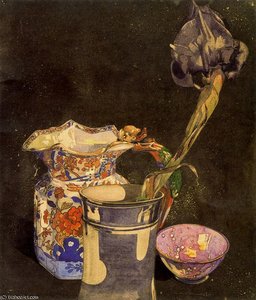
The First World War profoundly impacted Mackintosh’s life and career. Seeking respite from the anxieties of wartime Britain, he and Margaret relocated to Walberswick, Suffolk, where they cultivated a tranquil existence amidst the coastal landscape. Despite this shift in location, Mackintosh remained active as an artist, focusing primarily on watercolor painting—a medium that allowed him to express his innermost thoughts and emotions with remarkable subtlety and sensitivity. His watercolors depict serene scenes of Scottish countryside—rolling hills dotted with wildflowers, shimmering lochs reflecting the changing seasons—capturing a profound connection to nature and embodying the humanist values championed by the Arts and Crafts movement. These paintings stand in stark contrast to the monumental architectural projects that defined his earlier years, revealing a different facet of Mackintosh’s artistic personality—one marked by introspection and contemplation.
Legacy and Rediscovery: A Lasting Impact on Modern Design
Charles Rennie Mackintosh died in London on December 10, 1928, at the age of 60, leaving behind a legacy that would take decades to fully appreciate. For years after his death, his work remained largely unrecognized, overshadowed by more dominant architectural trends—particularly the rise of Bauhaus and functionalism. However, beginning in the 1960s and 1970s, a renewed interest in Art Nouveau and early modernism spurred a revival of fascination with Mackintosh’s distinctive style. Scholars and designers rediscovered his groundbreaking contributions to architecture and design, recognizing the profound influence of his ideas on subsequent generations. His emphasis on simplicity, functionality, and the integration of art and architecture resonated powerfully with modernist principles—establishing him as a precursor to many of the key movements that shaped 20th-century visual culture. Today, Mackintosh is celebrated as one of Scotland’s most important architects and designers—a visionary artist whose unique aesthetic continues to inspire and captivate audiences worldwide. His buildings stand as enduring monuments to his genius, while his furniture designs—particularly the iconic Mackintosh chairs—remain instantly recognizable symbols of Art Nouveau elegance and innovation.