Portrett av Charles Brooking

De 49 mest kjente Charles Brooking-maleriene, hvert og ett unikt

Oppdatert November 2026 · rangert etter vår popularitetsscore (søk, besøk og bestillinger for hvert verk) · 49 verk av Charles Brooking i vår katalog

Kort fortalt

Shipping in a Rough Sea (1741) er maleriet av Charles Brooking som vekker mest oppmerksomhet; originalen befinner seg i Nostell Priory, Wakefield. Deretter går blikket til A Flagship before the Wind with other Vessels (1744) og A Two-Decker on Fire at Night off a Fort (1740). Blant de 49 verkene til Charles Brooking i vår katalog, er disse 49 de mest kjente – hver og en et unikt originalverk presentert med sitt årstall, sitt museum og årsaken til at det består.

1723 – 1759, London Flest verk: National Maritime Museum

Topp 10 malerier av Charles Brooking, sett gjennom galleriets øyne

Charles Brookings berømte malerier, nummer 11 til 49

11An English Vice-Admiral of the Red and his Squadron at Sea (1754) av Charles BrookingAn English Vice-Admiral of the Red and his Squadron at Sea1754 · National Maritime Museum 12An East Indiaman in a Fresh Breeze (1755) av Charles BrookingAn East Indiaman in a Fresh Breeze1755 · National Maritime Museum 13Ships in a Light Breeze (1754) av Charles BrookingShips in a Light Breeze1754 · National Maritime Museum 14Commodore Walker's Action: the Privateer 'Boscawen' Engaging a Fleet of French Ships, 23 May 1745 (1750) av Charles BrookingCommodore Walker's Action: the Privateer 'Boscawen' Engaging a Fleet of French Ships, 23 May 17451750 · National Maritime Museum 15Shipping Becalmed in the Solent (1750) av Charles BrookingShipping Becalmed in the Solent1750 · National Maritime Museum 16An English Squadron Going to Windward (1750) av Charles BrookingAn English Squadron Going to Windward1750 · National Maritime Museum 17A Dutch Beach Scene with a Man-of-War in the Distance (1749) av Charles BrookingA Dutch Beach Scene with a Man-of-War in the Distance1749 · National Maritime Museum 18The Capture of the 'Marquise d'Antin' and 'Louis Erasme' by the English Privateers 'Duke' and 'Prince Frederick', 10 July 1745 (1745) av Charles BrookingThe Capture of the 'Marquise d'Antin' and 'Louis Erasme' by the English Privateers 'Duke' and 'Prince Frederick', 10 July 17451745 · National Maritime Museum 19The Capture of the 'Glorioso', 8 October 1747 (1747) av Charles BrookingThe Capture of the 'Glorioso', 8 October 17471747 · National Maritime Museum 20Men of War in Harbour (1750) av Charles BrookingMen of War in Harbour1750 · Walker Art Gallery 21The Capture of the "Marquis d'Antin" and the "Louis Erasme" (1750) av Charles BrookingThe Capture of the "Marquis d'Antin" and the "Louis Erasme"1750 · Yale Center for British Art 22The Coast near Scheveningen with Fishing Pinks on the Shore (1755) av Charles BrookingThe Coast near Scheveningen with Fishing Pinks on the Shore1755 · Yale Center for British Art 23English Ships Under Sail in a Very Light Breeze (1752) av Charles BrookingEnglish Ships Under Sail in a Very Light Breeze1752 · Yale Center for British Art 24A two-decker and a frigate running Into the Thames off Gravesend (1756) av Charles BrookingA two-decker and a frigate running Into the Thames off Gravesend1756 · National Maritime Museum 25English Ships Running before a Gale (1759) av Charles BrookingEnglish Ships Running before a Gale1759 · Yale Center for British Art 26A Smack Under Sail in a Light Breeze in a River (1756) av Charles BrookingA Smack Under Sail in a Light Breeze in a River1756 · Yale Center for British Art 27A Merchantman and a Royal Yacht Beating to Windward off Dover av Charles BrookingA Merchantman and a Royal Yacht Beating to Windward off DoverNational Maritime Museum 28Shipping in Light Airs in the Thames Estuary av Charles BrookingShipping in Light Airs in the Thames EstuaryNational Maritime Museum 29A cutter close-hauled on the port tack av Charles BrookingA cutter close-hauled on the port tackNational Maritime Museum 30A bomb-ketch, a two-decker and other shipping in a fresh breeze av Charles BrookingA bomb-ketch, a two-decker and other shipping in a fresh breezeNational Maritime Museum 31Fishing Smacks Becalmed near a Shore av Charles BrookingFishing Smacks Becalmed near a Shore 32Two Men-of-war in a Gale av Charles BrookingTwo Men-of-war in a Gale 33The flagship 'Admiral of the Blue' firing a gun and another two-decker getting underway at dawn av Charles BrookingThe flagship 'Admiral of the Blue' firing a gun and another two-decker getting underway at dawn 34Frigates shortening sails offshore av Charles BrookingFrigates shortening sails offshore 35A Beach Scene near Scheveningen av Charles BrookingA Beach Scene near ScheveningenNational Maritime Museum 36East Indiamen in a Gale av Charles BrookingEast Indiamen in a GaleNational Maritime Museum 37A naval snow av Charles BrookingA naval snowNational Maritime Museum 38Ship wrecked on a rocky coast av Charles BrookingShip wrecked on a rocky coastYale Center for British Art 39Shipping in a Calm av Charles BrookingShipping in a Calm 40Cutter Close Hauled in a Fresh Breeze, with Other Shipping av Charles BrookingCutter Close Hauled in a Fresh Breeze, with Other ShippingYale Center for British Art 41A Cutter in a Strong Breeze av Charles BrookingA Cutter in a Strong BreezeYale Center for British Art 42A Dutch Beach Scene with a Man-of-War in the Distance av Charles BrookingA Dutch Beach Scene with a Man-of-War in the DistanceFondation Custodia 43A Royal Yacht Firing a Salute av Charles BrookingA Royal Yacht Firing a Salute 44The Capture of a French Ship by Royal Family Privateers av Charles BrookingThe Capture of a French Ship by Royal Family Privateers 45Ship on fire at night av Charles BrookingShip on fire at nightYale Center for British Art 46Shipping in the English Channel av Charles BrookingShipping in the English ChannelYale Center for British Art 47An English Flagship Under Easy Sail in a Moderate Breeze av Charles BrookingAn English Flagship Under Easy Sail in a Moderate BreezeYale Center for British Art 48Fishing Boats in a Calm Sea av Charles BrookingFishing Boats in a Calm SeaYale Center for British Art 49A Lugger and a Smack in Light Airs av Charles BrookingA Lugger and a Smack in Light AirsYale Center for British Art

Motivene som fanget Charles Brookings blikk

De fire motivene som går igjen hyppigst i disse originalverkene, hver med sitt fremste eksempel.

Museene som har Charles Brookings originalverk

De 7 museene som innehar flest av maleriene på denne siden.

Museum By Verker av Charles Brooking Malerier fra denne listen
National Maritime Museum, LondonNational Maritime Museum London 21 Greenland Fishery: English Whalers in the Ice, A Galley with Other Vessels Wrecked on a Rocky Coast, Royal Yachts in a Storm
Yale Center for British Art, New HavenYale Center for British Art New Haven 14 A Two-Decker on Fire at Night off a Fort, The Capture of the "Marquis d'Antin" and the "Louis Erasme", The Coast near Scheveningen with Fishing Pinks on the Shore
Saltram House, PlymouthSaltram House Plymouth 2 British Warship firing Salvoes in a Calm with Other Boats, Schooner in a Storm
Nostell Priory, WakefieldNostell Priory Wakefield 1 Shipping in a Rough Sea
Anglesey AbbeyAnglesey Abbey 1 Fishing Boats on a Calm Sea
Walker Art Gallery, LiverpoolWalker Art Gallery Liverpool 1 Men of War in Harbour
Fondation Custodia, ParisFondation Custodia Paris 1 A Dutch Beach Scene with a Man-of-War in the Distance

Charles Brooking gjennom årene: de unike originalene fra hvert verk

En lang karriere på 20 år, fra 1740 til 1759: Charles Brookings mest kjente originalverk, vist år for år.

Verk per år

Velg et år for å se originalverkene.

Charles Brookings malerier: spørsmål til galleriet

Hva er det mest kjente verket til Charles Brooking?Avslør svaret

Shipping in a Rough Sea (1741), Nostell Priory, Wakefield. Deretter følger A Flagship before the Wind with other Vessels (1744) og A Two-Decker on Fire at Night off a Fort (1740).

Hvor gammel var Charles Brooking da Shipping in a Rough Sea ble skapt?Avslør svaret

18 år gammel: Shipping in a Rough Sea er fra 1741, og Charles Brooking ble født i 1723.

Hvilke ti malerier av Charles Brooking er de mest kjente?Avslør svaret

Shipping in a Rough Sea, A Flagship before the Wind with other Vessels, A Two-Decker on Fire at Night off a Fort, Fishing Boats on a Calm Sea, British Warship firing Salvoes in a Calm with Other Boats, Schooner in a Storm, Greenland Fishery: English Whalers in the Ice, A Galley with Other Vessels Wrecked on a Rocky Coast, Royal Yachts in a Storm og East Indiamen Driven Ashore in a Storm. Rangeringen ovenfor viser årstall og museum for hvert verk.

Hvor mange verk av Charles Brooking er kjent?Avslør svaret

Vår katalog inneholder 49 verk av Charles Brooking, datert fra 1740 til 1759.

Hvor kan de mest kjente originalverkene til Charles Brooking ses?Avslør svaret

Hovedsakelig i National Maritime Museum (London), Yale Center for British Art (New Haven) og Saltram House (Plymouth). Museumslisten ovenfor viser alle.

I hvilken periode malte Charles Brooking sine mest kjente malerier?Avslør svaret

I 1750: 9 av de 49 verkene på denne siden ble laget da, Greenland Fishery: English Whalers in the Ice av dem.

Hvilket kjent maleri av Charles Brooking er det eldste, og hvilket er det nyeste?Avslør svaret

På denne siden er det eldste A Two-Decker on Fire at Night off a Fort (1740) og det nyeste English Ships Running before a Gale (1759).

Hvilke motiver foretrakk Charles Brooking?Avslør svaret

Beach (4), Boats (4) og Scenes (2), fordelt på 49 verk på denne siden.

Hvilke originalverk av Charles Brooking kan jeg se på National Maritime Museum?Avslør svaret

Greenland Fishery: English Whalers in the Ice, A Galley with Other Vessels Wrecked on a Rocky Coast og Royal Yachts in a Storm: National Maritime Museum, London har 21 av verkene på denne siden.

Charles Brooking: et portrett av kunstneren

Charles Brooking: A Pioneer of Naval Romanticism

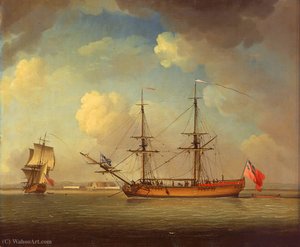
Charles Brooking (1723 – 1759) stands as a pivotal figure in the burgeoning field of marine painting during the mid-18th century, marking a significant transition from academic tradition to the expressive dynamism that would characterize Romantic art. Born in England, his artistic journey unfolded against the backdrop of Britain’s imperial ambitions and naval prowess, shaping him into one of the foremost practitioners of depicting maritime life with unprecedented realism and emotional intensity.

Early Life and Apprenticeship

Little is known definitively about Brooking's formative years beyond documented evidence suggesting he was born in London. His father, Charles Brooking Sr., a skilled painter and decorator employed by Greenwich Hospital, instilled in him an early appreciation for visual arts and craftsmanship. Crucially, Brooking’s apprenticeship with his father at Greenwich Hospital provided invaluable experience—a cornerstone of his artistic education—and exposed him to the meticulous observation demanded by topographical painting. This formative period cemented his dedication to capturing accurate representations of ships and their surroundings. He diligently studied the techniques of his father, mastering the art of layering paint to achieve remarkable detail and luminosity – skills that would become central to his distinctive style.

The Foundling Hospital Commission and Artistic Breakthrough

Brooking’s career gained considerable momentum in 1754 when he was commissioned by the Foundling Hospital in London to create “A Flagship Before the Wind Under Easy Sail.” This monumental undertaking, undertaken at the behest of Treasurer Taylor White, catapulted him into public recognition and established his reputation as a master of maritime art. The commission necessitated collaboration with Peter Monamy, whose painting "Fleet in the Downs" served as inspiration—a testament to Brooking’s engagement with contemporary artistic trends. Furthermore, Dominic Serres, a fellow artist who briefly mentored Brooking, acknowledged Brooking's influence on his own style, highlighting the transmission of artistic techniques and sensibilities across generations. The sheer scale of this project demanded exceptional skill and dedication, resulting in an artwork that instantly captivated audiences and solidified Brooking’s position as a leading voice in British art.

Technique and Style: Realism Elevated

Brooking’s distinctive artistic approach distinguished him from many of his contemporaries. He championed meticulous observation—a hallmark of topographical painting—translating it into breathtakingly detailed depictions of naval vessels and their crews. Unlike some artists who prioritized idealized beauty, Brooking relentlessly pursued realism, meticulously rendering textures, lighting effects, and the turbulent conditions of sea voyages. His canvases pulsate with palpable energy, conveying not merely visual accuracy but also a profound emotional response to the grandeur and drama of maritime experience. The artist’s masterful use of oil paint—particularly his ability to capture shimmering reflections on water surfaces—became synonymous with the Romantic aesthetic. He achieved this remarkable effect through painstaking layering of glazes and impasto techniques, creating surfaces that seemed to vibrate with movement and light.

Legacy and Historical Significance

Despite his untimely death in 1759 at the age of 36 from consumption, Charles Brooking left an indelible mark on British art history. His “Flagship Before the Wind Under Easy Sail” remains a celebrated masterpiece, embodying the spirit of Romanticism’s fascination with nature and heroic endeavor. More broadly, Brooking's pioneering realism paved the way for subsequent generations of marine artists—establishing him as a foundational figure in shaping the visual language of naval art and contributing significantly to Britain’s artistic heritage. His work continues to inspire admiration for its technical brilliance and emotive power, securing his place among the most influential painters of his era. He is remembered not only for his stunning depictions of ships but also for elevating realism to new heights—a legacy that resonates powerfully within the annals of British art.