Portrett av Benjamin Duterrau

Benjamin Duterraus malerier: De 5 mest kjente, sett gjennom et galleris øyne

Oppdatert November 2026 · rangert etter vår popularitetsscore (søk, besøk og bestillinger for hvert verk) · 6 verk av Benjamin Duterrau i vår katalog

Kort fortalt

Etter galleriets vurdering er Benjamin Duterraus mest kjente maleri Woureddy, a wild native of Brune Island (1835), hvis original henger i National Portrait Gallery, Canberra. Truggernana, a native of southern part of V.D. Land (1835) og Mr Robinson's first interview with Timmy (1840) fullfører trioen som alle kjenner igjen. Av de 6 verkene til Benjamin Duterrau i vår katalog, presenterer galleriet de 5 mest kjente nedenfor; hvert originalverk med årstall, museum og hva som gjør det unikt.

1768 – 1851, London Flest verk: National Portrait Gallery

Galleriets 10 beste malerier av Benjamin Duterrau

1
Woureddy, a wild native of Brune Island (1835) av Benjamin Duterrau

Woureddy, a wild native of Brune Island

1835 · Etching · National Portrait Gallery, Canberra

The etching titled Woureddy, a wild native of Brune Island was created by Benjamin Duterrau in 1835. This portrait captures Woureddy, a Nuennone man from Bruny Island. He was a man of many voices, capable of speaking five different dialects. His hands were those of a skilled boat builder, accustomed to the grain of wood and the salt of the sea.

2
Truggernana, a native of southern part of V.D. Land (1835) av Benjamin Duterrau

Truggernana, a native of southern part of V.D. Land

1835 · Ink On Paper · National Portrait Gallery, Canberra

The ink meets the paper with a quiet, deliberate precision, capturing a moment of profound stillness. A figure emerges from the pale expanse of the page, rendered in the meticulous lines of a pen and ink drawing. This is Truggernana, a woman of the Nuennone people, her presence felt through the delicate hatching and the careful weight of every stroke. She exists in a space that feels both intimate and…

3
Mr Robinson's first interview with Timmy (1840) av Benjamin Duterrau

Mr Robinson's first interview with Timmy

1840 · Oil On Canvas · National Gallery of Australia, Canberra

The painting depicts a formal meeting between a European man and several Indigenous men under a heavy, overcast sky. In the foreground, the two primary figures are engaged in a handshake, a gesture that anchors the composition. The European man wears a dark, heavy coat over a shirt with white and blue stripes. His skin tone and the skin of the Indigenous men are rendered in deep browns and earthy…

5
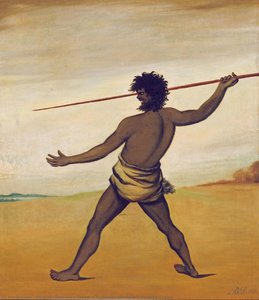
Timmy, a Tasmanian Aboriginal, throwing a spear (1838) av Benjamin Duterrau

Timmy, a Tasmanian Aboriginal, throwing a spear

1838 · Oil On Canvas · Art Gallery of South Australia, Adelaide

In this 1838 oil painting, titled Timmy, a Tasmanian Aboriginal, throwing a spear, we encounter a singular moment of focused intensity. The artist, Benjamin Duterrau, captures a solitary Tasmanian Aboriginal man at the precise instant of action. There is a palpable sense of muscular tension in the figure, frozen in the middle of a throw. It is a quiet, heavy moment that speaks to the skill and survival required by…

Motivene som fanget Benjamin Duterraus blikk

De fire motivene som går igjen hyppigst i disse originalverkene, hver med sitt fremste eksempel.

Museene som har Benjamin Duterraus originalverk

De 3 museene som innehar flest av maleriene på denne siden.

Museum By Verker av Benjamin Duterrau Malerier fra denne listen
National Portrait Gallery, CanberraNational Portrait Gallery Canberra 2 Woureddy, a wild native of Brune Island, Truggernana, a native of southern part of V.D. Land
Art Gallery of South Australia, AdelaideArt Gallery of South Australia Adelaide 2 Jack, a Tasmanian Aboriginal, holding a club, Timmy, a Tasmanian Aboriginal, throwing a spear
National Gallery of Australia, CanberraNational Gallery of Australia Canberra 1 Mr Robinson's first interview with Timmy

Benjamin Duterrau, årets signaturmalerier

7 år, fra 1835 til 1841, finner du hele Benjamin Duterrau sin tidslinje på denne siden: en kort oversikt, presentert år for år gjennom de mest kjente originalverkene.

Verk per år

Velg et år for å se originalverkene.

Benjamin Duterraus malerier: galleriets svar

Hvilket maleri av Benjamin Duterrau er det mest kjente av alle?Avslør svaret

Woureddy, a wild native of Brune Island (1835), National Portrait Gallery, Canberra. Deretter følger Truggernana, a native of southern part of V.D. Land (1835) og Mr Robinson's first interview with Timmy (1840).

Hvor gammel var Benjamin Duterrau da Woureddy, a wild native of Brune Island ble ferdigstilt?Avslør svaret

67 år gammel: Woureddy, a wild native of Brune Island er fra 1835, og Benjamin Duterrau ble født i 1768.

Hvor mange verk skapte Benjamin Duterrau?Avslør svaret

Vår katalog inneholder 6 verk av Benjamin Duterrau, datert fra 1835 til 1841.

Hvor henger de mest kjente originalverkene til Benjamin Duterrau?Avslør svaret

Hovedsakelig i National Portrait Gallery (Canberra), Art Gallery of South Australia (Adelaide) og National Gallery of Australia (Canberra). Museumslisten ovenfor viser alle.

Når malte Benjamin Duterrau sine mest kjente malerier?Avslør svaret

I 1835: 2 av de 5 verkene på denne siden ble laget da, Woureddy, a wild native of Brune Island av dem.

Hvilke er Benjamin Duterraus tidligste og nyeste berømte verk?Avslør svaret

På denne siden er det eldste Woureddy, a wild native of Brune Island (1835) og det nyeste Jack, a Tasmanian Aboriginal, holding a club (1841).

Hvilke motiver vendte Benjamin Duterrau oftest tilbake til?Avslør svaret

Man (3), Indigenous australia (2) og Cloudy sky (2), fordelt på 5 verk på denne siden.

Hvilket medium arbeidet Benjamin Duterrau mest med?Avslør svaret

Oil On Canvas, for 3 av de 5 verkene på denne siden.

Hvilke originalverk av Benjamin Duterrau har National Portrait Gallery i sin samling?Avslør svaret

Woureddy, a wild native of Brune Island og Truggernana, a native of southern part of V.D. Land: National Portrait Gallery, Canberra har 2 av verkene på denne siden.

Benjamin Duterrau: kunstneren

A Life Between Two Hemispheres

Benjamin Duterrau arrived in Van Diemen's Land in August 1832, a man of sixty-five years who had already seen the bustling streets of London and the rigorous training of an English apprenticeship. Born in Soho to Anglo-French parents, his early life was shaped by the precision of an engraver’s craft and the artistic shadows of masters like Thomas Gainsborough and William Hogarth. He did not seek a quiet retirement in the colonies; instead, he brought with him a drive to lecture on the civilizing influence of art at the Hobart Mechanics' Hall only months after his arrival.

His transition from the established art circles of England to the rugged landscape of Tasmania was marked by a singular purpose. While many migrants sought fortune through trade, Duterrau sought to document a world in flux. He settled in Hobart, establishing a studio where he could apply the meticulous observation learned in London to the faces and environments of a new territory. His work as a painter, etcher, and sculptor allowed him to capture the nuances of a society undergoing profound colonial shifts.

The Documentation of a Vanishing People

Duterrau’s most significant contribution lies in his sensitive treatment of the Indigenous Tasmanian population. Working alongside figures such as George Augustus Robinson, he found himself positioned at the intersection of colonial expansion and the survival of Aboriginal culture. He did not merely paint subjects; he recorded individuals with a level of dignity that was rare for the 1830s. His etchings and portraits of Aboriginal men and women provided a visual record of people whose lives were being irrevocably altered by settlement.

His technical approach often relied on a realistic style, prioritizing ethnographic accuracy. In works such as his depiction of "Timmy, a Tasmanian Aboriginal, throwing a spear," he utilized layered brushstrokes to build physical presence and texture. He possessed a particular skill for capturing the tension of a moment, such as the muscular focus of a hunter or the quiet strength in a sitter's expression. These portraits remain vital historical documents for those studying the Nuennone and other tribes of the region.

Historical Weight and Artistic Legacy

The scale of Duterrau’s ambition is perhaps best seen in his larger-scale historical compositions. His painting "The Conciliation" (1840) depicts a formal meeting between European colonists and Aboriginal chiefs, utilizing light and color to convey the gravity of the encounter. This work was intended as a study for an even more expansive project titled "A National Picture," an epic canvas that remains lost to history. Despite the disappearance of his largest intended works, his presence in the Tasmanian colonial narrative is firmly established through his surviving sketches and etchings.

Duterrau’s life ended in Hobart in 1851, leaving behind a body of work that functions as both art and archive. His legacy is found in the collections of the Tasmanian Museum and Art Gallery, where his depictions of the landscape and its original inhabitants continue to provide insight into the nineteenth century. He remains a figure who used the tools of an engraver and painter to illuminate the human dimension of Australian colonization.