Portrett av Alice Havers

De 13 mest kjente Alice Havers-maleriene, hvert og ett unikt

Oppdatert November 2026 · rangert etter vår popularitetsscore (søk, besøk og bestillinger for hvert verk) · 14 verk av Alice Havers i vår katalog

Kort fortalt

Men Maria bevarte alle disse tingene og grublet over dem i sitt hjerte - Alice Havers (2026) er maleriet av Alice Havers som vekker mest oppmerksomhet. Deretter går blikket til Belle of the Village (1883) og Blanchisseuses 'What, no soap ' (1880). Blant de 14 verkene til Alice Havers i vår katalog, er disse 13 de mest kjente – hver og en et unikt originalverk presentert med sitt årstall, sitt museum og årsaken til at det består.

1850 – 1890 Flest verk: Walker Art Gallery

Topp 10 malerier av Alice Havers, sett gjennom galleriets øyne

1
Men Maria bevarte alle disse tingene og grublet over dem i sitt hjerte - Alice Havers (2026) av Alice Havers

Men Maria bevarte alle disse tingene og grublet over dem i sitt hjerte - Alice Havers

2026 · Akryl

“Men Maria bevarte alle disse tingene og grublet over dem i sitt hjerte” – Alice Havers’ stemningsfulle akvarell fanger selve essensen av romantikken, og transporterer betrakteren til de fredfulle Falklandsøyene, hvor Havers tilbrakte formative år fordypet i kunstnerisk utforskning. Dette er ikke bare en avbildning; det er en invitasjon inn i et rike av dype følelser og idealisert skjønnhet—et vitnesbyrd om romantikkens urokkelige tro på fantasien kraft.

2
Belle of the Village (1883) av Alice Havers

Belle of the Village

1883 · Oil On Canvas

Alice Havers captures a specific moment of rural life in Belle of the Village. Painted about 1883, this work emerges from the artist's deep connection to the landscapes of the United Kingdom. Born in 1850, Havers brought a keen eye for the quiet rhythms of the countryside to her canvas. The scene settles into the viewer's gaze through a series of layered brushstrokes and a focus on the textures of…

4
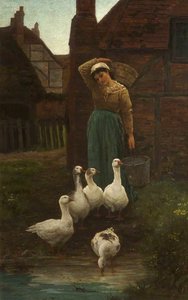
The Goose Girl av Alice Havers

The Goose Girl

Watercolor

In The Goose Girl by Alice Havers, a woman moves through a quiet landscape. She walks across a field where grass meets patches of bare dirt. In her hands, she holds two birds. These geese are part of a larger gathering, as several other birds are scattered throughout the scene. The woman’s presence is central to this rural setting, her movement steady against the natural terrain.

5
Sheep in an Orchard av Alice Havers

Sheep in an Orchard

Sheep in an Orchard by Alice Havers presents a pastoral scene centered on a herd of sheep. These animals graze upon a field of grass situated within an orchard. At least nine sheep are visible throughout the composition, positioned at varying distances from the viewer to establish a sense of depth. Some sheep occupy the foreground, while others are located further back among the vegetation.

6
They Homeward Wend Their Weary Way (1875) av Alice Havers

They Homeward Wend Their Weary Way

1875 · Oil

In this 1875 composition, a woman and a young boy move through a natural setting near a body of water. The woman carries a large straw basket on her back, her posture suggesting the weight of the object. Beside her, a young boy walks, holding a smaller basket in his hands. They are positioned within a landscape of trees and bushes that line the edge of a stream or river.…

7
Trouble (The Sick Child) (1882) av Alice Havers

Trouble (The Sick Child)

1882 · Oil On Canvas · Southwark Art Collection, London

The air in the room feels heavy, thick with the scent of medicinal herbs and the stillness of a house in mourning. A woman sits by the bedside, her posture a study in weary devotion. She leans toward a small, pale figure—a child whose breath is a shallow, rhythmic struggle. The light does not dance here; it settles. It clings to the folds of fabric and the rim of a…

8
Roses in a Vase (1887) av Alice Havers

Roses in a Vase

1887 · Oil On Canvas

We are looking at Roses in a Vase, a work by the British artist Alice Havers. Created in 1887, this piece emerged during a period when Havers was establishing her presence within the English art scene. The painting reflects the steady, observant hand of an artist who understood the quiet nuances of her surroundings.

9
'But Mary kept all these things and pondered them in her heart' (1888) av Alice Havers

'But Mary kept all these things and pondered them in her heart'

1888 · Watercolor

The painting titled 'But Mary kept all these things and pondered them in her heart' is a work by the English artist Alice Havers. It emerged from a period of significant recognition for the painter, finding its way into the public eye through prestigious exhibitions. In 1888, the piece was presented at the Royal Academy. A year later, in 1889, it traveled to the Paris Salon.

10
Rush Cutters av Alice Havers

Rush Cutters

Oil On Canvas

In Rush Cutters, Alice Havers captures a quiet moment of rural labor unfolding near the edge of a body of water. The scene centers on the rhythmic, heavy work of harvesting from the marshy ground. Two men bend low over the damp earth, their bodies focused on the task of collecting whatever the marsh yields. Beside them, a woman kneels in the mud, her presence a steady part of the…

Alice Haverss berømte malerier, nummer 11 til 13

Motivene som fanget Alice Haverss blikk

De fire motivene som går igjen hyppigst i disse originalverkene, hver med sitt fremste eksempel.

Museene som har Alice Haverss originalverk

De 3 museene som innehar flest av maleriene på denne siden.

Museum By Verker av Alice Havers Malerier fra denne listen
Walker Art Gallery, LiverpoolWalker Art Gallery Liverpool 1 Blanchisseuses 'What, no soap '
Southwark Art Collection, LondonSouthwark Art Collection London 1 Trouble (The Sick Child)
Touchstones Rochdale, RochdaleTouchstones Rochdale Rochdale 1 End of Her Journey

Alice Havers gjennom årene: de unike originalene fra hvert verk

14 år skiller Alice Haverss første og siste daterte originaler vist her, 1875 og 1888: hvert år har sin plass nedenfor.

Verk etter år

Velg et år for å se originalverkene.

Alice Haverss malerier: spørsmål til galleriet

Hva er det mest kjente verket til Alice Havers?Avslør svaret

Men Maria bevarte alle disse tingene og grublet over dem i sitt hjerte - Alice Havers (2026). Deretter følger Belle of the Village (1883) og Blanchisseuses 'What, no soap ' (1880).

Hvilke ti malerier av Alice Havers er de mest kjente?Avslør svaret

Men Maria bevarte alle disse tingene og grublet over dem i sitt hjerte - Alice Havers, Belle of the Village, Blanchisseuses 'What, no soap ', The Goose Girl, Sheep in an Orchard, They Homeward Wend Their Weary Way, Trouble (The Sick Child), Roses in a Vase, 'But Mary kept all these things and pondered them in her heart' og Rush Cutters. Rangeringen ovenfor viser årstall og museum for hvert verk.

Hvor mange verk av Alice Havers er kjent?Avslør svaret

Vår katalog inneholder 14 verk av Alice Havers, datert fra 1875 til 1888.

Hvor kan de mest kjente originalverkene til Alice Havers ses?Avslør svaret

Hovedsakelig i Walker Art Gallery (Liverpool), Southwark Art Collection (London) og Touchstones Rochdale (Rochdale). Museumslisten ovenfor viser alle.

I hvilken periode malte Alice Havers sine mest kjente malerier?Avslør svaret

I 1875: 2 av de 13 verkene på denne siden ble laget da, They Homeward Wend Their Weary Way av dem.

Hvilket kjent maleri av Alice Havers er det eldste, og hvilket er det nyeste?Avslør svaret

På denne siden er det eldste They Homeward Wend Their Weary Way (1875) og det nyeste 'But Mary kept all these things and pondered them in her heart' (1888).

Hvilke motiver foretrakk Alice Havers?Avslør svaret

Woman (6), Child (5) og Grass (3), fordelt på 13 verk på denne siden.

Hvilke materialer brukte Alice Havers mest av?Avslør svaret

Oil On Canvas, for 6 av de 13 verkene på denne siden.

Alice Havers: et portrett av kunstneren

A Life Amongst Landscapes: The Evocative World of Alice Mary Havers

Alice Mary Havers, a name perhaps less celebrated than some of her Victorian contemporaries, nonetheless carved a significant niche for herself as an English painter specializing in evocative watercolors and poignant illustrations. Born on May 19th, 1850, at Thelton Hall in Norfolk, she was steeped in a world of rural beauty and familial stability—a foundation that would profoundly shape her artistic vision. Her father, Thomas Havers, a man of commerce and administration, instilled within his children an appreciation for observation, while the family’s ancestral home provided a constant source of inspiration. However, this idyllic existence was soon disrupted by a journey to the remote Falkland Islands in 1854, when her father accepted a managerial position with the Falkland Islands Company. This relocation, though challenging, proved formative, exposing young Alice to a dramatically different landscape and culture—a world far removed from the gentle English countryside she had known. The family remained there until 1860, an experience that subtly infused her later work with a sense of melancholy and a keen awareness of social disparities.

From Falkland Islands to Parisian Studios: A Developing Artistic Voice

The Havers family’s subsequent move to Montevideo, Uruguay, further broadened Alice's horizons before their return to England in 1870 following the death of her father. It was upon this return that Alice truly began to pursue her artistic inclinations. She enrolled at the School of Art at South Kensington—now the Royal College of Art—where she quickly distinguished herself and earned a free studentship, demonstrating an innate talent and dedication to her craft. Her early works reflected a growing mastery of watercolor techniques, capturing scenes of domestic life and rural landscapes with remarkable sensitivity. In 1872, Alice married fellow artist Frederick Morgan, and for the next two decades, she exhibited regularly at prestigious venues such as the Society of British Artists and the Royal Academy. A pivotal moment in her artistic development came in 1888 when she moved to Paris with her three children, drawn by the allure of the French school of painting. This immersion in the Parisian art world exposed her to new influences—Impressionism and Realism—which subtly began to inform her style, adding a greater emphasis on light, color, and atmospheric effects.

Themes of Social Conscience and Domesticity

Havers’s oeuvre is characterized by a compelling blend of social commentary and intimate portrayals of domestic life. While she achieved recognition for paintings like *Ought and Carry One*, purchased by Queen Victoria, it was her works addressing the plight of the working class that truly revealed her artistic depth. Paintings such as *'Tis a Very Good World We Live In* and *The Rights of the Poor* offered poignant glimpses into the lives of those less fortunate, challenging Victorian societal norms and prompting viewers to confront uncomfortable truths. These were not merely depictions of poverty; they were empathetic studies of human resilience and dignity. Alongside these socially conscious pieces, Havers also excelled in capturing the quiet moments of everyday life—mothers with children, women engaged in domestic tasks—imbued with a sense of warmth, tenderness, and psychological insight. Her ability to convey emotion through subtle gestures and nuanced expressions established her as a leading figure in Victorian genre painting.

A Brief but Brilliant Career: Legacy and Historical Significance

Tragically, Alice Havers’s career was cut short by her untimely death on August 26th, 1890, at the age of forty. The circumstances surrounding her death—an accidental overdose of morphia—overshadowed much of the critical acclaim she had received during her lifetime. However, in recent years, there has been a renewed appreciation for her artistic achievements and her unique contribution to Victorian art. Her paintings offer valuable insights into the social and cultural landscape of 19th-century England, while her mastery of watercolor techniques continues to inspire artists today. Havers’s work also highlights the challenges faced by women artists during this period—the societal expectations that often limited their opportunities and the tendency to focus on personal tragedies rather than professional accomplishments. Her story serves as a reminder of the importance of recognizing and celebrating the contributions of all artists, regardless of gender or circumstance.

Illustrations and Final Recognition

Beyond her paintings, Havers also found success as an illustrator, collaborating with her sister Dorothy Henrietta Boulger—writing under the pseudonym “Theo Gift”—on several popular stories. This work allowed her to explore different narrative styles and reach a wider audience. Her commissions for special programs at Savoy Operas further demonstrate her versatility and artistic range. While she may not be a household name, Alice Mary Havers’s legacy endures through her evocative paintings, which continue to captivate viewers with their beauty, sensitivity, and social conscience. She stands as a testament to the power of art to illuminate the human condition and challenge conventional perspectives—a truly remarkable artist whose work deserves continued recognition and appreciation.