Portrett av Adolfo Hohenstein

De 24 mest kjente Adolfo Hohenstein-maleriene, hvert og ett unikt

Oppdatert November 2026 · rangert etter vår popularitetsscore (søk, besøk og bestillinger for hvert verk) · 25 verk av Adolfo Hohenstein i vår katalog

Kort fortalt

Gnà Lola (mezzo soprano) (1890) er maleriet av Adolfo Hohenstein som vekker mest oppmerksomhet. Deretter går blikket til Mimi's Costume For Act I Of La Boheme For The Premiere Performance og Set Design For Act 2 Of Puccini's Opera Tosca. Blant de 25 verkene til Adolfo Hohenstein i vår katalog, er disse 24 de mest kjente – hver og en et unikt originalverk presentert med sitt årstall, sitt museum og årsaken til at det består.

1854 – 1928, St. Petersburg Art nouveau Flest verk: Teatro dell'Opera di Roma

Topp 10 malerier av Adolfo Hohenstein, sett gjennom galleriets øyne

1
Gnà Lola (mezzo soprano) (1890) av Adolfo Hohenstein

Gnà Lola (mezzo soprano)

1890 · Watercolor

Gnà Lola (mezzo soprano) is a costume design sketch by Adolfo Hohenstein. Created about 1890, the work functions as a visual blueprint for the character of the same name, a mezzo soprano. The sketch provides a detailed study of the attire intended for the stage, specifically tailored to the requirements of theatrical performance.

2
Mimi's Costume For Act I Of La Boheme For The Premiere Performance av Adolfo Hohenstein

Mimi's Costume For Act I Of La Boheme For The Premiere Performance

Painting

The scene unfolds through Mimi's Costume For Act I Of La Boheme For The Premiere Performance, a work that captures a specific moment of theatrical history. This piece is the creation of Adolfo Hohenstein, an artist whose life began in Saint Petersburg, Russia, in 1854. His creative spirit traveled through the cultural landscapes of Vienna and Milan, eventually leading him to become a central figure in the visual language of…

3
Set Design For Act 2 Of Puccini's Opera Tosca av Adolfo Hohenstein

Set Design For Act 2 Of Puccini's Opera Tosca

Watercolor

Set Design For Act 2 Of Puccini's Opera Tosca is a watercolor illustration by Adolfo Hohenstein. The work functions as a visual blueprint for the theatrical environment, focusing on purely architectural and decorative elements. It establishes the physical parameters of the stage through a detailed rendering of an opulent interior space.

4
Tosca - Sketch of Act III (1899) av Adolfo Hohenstein

Tosca - Sketch of Act III

1899 · Drawing · Teatro dell'Opera di Roma, Roma

In the delicate, evocative strokes of Adolf Hohenstein’s 1899 sketch for Act III of Tosca, we are transported to a moment where theatrical drama meets the timeless majesty of the Eternal City. This piece is far more than a mere preparatory study; it is a window into the soul of Puccini’s operatic masterpiece. Hohenstein, a master of capturing the intersection between human emotion and architectural scale, presents a panoramic view…

Adolfo Hohensteins berømte malerier, nummer 11 til 24

Adolfo Hohensteins berømte malerier, periode for periode

Motivene som fanget Adolfo Hohensteins blikk

De fire motivene som går igjen hyppigst i disse originalverkene, hver med sitt fremste eksempel.

Museene som har Adolfo Hohensteins originalverk

Museet som innehar flest av maleriene på denne siden.

Museum By Verker av Adolfo Hohenstein Malerier fra denne listen
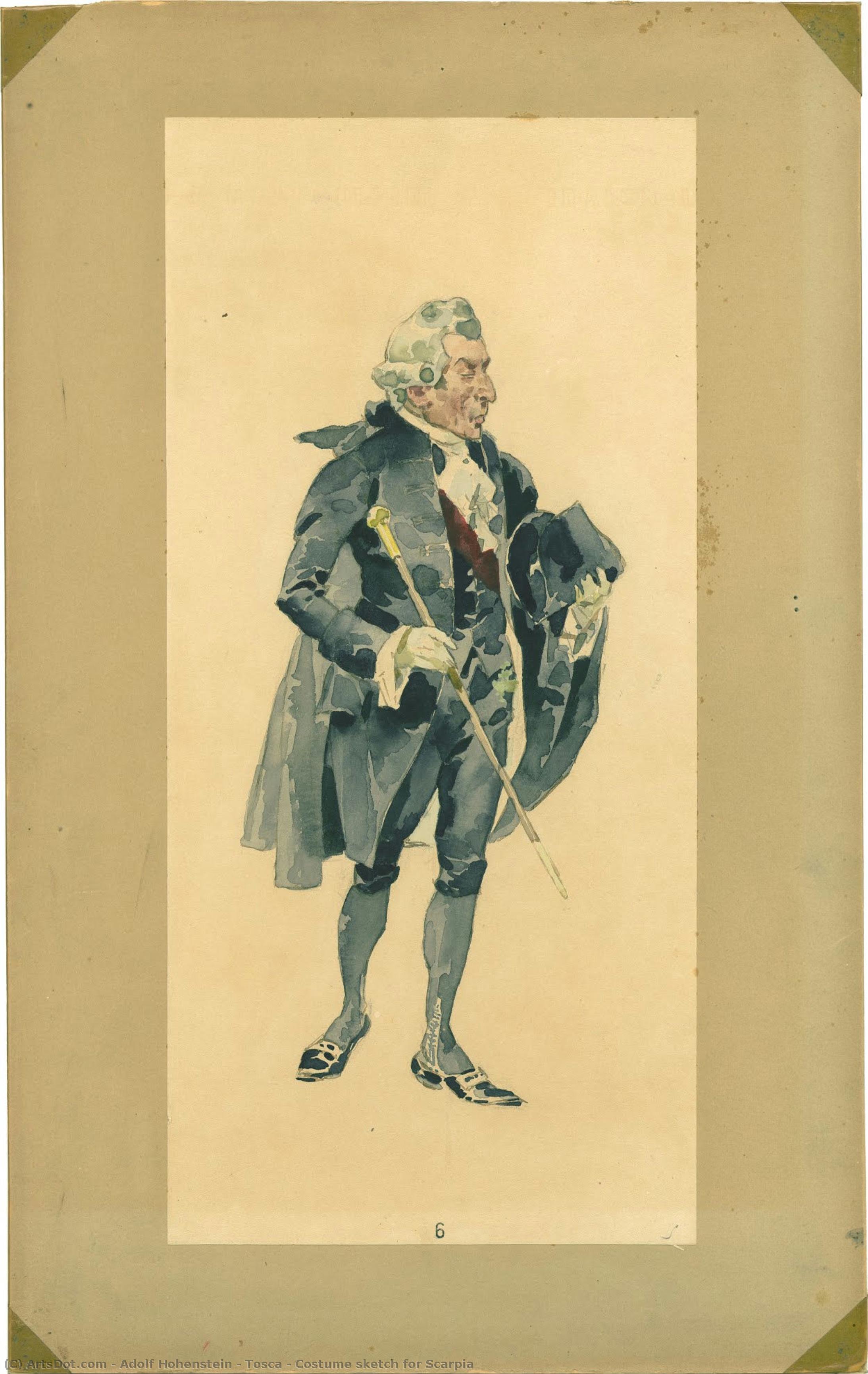
Teatro dell'Opera di Roma, RomaTeatro dell'Opera di Roma Roma 3 Tosca - Sketch of Act III, Tosca - Costume sketch for Scarpia, Tosca - Costume sketch for Floria Tosca

Adolfo Hohenstein gjennom årene: de unike originalene fra hvert verk

Adolfo Hohensteins daterte originaler som vises her, strekker seg over omtrent ti år, fra 1890 til 1899: øyet følger dem år for år.

Verk per år

Velg et år for å se originalverkene.

Adolfo Hohensteins malerier: spørsmål til galleriet

Hva er det mest kjente verket til Adolfo Hohenstein?Avslør svaret

Gnà Lola (mezzo soprano) (1890). Deretter følger Mimi's Costume For Act I Of La Boheme For The Premiere Performance og Set Design For Act 2 Of Puccini's Opera Tosca.

Hvor gammel var Adolfo Hohenstein da Gnà Lola (mezzo soprano) ble skapt?Avslør svaret

36 år gammel: Gnà Lola (mezzo soprano) er fra 1890, og Adolfo Hohenstein ble født i 1854.

Hvilke ti malerier av Adolfo Hohenstein er de mest kjente?Avslør svaret

Gnà Lola (mezzo soprano), Mimi's Costume For Act I Of La Boheme For The Premiere Performance, Set Design For Act 2 Of Puccini's Opera Tosca, Tosca - Sketch of Act III, A Square, on the right the exterior of Osteria della Giarrettiera, Tosca - Costume sketch for Scarpia, Tosca - Costume sketch for Floria Tosca, Costume design for a servant girl from the Opera, The Image Describe A Poster Drawn By Adolf Hohenstein og Le Villi Act Ii. Rangeringen ovenfor viser årstall og museum for hvert verk.

Hvor mange verk av Adolfo Hohenstein er kjent?Avslør svaret

Vår katalog inneholder 25 verk av Adolfo Hohenstein, datert fra 1890 til 1899.

Hvor kan de mest kjente originalverkene til Adolfo Hohenstein ses?Avslør svaret

Hovedsakelig i Teatro dell'Opera di Roma (Roma). Museumslisten ovenfor viser alle.

I hvilken periode malte Adolfo Hohenstein sine mest kjente malerier?Avslør svaret

I 1899: 3 av de 24 verkene på denne siden ble laget da, Tosca - Sketch of Act III av dem.

Hvilket kjent maleri av Adolfo Hohenstein er det eldste, og hvilket er det nyeste?Avslør svaret

På denne siden er det eldste Gnà Lola (mezzo soprano) (1890) og det nyeste Tosca - Sketch of Act III (1899).

Hvilke motiver foretrakk Adolfo Hohenstein?Avslør svaret

Poster (4), Urban landscape (2) og Clothing (2), fordelt på 24 verk på denne siden.

Hvilke materialer brukte Adolfo Hohenstein mest av?Avslør svaret

Watercolor, for 2 av de 24 verkene på denne siden.

Hvilken kunstretning tilhører verkene til Adolfo Hohenstein?Avslør svaret

Art nouveau, basert på originalene på denne siden.

Hvilke originalverk av Adolfo Hohenstein kan jeg se på Teatro dell'Opera di Roma?Avslør svaret

Tosca - Sketch of Act III, Tosca - Costume sketch for Scarpia og Tosca - Costume sketch for Floria Tosca: Teatro dell'Opera di Roma, Roma har 3 av verkene på denne siden.

Adolfo Hohenstein: et portrett av kunstneren

The Architect of Italian Elegance

Born in Saint Petersburg, Russia, to German parents, Adolf Hohenstein emerged as a transformative figure whose creative reach extended far beyond the boundaries of a single medium. Though his roots were in the Russian Empire, his artistic soul was forged in the vibrant cultural landscapes of Vienna and Milan. As a painter, illustrator, advertiser, and set designer, he possessed a rare ability to weave together the theatrical and the graphic, ultimately earning him the prestigious title of the father of Italian poster art. His journey from the imperial atmosphere of his birthplace to the heart of the Italian Stile Liberty—the local expression of Art Nouveau—is a testament to a life lived at the intersection of diverse European traditions.

Hohenstein’s career was defined by an extraordinary versatility that allowed him to command both the grand stage and the intimate printed page. His early years in Vienna provided a foundation of classical training, while his travels through India offered him unique perspectives on decoration and ornamentation. However, it was his move to Milan in 1879 that would forever alter the course of graphic design history. Settling in this burgeoning metropolis, he became an essential collaborator for the legendary musical publisher Giulio Ricordi. Within the Ricordi Graphical Workshops, Hohenstein acted as a visionary, translating the soaring emotions of opera into striking visual narratives. His hand was instrumental in creating the iconic posters for masterpieces such as Puccini’s Tosca and Madama Butterfly, works that required a delicate balance of dramatic tension and aesthetic grace.

A Legacy of Line and Light

The artistry of Hohenstein is characterized by a profound command over atmosphere and the evocative power of the line. Whether he was designing elaborate costumes and sets for La Scala or crafting advertisements for brands like Campari, his work breathed with a rhythmic vitality. In his poster designs, one finds a masterful use of flowing, organic shapes and a vibrant color palette that could capture the public's imagination instantly. He had a singular talent for world-building; even in a single sketch or a promotional print, he could evoke the heavy, cloud-swept skies of Rome or the glamorous allure of a modern cityscape.

His contributions to the visual language of his era cannot be overstated. Beyond the realm of fine art, his work as an advertiser and illustrator helped define the commercial aesthetic of the early 20th century. His achievements include:

  • Pioneering Graphic Design: Establishing the foundations of the Italian poster movement through highly decorative and emotionally resonant illustrations.
  • Theatrical Mastery: Creating immersive environments for opera through meticulous set and costume designs that complemented the musical drama of composers like Verdi and Puccini.
  • Art Nouveau Exponent: Serving as a leading figure of the Stile Liberty, integrating classical revivalism with the modern, flowing aesthetics of the period.

Ultimately, Adolf Hohenstein remains a seminal figure whose influence resonated through the evolution of graphic design in Italy and beyond. His ability to bridge the gap between high culture—the opera house and the theater—and the everyday experience of the public through posters and postcards ensures his place in the pantheon of great illustrators. He did not merely decorate the world; he redesigned how it was seen, leaving behind a legacy of elegance, drama, and enduring beauty.