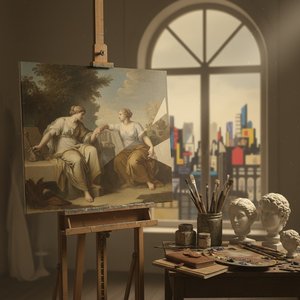
Mastering the Classics: A Definitive Guide to the Principles and Legacy of Academic Painting
Explore the profound world of Academic Painting. From Poussin's intellectual clarity to Neoclassical realism, discover the techniques, history, and enduring legacy of the masters through our expert-led guide to classical art excellence.
The Intellectual Framework: Defining Academic Realism and its Pursuit of Order Mastering Perfection: A Definitive Guide to the Elegance and Precision of Academic Classicism The Foundations of Order: Defining the Principles of Academic Classicism Mast...
To step into the world of Academic Realism is to leave behind the frantic, unscripted energy of the modern age and enter a sanctuary of profound logic and historical reverence. At its very core, this movement was never merely about the imitation of life; it was an intellectual pursuit of absolute truth through the disciplined application of form, light, and anatomy. Unlike the spontaneous bursts of emotion found in later avant-garde movements, Academic Realism sought to establish a rigorous framework where technical perfection met profound narrative depth. It is a realm where every brushstroke serves a higher purpose, acting as a deliberate step toward capturing the immutable laws of nature.
The essence of this discipline lies in its commitment to disegno—the primacy of line and structure. This focus on clear, decisive contours allows the artist to create a sense of permanence, as if the subjects were carved from marble rather than rendered in oil. By mastering the subtle interplay of light and shadow, or chiarosc/scuro, the academic painter provides a weight and volume to figures that feels both monumental and spiritually significant. This pursuit of order is not a limitation of creativity but rather its highest expression, providing a stage where the drama of human existence can be observed with clarity and grace.
The Pillars of Tradition: The Influence of European Art Academies
Academic art, academicism, or academism, is a style of painting and sculpture produced under the influence of European academies of art. This method extended its influence throughout the Western world over several centuries, from its origins in Italy...
The history of Western art was profoundly shaped by the rise of the great European academies, institutions designed to replace the medieval guilds and systematize the teaching of fine art. From its origins in mid-16th century Italy to its zenith in the 19th century, the influence of these academies extended across the globe, establishing a standardized language of excellence. The prestigious French Académie des Beaux-Arts, for instance, became the ultimate arbiter of taste, blending elements of Neoclassicism and Romanticism into a cohesive aesthetic that defined "official art." These institutions were more than mere schools; they were gatekeepers of cultural ideology, controlling everything from the art market to the very definition of beauty.
The legacy of these academies is visible in the architectural and curatorial blueprints of history’s most renowned institutions. Consider the Pennsylvania Academy of the Fine Arts (PAFA), founded in 1805, which stands as a living testament to this tradition in America. Similarly, the Accademia di Belle Arti di Brera in Milan serves as a sanctuary where the echoes of the Enlightenment still resonate through its halls. These academies emphasized the emulation of established masters, teaching students that true innovation is built upon a bedrock of classical tradition. Through this rigorous training, artists were elevated from mere artisans to respected intellectuals, capable of communicating complex political and social ideals through the medium of canvas and stone.
Masters of the Canon: From Poussin’s Intellectual Clarity to Neoclassical Precision
Introduction To step into the world of Nicolas Poussin is to leave the chaotic whims of emotion behind and enter a realm of profound intellectual clarity. As you wander through this curated selection of his top twenty-five masterpieces, you are not m...
To wander through the works of the masters is to participate in a grand, silent dialogue with antiquity. No figure embodies this intellectual rigor more profoundly than Nicolas Poussin, the architect of French Classicism. To view a Poussin masterpiece is to leave the chaotic whims of emotion behind and enter a realm of profound clarity. He did not seek to dazzize the eye with fleeting light; instead, he sought to capture the eternal—the weight of moral virtue and the stoic dignity of the human spirit. His compositions are structured, almost sculptural arrangements where every gesture is deliberate, transforming mythological narratives into philosophical contemplations.
This lineage of precision extends into the 19th century through the rise of NeoclassicalRealism. Artists such as Jean-Auguste-Dominique Ingres and contemporary figures like Jin Shangyi demonstrate how the dedication to meticulous observation can serve as a powerful counterpoint to more experimental trends. In the works of Jin Shangyi, we see a profound engagement with traditional techniques that prioritize faithful representation and the subtle nuances of emotion. This commitment to the "true" form ensures that the subject remains anchored in reality, even when the themes are epic or historical. Whether it is the architectural precision found in 18th-century engravings or the psychological depth of a portrait, these masters remind us that beauty is most impactful when it is grounded in truth.
The Living Legacy: How Academic Techniques Endure in Contemporary Fine Art
Classical Realism is an artistic movement in the late-20th and early 21st century in which drawing and painting place as high value upon skills and beauty, combining elements of 19th-century neoclassicism and realism. == Origins == The term Classical...
While the era of the great academies may have dissipated in the early 20th century, the spirit of academic excellence has never truly vanished; it has merely evolved. Today, we see a vibrant resurgence in Classical Realism, a movement where contemporary artists continue to place high value upon skill, beauty, and the mastery of traditional media. Figures like John Nelson Shanks and Andrew Robertson stand as singular examples of this dedication, using their brushes to revive the traditions of meticulously rendered portraiture and historical reverence in an age often dominated by abstraction.
This endurance is also evident in the way we approach the "remixing" of art history. The techniques once reserved for the halls of the Louvre or the Royal Academy are now being applied to new, personal narratives. We see the influence of academic precision in modern works that celebrate the tactile beauty of nature—a symphony of light and texture that transcends time. This continuity proves that the fundamental principles of composition, anatomy, and color theory are universal. The academy provided a vocabulary that remains just as potent today, allowing contemporary creators to bridge the gap between the ancient past and the digital present.
Bringing the Academy Home: Preserving Masterpieces through Hand-Painted Reproductions
A Symphony of Light and Texture In this breathtaking display of Classical Realism , the canvas becomes a stage for a sensory feast that transcends time. This hand-painted acrylic masterpiece invites the viewer into an intimate world of abundance, whe...
For the true art enthusiast, the desire to surround oneself with the grandeur of the classics is a profound calling. However, owning an original Poussin or a 19th-century masterpiece is a feat reserved for museums. This is where the art of the hand-painted reproduction offers a bridge to the sublime. At OriginalUniqueArt.com, we believe that the soul of a painting lies in its physical presence—the visible brushstrokes, the depth of the tonal range, and the tactile texture of oil on canvas. Our reproductions are not mere prints; they are bespoke works of art, meticulously crafted by artists trained in the very academic traditions we celebrate.
Each piece is a labor of passion, painted by hand on 100% cotton canvas to ensure a match that approaches the original's majesty. We offer more than just replication; we offer the opportunity for personal expression through our Professional Digital Mockup Service and stylistic customizations. Imagine transforming a modern memory into a portrait rendered in the impasto style of Van Gogh, or bringing the architectural elegance of a classical landscape into your own study. By choosing a hand-painted reproduction, you are not simply decorating a wall; you are preserving a legacy and inviting the timeless dignity of the masters into your daily life.
Authentic Craftsmanship: 100% hand-painted on cotton canvas with no computer printing involved.
Bespoke Customization: The ability to "remix" history, from color matching to period shifts.
Museum-Grade Quality: Deep tonal ranges and textured brushwork that capture the essence of the original.
Global Preservation: Secure, worldwide shipping via DHL/FedEx to ensure your masterpiece arrives in pristine condition.
Explore the rigorous discipline of Academic Realism. Discover how masters achieved technical perfection through anatomy, light, and form, and learn how our hand-painted oil reproductions bring this timeless elegance to professional and private collections worldwide.
Journey through the grandeur of French Baroque with our curated list of the top 25 Nicolas Poussin masterpieces. Explore the stories behind these timeless classical paintings and find museum-quality art reproductions for your decor. Discover all masterpieces on OriginalUniqueArt.com.
Explore the rich history of Academic Art – its techniques, key masters like Bouguereau & Ingres, and influence on 19th-century painting. Discover this enduring tradition.
Explore 10 defining masterpieces of Romantic Realism! Discover Courbet, Millet & Daumier's powerful paintings—capturing emotion and social realities. Find museum-quality reproductions for your home at OriginalUniqueArt.com.
Explore the profound elegance of Academic Realism. Discover how meticulous observation, anatomical precision, and the pursuit of ideal beauty created a timeless legacy of technical mastery and emotional depth in the world's most revered art academies.

 Mastering Reality: A Definitive Guide to the Precision and Elegance of Academic Realism
 Academic art
 Mastering the Classics: The 25 Greatest Paintings by Nicolas Poussin
 untitled - unknown