The Dawn of Disruption: From Impressionism to Avant-Garde
 Wikipedia: Avant-garde
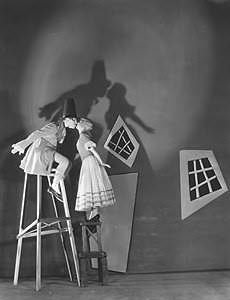
In the arts and literature, the term avant-garde (from French meaning 'advance guard' or 'vanguard') identifies an experimental genre or work of art, and the artist who created it, which usually is aesthetically innovative, whilst initially being ide...
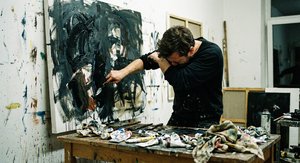
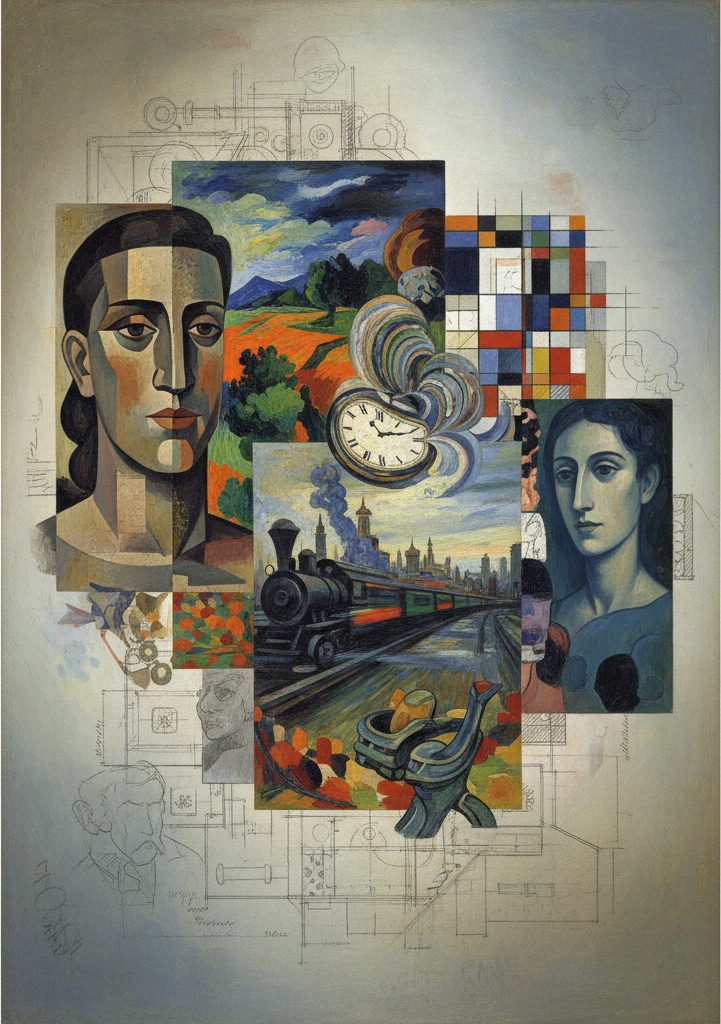
The early decades of the 20th century witnessed a seismic shift in the world of art, a dismantling of established conventions that reverberates even today. While the Impressionists had begun to challenge academic traditions by focusing on fleeting moments and the subjective experience of light, their innovations proved merely a prelude to the radical upheavals that followed. The pursuit of capturing *perception* gave way to an exploration of inner realities, emotional states, and the very essence of form itself. This period wasn’t simply about new ways of seeing; it was a fundamental questioning of what art *could be*. Artists began to reject the notion of representing the world as it appeared, instead seeking to express their individual responses to it – or even to create entirely new worlds divorced from external reality. The seeds of this disruption were sown in the late 19th century, with Symbolism and Post-Impressionism laying the groundwork for a more subjective and expressive approach, but it was the emergence of movements like Fauvism that truly shattered the mold.
Fauvism: A Wild Embrace of Color and Emotion
Fauvism ( FOH-viz-əm) is a style of painting and an art movement that emerged in France at the beginning of the 20th century. It was the style of les Fauves (French pronunciation: [le fov], the wild beasts), a group of modern artists whose works emph...
The name itself – “Fauves,” meaning “wild beasts” – hints at the untamed energy that characterized this brief but influential movement. Emerging around 1905, Fauvism was less a unified style than a shared sensibility among a group of artists including Henri Matisse, André Derain, and Maurice de Vlaminck. They rejected the subtle harmonies of Impressionism in favor of bold, non-naturalistic colors applied with unrestrained brushwork. Imagine canvases exploding with vibrant oranges, searing reds, and electric blues – hues chosen not to depict reality but to convey emotion and create a purely visual experience. Matisse’s “Woman with a Hat,” for example, scandalized audiences with its jarring color combinations and seemingly arbitrary application of paint. The Fauves weren't interested in meticulous representation; they sought to liberate color from its descriptive function, allowing it to become an independent force capable of evoking mood and structure. This emphasis on painterly qualities and subjective expression paved the way for further experimentation and abstraction.
Cubism's Fragmented Vision: Reconstructing Reality on Canvas
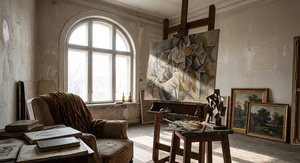
If Fauvism unleashed color, Cubism deconstructed form. Led by Pablo Picasso and Georges Braque, this movement challenged the traditional notion of perspective and representation by fracturing objects into geometric shapes and presenting multiple viewpoints simultaneously. Rather than depicting an object from a single fixed point, Cubist artists sought to capture its totality – its essence – by showing it from all angles at once. Early Cubism, often referred to as Analytical Cubism, employed a muted palette of browns, grays, and blacks, focusing on dissecting forms and reassembling them in abstract compositions. Braque’s “Bottle, Newspaper, Pipe, and Glass” exemplifies this approach, with its fragmented objects and overlapping planes creating a complex visual puzzle. Later, Synthetic Cubism introduced collage elements – fragments of real-world materials like newspaper clippings and wallpaper – further blurring the boundaries between art and reality.
Beyond Representation: The Rise of Abstract Art and Expressionism
Modernism was an early 20th-century movement in literature, visual arts, performing arts, and music that emphasized experimentation, abstraction, and subjective experience. Philosophy, politics, architecture, and social issues were all aspects of thi...
The fragmentation of Cubism ultimately led to a complete rejection of representational form in abstract art. Artists like Kazimir Malevich, with his Suprematist compositions featuring pure geometric shapes on stark backgrounds – as seen in “On the Boulevard” – sought to create a new visual language devoid of any reference to the external world. Simultaneously, Expressionism emerged as a powerful force, particularly in Germany. Unlike Cubism’s intellectual approach, Expressionism prioritized emotional intensity and subjective experience. Artists like Ernst Ludwig Kirchner used distorted forms, jarring colors, and agitated brushwork to convey feelings of alienation, anxiety, and social unrest. Kirchner’s “Street, Dresden” captures the dynamism and psychological tension of modern urban life with a raw, visceral energy. These movements weren't simply about aesthetics; they were reflections of a rapidly changing world grappling with industrialization, urbanization, and existential anxieties.
The Influence of Philosophy & Societal Shifts on Modernist Painting
The artistic upheavals of the early 20th century were deeply intertwined with broader philosophical and societal shifts. The writings of Friedrich Nietzsche, with his critique of traditional morality and emphasis on individual self-discovery, resonated strongly with many artists seeking to break free from established norms. The rise of psychoanalysis, pioneered by Sigmund Freud, also influenced artistic exploration of the subconscious mind and inner emotions. Furthermore, the rapid pace of technological innovation – including photography, which challenged painting’s role as a means of accurate representation – contributed to a sense of uncertainty and experimentation. The “high modernism” ethos, as described in academic discourse, placed man at the center of culture, celebrating innovation and seeking new ways of interacting with society. This period saw a rejection of rationalism and a growing interest in reflexivity about artistic convention.
Legacy and Evolution: How Early 20th-Century Movements Shaped the Future of Art
The impact of Fauvism, Cubism, and Expressionism on subsequent art movements is undeniable. These early experiments laid the foundation for Abstract Expressionism, Surrealism, and countless other styles that followed. They challenged fundamental assumptions about what art could be, paving the way for a more diverse and experimental artistic landscape. The emphasis on subjective experience, emotional intensity, and formal innovation continues to inspire artists today. The legacy of these movements extends beyond painting, influencing sculpture, architecture, literature, and music. At OriginalUniqueArt.com, we celebrate this rich heritage by offering high-quality reproductions of masterpieces from this transformative era, allowing you to bring the energy and vision of these groundbreaking artists into your own home. Explore our collection and discover the enduring power of early 20th-century painting – a testament to the human spirit’s capacity for innovation and self-expression.