Bold, Exotic, Iconic: Unveiling the Visual Power and Complex Legacy of Orientalist Art
Uncover the breathtaking allure of Orientalist art. Journey through 19th-century masterpieces shaped by Napoleon’s expeditions and Romanticism. Explore the vibrant colors, dramatic light, and complex historical narratives that define this iconic era of visual storytelling.
The Historical Context: Europe's Fascination with the 'Orient' For centuries, the lands beyond the Mediterranean – encompassing present-day Turkey, Greece, the Middle East, and North Africa – held a potent allure for the Western imagination. This fas...
For centuries, the lands stretching beyond the Mediterranean—encompassing the vibrant landscapes of present-day Turkey, Greece, North Africa, and the Middle East—exerted a potent, almost hypnotic allure on the Western imagination. Long before the nineteenth century reached its fever pitch, figures draped in exotic Eastern attire graced the canvases of Renaissance and Baroque masters like Bellini and Rembrandt, hinting at a fascination with the distant and the different. This was not merely an interest in geography, but a deep-seated longing for the mysterious and the unfamiliar. The Orientalist aesthetic emerged as a window into this perceived world, offering a visual language that blended the boundaries between documented reality and fevered fantasy. It was a style defined by its ability to transport the viewer to a realm where the familiar rules of the West seemed suspended, replaced by an atmosphere of opulence, intrigue, and ancient splendor.
The Spark of Discovery: Napoleon, Egyptology, and the Birth of a Movement
The Dawn of Discovery: Napoleon, Egyptology, and the Spark of Western Curiosity 19th-century French art 19th-century French art was made in France or by French citizens during the following political regimes: Napoleon's Consulate (1799–1804) and Empi...
While the fascination with the East predates the nineteenth century, the true seismic shift in European consciousness occurred in 1798. The dust and drama of military conquest provided the catalyst when Napoleon Bonaparte’s expedition to Egypt opened a gateway into a world previously shrouded in myth. This was far more than a campaign of war; it was an unprecedented scientific endeavor that brought scholars, illustrators, and artists into direct contact with the Nile's wonders. The subsequent publication of the monumental Description de l’Égypte acted as a visual manifesto, documenting the topography, architecture, and life of Egypt with meticulous detail. Suddenly, the ancient splendors of the Pharaohs were no longer distant legends but tangible, documented realities that fueled a wave of Western curiosity. This era of discovery transformed the "Orient" from a vague concept into a vivid destination, providing artists with a rich tapestry of motifs—from the imposing pylons of Luxor to the intricate textures of desert sands—that would define an entire movement.
Visual Powerhouse: Exploring Color, Texture, and Dramatic Light
A Life Immersed in North African Light: Eugène Alexis Girardet Eugène Alexis Girardet, born in Paris in 1853 and passing away there in 1907, was a pivotal figure in the world of 19th-century Orientalist painting. He wasn’t merely depicting scenes fro...
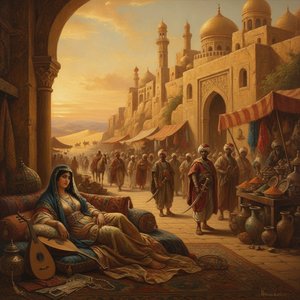
At its core, Orientalist art is a masterclass in visual impact. The movement reached its zenith through the technical brilliance of Academic artists who utilized light and color to create immersive, sensory experiences. To look upon an Orientalist masterpiece is to witness a profound command over texture and atmosphere. Artists like Jean-Léon Gérôme or Alexandre Gabriel Decamps mastered the ability to capture the way sunlight filters through a bazaar or reflects off the luminous white cloth of a seated figure. The movement thrived on:
Chromatic Intensity: The use of vibrant, saturated pigments to evoke the heat of the desert and the richness of Eastern textiles.
Tactile Realism: A meticulous attention to detail that allows the viewer to almost feel the grain of stone, the softness of silk, and the grit of sand.
Dramatic Chiaroscuro: The interplay of deep shadows and brilliant highlights that lends a sense of theatricality and depth to every scene.
This technical prowess allowed for the creation of works that were not merely decorative but emotionally resonant, utilizing the impasto technique and layered glazes to create a sense of physical presence that remains breathtaking even centuries later.
Beyond the Surface: Unpacking the Complex Legacy of the 'Orient'
The Rise of Orientalism: A 19th-Century Fascination Wikipedia: Orientalism In art history, literature, and cultural studies, Orientalism is the imitation or depiction of aspects of the Eastern world (or "Orient") by writers, designers, and artists fr...
To truly appreciate Orientalist art, one must look beyond the beautiful surfaces and engage with its complex, often problematic, historical legacy. As scholars like Edward Said have noted, Orientalism was not an innocent exploration; it was a system of representation deeply intertwined with the power dynamics of European colonialism. The "Orient" was often constructed through a Western lens—a mirror reflecting European anxieties, desires, and the need to define "the Other." By portraying Eastern societies as exotic, irrational, or stagnant, these paintings frequently served to justify colonial expansion and the perceived necessity of Western guidance. The imagery we associate with the genre—the idealized harem scenes or the romanticized desert wanderer—often obscured the complex political and social realities of the regions being depicted. Understanding this tension between aesthetic brilliance and colonial construction is essential for any modern viewer seeking to navigate the profound cultural impact of this era.
Modern Remix: Reimagining Orientalist Grandeur for Today’s Interiors
Despite its complicated history, the visual power of Orientalism remains undeniably iconic, offering a bold aesthetic that continues to inspire contemporary design. In an age of rapid change, there is a growing desire to bring the weight and drama of history into our modern living spaces. We see this in the way today's collectors "remix" the past—taking the grand, light-drenched motifs of the nineteenth century and integrating them into sleek, urban environments. Whether it is through high-impact reproductions that celebrate the movement's incredible textures or custom commissions that transform personal memories into historical masterpieces, the spirit of Orientalism lives on. By embracing the boldness and exoticism of these classical themes, we can create interiors that are not just decorated, but deeply storied, bridging the gap between the ancient splendors of the past and the vibrant energy of the present.
Oppdag kunsten bak oljemalerireproduksjon! Lær om prosessen fra skisse til ferdig kunstverk, håndmalt av profesjonelle artister. Museumskvalitet og personlig tilpasning – garantert.
Elevate your home with museum-quality, hand-painted oil portraits. OriginalUniqueArt specializes in bespoke commissions that transform personal memories into timeless legacies through academic artistry and unparalleled craftsmanship. Invest in a masterpiece designed to last generations.
Discover the unparalleled elegance of OriginalUniqueArt’s premium hand-painted oil reproductions. From bespoke portraits to museum-quality masterpieces, our expert artists transform visions into timeless legacies with 100% satisfaction guaranteed. Elevate your collection with true artistry.
Discover the enduring allure of hand-painted oil reproductions. OriginalUniqueArt offers museum-quality, archival masterpieces designed for discerning collectors seeking timeless beauty and a lasting legacy. Invest in fine art that transcends generations with our expert craftsmanship.
Utforsk kunnskapen bak kunstgjengivelse! Vår guide dekker medier, prissetting og bestillingsprosesser for elite-samlere. Sikre kvalitetskunst og langsiktig verdi – lær hvordan.


 The Alluring Gaze: Orientalism in 19th-Century Art – Representation, Reception & Construction of the 'Orient'
 Orientalism: Exploring the Exotic Allure and Complex Legacy of 19th-Century Masterpieces
 eugène alexis girardet
 Beyond Exoticism: Unveiling the Complex Legacy of Orientalist Painting